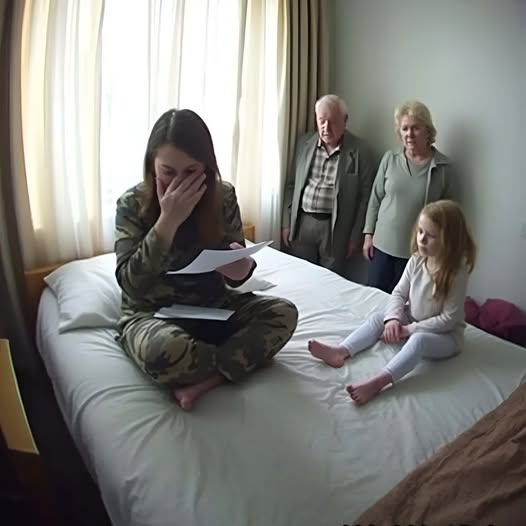
My name is Valerie, and I’m a 32-year-old combat medic in the U.S. Army. After nine grueling months deployed overseas, all I wanted, more than anything else in the world, was to hug my 14-year-old daughter, Lily, and tell her how much I had missed her every single day.
Before I left, I had made arrangements to ensure she was cared for while I served. I’d been sending $2,000 each month to my parents in Baton Rouge, trusting them completely to provide for her. I assumed that the money would cover her needs, her little comforts, and maybe even a few small extras to make life a little brighter in my absence.
When I finally returned, driving up the familiar streets, I couldn’t wait to see her face light up. I asked, softly, almost nervously, “Lily, did the money I sent you help?”
She blinked at me in confusion.
“What money?” she asked.
My parents froze in the background. Their faces went pale, and something in their body language made my stomach twist.
Five years earlier, my husband, Chris, had died in a car accident. I was only 27, suddenly a widow raising a little girl on my own. Joining the military became my lifeline, a way to rebuild our lives, to create some stability amid chaos. For a while, it worked. We found routines. We found laughter. But deployments are always disruptive.
When the orders came, my parents had volunteered to take Lily in. Their eagerness seemed sincere, so I didn’t think twice. I transferred $2,000 each month into their account — enough for her needs, her schooling, a little savings, and comfort. I even helped decorate her room, making sure her space felt like home before leaving. I promised to call whenever possible and tried to memorize every last detail of her face before boarding the plane. Watching her cry as I drove away was one of the most painful moments of my life.
When I returned, my sister Sarah met me at the airport. She was unusually quiet and a little stiff, saying only, “You’ll be surprised how much Lily has grown.” I thought nothing of it at first.
When I stepped into my parents’ house, Lily ran straight into my arms. Relief and joy flooded me. But as I looked around, things didn’t add up. Her clothes were small, worn, and mismatched. Her shoes had patches on the soles. Her phone was cracked, and yet, the house gleamed with new furniture, a remodeled kitchen, and a brand-new SUV sitting in the driveway.
At dinner, I asked Lily about school and soccer. She mentioned quitting the soccer team because she couldn’t afford the uniform. My fork froze mid-air. My mother quickly changed the subject, brushing over the comment. But I had already felt it — the gnawing, sinking suspicion that something was terribly wrong.
That night, I checked my bank account. Every transfer had gone through. $18,000 in total. Every cent I had sent for Lily’s care. None of it seemed to have reached her.
The next morning, Lily made breakfast — toast and fruit — quietly, almost as if trying not to be noticed.
“Grandma says we need groceries,” she said softly. “We don’t have much food.”
Her backpack was torn, her boots patched. She said she couldn’t buy school supplies. I felt a wave of nausea. This wasn’t right.
Later, I overheard whispers. My mother’s voice trembled: “She’s starting to suspect. Just stick with the story about Dad’s medical bills.”
Then Sarah’s voice: “Hide the cruise receipts.”
I followed the trail. In my father’s desk, I found receipts for a $5,000 Caribbean cruise, jewelry bills, and home renovations. The picture became horrifyingly clear.
When I confronted Sarah, she stammered: “Mom said you didn’t send much. Maybe they had to use their own money.”
I gathered proof. I talked to Lily’s school counselor, who told me Lily had been working part-time at a café, exhausted and falling asleep in class. A friend’s mother revealed that Lily had even sold her iPad and her late father’s locket to afford a school trip.
That night, I asked Lily again, “Was the money I sent enough?”
She frowned. “What money? Grandma said you couldn’t send anything.”
I froze. My mind raced. The betrayal ran deep, but I didn’t act in anger; I acted in protection. The next morning, I froze all transfers, opened a joint account in Lily’s name, and contacted my unit’s legal office. They confirmed what my parents had done could be considered financial exploitation.
On Christmas Eve, with the family gathered, I laid everything out.
“While I was deployed,” I said, my voice steady, “I sent $2,000 a month for Lily’s care. That’s $18,000. She never received a cent.”
The room went silent. My mother’s hand shook as she held her glass. My father looked away. Sarah tried to cover, but I set the folders of records, receipts, and Lily’s statements on the table.
“She sold her father’s locket while this house was remodeled,” I said quietly but firmly.
My father snapped, “Do you know how expensive it is to raise a child?”
“Yes,” I said, my throat tight. “I’ve been doing it alone for five years.”
My mother whispered, “We provided love. Love doesn’t have a price tag.”
“Love doesn’t lie,” I replied. “Love doesn’t steal from a child.”
Then Lily’s soft voice broke the tension: “They said you couldn’t send anything.” That shattered any remaining illusion.
Finally, my father admitted the truth. “We took the money. At first, just a little. Then more. We thought we’d pay it back.”
“You didn’t,” I said calmly. “You spent it all.”
I wasn’t seeking revenge. I wanted accountability, repayment, and a written apology. I warned, “If you refuse, I’ll press charges.”
Two days later, with a military attorney present, my parents confessed. They agreed to sell the car, cancel the cruise, and repay $1,000 per month until the debt was cleared. They also apologized to Lily — she came out of that discussion teary but composed.
“They said they’re sorry,” she whispered. “Now they need to prove it,” I told her.
Months passed. They kept up with the repayments. I moved to a new base, focusing on Lily and her healing. Therapy helped her regain confidence, and she gradually rejoined soccer, her smile returning piece by piece. By summer, $12,000 had been repaid.
When Lily suggested inviting her grandparents for Thanksgiving — “just dinner, not overnight” — I realized forgiveness had begun, at least in part.
This wasn’t about money alone. It was about trust, courage, and protecting what is right. Forgiveness doesn’t erase consequences — it allows you to move forward lighter.
And Lily? She’ll never again ask, “What money?” because now, every truth, every promise, and every dollar is finally where it belongs: in her hands.