That winter settled over the village like a curse. Snow piled so high it swallowed fences and blurred the edges of the road, turning familiar paths into endless white voids. At night, the cold crept through walls and bones alike, and the forest answered with long, hollow howls that made people pull blankets tighter and pray their doors would hold. No one dared enter the woods unless they had no choice—you could freeze, get lost, or stumble into something that wouldn’t hesitate to kill you.
But when the water stopped flowing, choice vanished.
The old underground pipeline supplying half the village had frozen again. It happened every few winters, and each time, someone had to go out and clear it. The job usually fell to Mikhail. He was used to harsh winters and harder labor—a man who read snow and silence like a map. He strapped a heavy pack of tools onto his back, wrapped his scarf higher over his face, and set out before dawn, leaving the village still half-asleep.
The forest greeted him with a biting wind and the crunch of snow beneath his boots. The sky hung low and gray, pressing everything into stillness. He moved steadily, following faint markers that led toward the buried pipeline.
Halfway across a wide clearing where the trees thinned, something dark broke the monotony of white.
At first, he thought it was debris—perhaps a fallen branch or a sack torn loose by the wind. He slowed, hand drifting toward the knife at his belt. As he drew closer, the shape shifted.
It was a wolf.
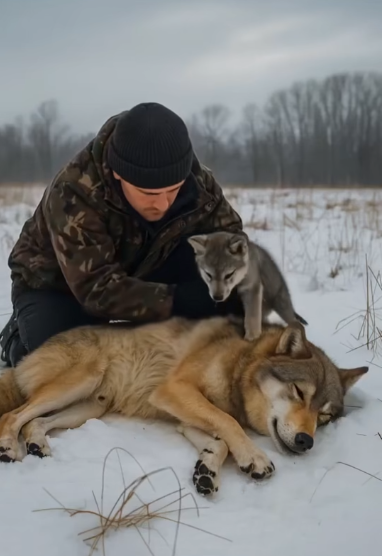
Mikhail froze. His breath fogged in front of him as instinct screamed to retreat. Then he saw the smaller figure darting around it, whining and pressing close. A pup. Thin. Terrified.
The she-wolf lay on her side, chest rising and falling in shallow, uneven breaths. One hind leg was twisted at an unnatural angle, caught in a rusted steel trap almost entirely buried under snow. Her eyes followed him, dull yet watchful, tracking every movement.
Everyone knew the rule: never approach a wounded predator. Pain made animals unpredictable, desperate, deadly.
Mikhail stood still, heart hammering, knowing exactly what he should do—and knowing he wouldn’t turn away.
He set his pack down carefully and raised his hands, moving with deliberate care. The pup growled weakly, trying to place itself between him and its mother, but its legs shook too much to be convincing. The she-wolf didn’t snarl or lunge. She only watched, eyes glassy with exhaustion.
Slowly, inch by inch, Mikhail knelt. He spoke softly, words meaningless but steady, as if sound alone could hold the moment together. His fingers trembled as he chipped away the ice and exposed the trap. The metal had bitten deep; the wound was swollen and raw.
He worked fast but gentle—cutting the wire, prying the jaws apart. When the trap finally released, the she-wolf let out a sound that was half growl, half breathless cry.
Mikhail wrapped the leg as best he could, poured disinfectant over the wound, and draped his jacket over her body. The cold would kill faster than infection if he didn’t. When she shifted weakly, he stepped back.
Their eyes met.
No gratitude. No understanding. Only survival.
That was enough.
Mikhail left without another glance, heart hammering all the way back to the village. By the time he reached the pipeline and finished the repair, his hands were numb, and his thoughts unsettled. He told no one. Some things are better left unspoken.
The next morning, the village woke to screams.
People poured outside to find chaos etched into the snow: chicken coops torn open, feathers scattered like confetti, blood streaking the white ground, deep paw prints circling homes, crisscrossing paths, looping back again and again.
It wasn’t one wolf.
It was a pack.
Panic spread faster than the cold. Someone shouted that wolves had been seen at the edge of the square. Another swore they’d heard scratching under their window all night. One man appeared with his sleeve torn and arm bleeding, pale and shaken, saying something had almost dragged him down while checking his dogs.
Mikhail stepped outside, stomach sinking. He recognized the tracks, the direction they’d come from—and worse—the pattern.
They weren’t wandering.
They were searching.
By nightfall, the howling returned, closer this time. Shadows moved at the edges of lantern light, eyes reflecting in the dark. The wolves tested doors and barns, driven not by hunger alone but by something sharper.
The scent.
His scent.
Fear twisted into anger. Men armed themselves with rifles and torches. No one slept. When the wolves surged closer, shots rang out, cracking the frozen air. Several fell; the rest scattered into the forest, howls fading among the trees.
By morning, the snow was stained and trampled, the village scarred but still standing.
Only then did Mikhail speak.
He told them everything.
Silence followed—thick, heavy. Some stared in disbelief. Others in fury. A few with something quieter—unease, maybe, or reluctant understanding.
“You brought them here,” someone said.
“I tried to save a life,” Mikhail replied, voice rough.
Both were true.
The village survived. Repairs were made, losses counted. The forest reclaimed its quiet. But something had shifted. People locked doors tighter. Listened harder at night.
Mikhail never entered the woods without remembering that choice. Kindness, he learned, carries no guarantees. Nature does not repay mercy with gentleness or gratitude. It answers in its own language, shaped by instinct and consequence.
Still, when he thought of the she-wolf and her pup, alive at least one more night, he knew he would do it again.
Some acts are done not for safety, praise, or certainty—but because leaving suffering behind feels like a worse danger.
And in the frozen silence of that winter, the village learned the same lesson: compassion can save a life, and it can also change everything that follows.