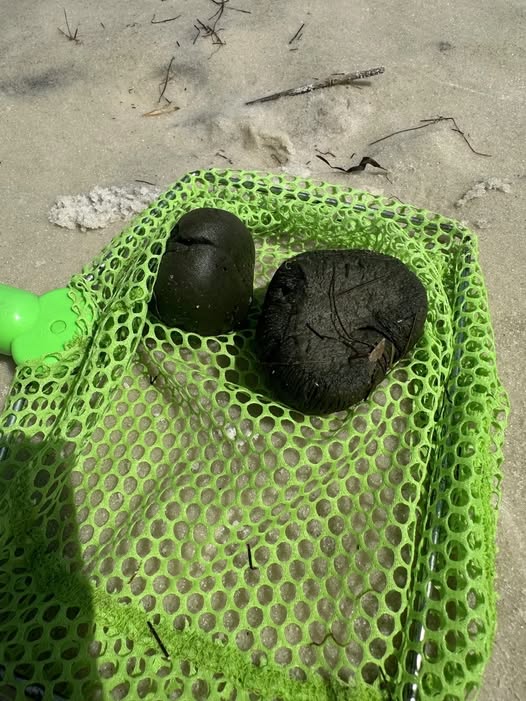
Anyone who has spent even a short amount of time along the shores of Pensacola Bay with children knows that what starts as a simple walk along the beach can quickly turn into a small adventure of exploration and discovery. Children are naturally curious, and their eyes are drawn to the tiniest details that adults might easily overlook. As they wander along the soft, sandy shoreline, they often spot small, round, squishy objects partially buried in the wet sand or scattered among the pebbles and shells. The instant they notice something unusual, their excitement bursts forth—they run over with laughter and wide-eyed anticipation, holding the object carefully in their tiny hands and proudly announcing their latest find to anyone nearby. The way they shout “look at this!” or “what is it?” makes even ordinary objects seem extraordinary, transforming a quiet beach walk into a moment of wonder and connection with the natural world.
Adults often chuckle at the playful nicknames children invent for these discoveries, delighting in the joy that emerges from such simple treasures. But behind the amusement lies a fascinating natural phenomenon, one that highlights the intricate processes shaping the coastal environment. What children are usually uncovering are mudballs—small, harmless formations that have existed along the bay for decades, if not centuries. Although they may appear strange or even a little gross at first glance, these rounded clumps are a natural product of Pensacola Bay’s unique ecological conditions. They are an everyday reminder of the hidden life and ongoing geological activity that quietly shape the shoreline, providing endless opportunities for learning and curiosity.
Mudballs are particularly common in the calmer, bayside areas where a combination of soft sediments, grassy marshes, and gentle tidal action creates the ideal conditions for their formation. Unlike the rougher, wave-battered ocean beaches where constant surf tends to scatter and reshape the sand and sediment rapidly, Pensacola Bay’s waters are relatively sheltered and tranquil. This allows fine particles of mud, clay, and organic material to settle to the bottom without being washed away. Over time, sections of these soft deposits become detached due to natural movements of water, subtle weather changes, or even the pressure of footsteps from people or wildlife along the shoreline. Once freed from the larger sediment mass, these fragments are at the mercy of the bay’s gentle motions. The ebb and flow of tides, along with occasional rolling caused by water currents or small waves, gradually shapes the fragments into smooth, rounded spheres, giving rise to the mudballs that so delight children.
The formation of these mudballs is a slow, patient process, almost imperceptible to anyone not paying close attention. Each ball tells a small story about the interactions between water, sediment, and the ecosystem of the bay. They often start as irregular clumps of mud, rich with organic matter and sometimes dotted with tiny shells or plant material, then slowly roll back and forth along the sand and shallow water until their edges become smooth and perfectly rounded. Once formed, they blend almost seamlessly with the surrounding sand and sediment, so much so that an unobservant adult might step right over them without a second thought. Yet for a curious child—or anyone willing to slow down and examine the small details of the shoreline—these mudballs offer a tangible, hands-on connection to the natural world, a momentary bridge between play and education, imagination and observation. In this way, a simple walk along Pensacola Bay becomes far more than a stroll; it becomes an opportunity to engage with centuries-old natural processes, to witness the quiet shaping of the coastal environment, and to marvel at the small wonders that persist, waiting to be discovered by those who care to look.