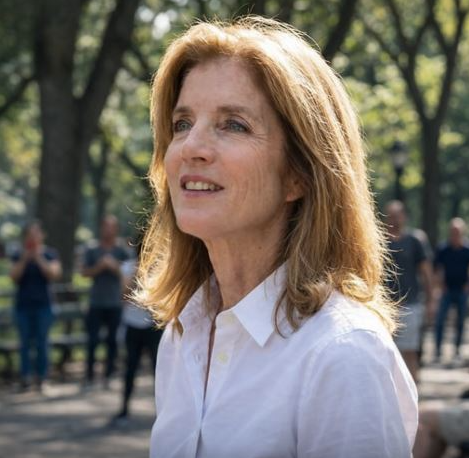
A rare and almost sacred hush fell over Manhattan’s Upper East Side as mourners began to gather for a deeply personal and intimate farewell. The streets, often bustling with the clamor of the city, seemed to pause, as if the city itself recognized the solemnity of the occasion. This was not a public spectacle, nor a carefully choreographed media event; it was a private moment reserved for family, close friends, and those who had shared in Tatiana Schlossberg’s life in meaningful ways. At the Church of St. Ignatius of Loyola, the historic stone walls and stained-glass windows offered a quiet sanctuary, a setting steeped in tradition that reflected the family’s enduring ties to faith, community, and each other. Guests arrived with measured footsteps, exchanging subdued greetings, soft smiles, and gentle embraces, all aware that this moment was intended for remembrance and reflection rather than public attention or scrutiny. The atmosphere carried a weight of reverence; there were no flashbulbs, no reporters, no announcements—just a shared understanding that grief, when intimate, deserves its own quiet space.
Inside the church, the focus remained resolutely on Tatiana’s life, her character, and the ways she had touched those around her, rather than on her family’s prominence or the renown attached to her surname. Tatiana was remembered as a devoted and loving wife to George Moran, whose partnership had been marked by tenderness and mutual support. She was also a dedicated mother to two young children, whose lives she had nurtured with patience, warmth, and unwavering attention, balancing the demands of parenthood with a professional life committed to environmental journalism and writing. Her work, deeply informed by a sense of responsibility to the planet, addressed climate awareness, sustainability, and ecological stewardship, reflecting a mind attuned to both ethics and action. Those gathered were reminded that her intellect and compassion extended far beyond her immediate family, touching communities and readers alike through her thoughtful writing.
Seated in close proximity, united by grief yet strengthened by presence, were the central figures in Tatiana’s life: her mother, Caroline Kennedy, whose grace and resilience have long been admired; her father, Edwin Schlossberg, whose thoughtful demeanor mirrored his daughter’s contemplative nature; and her siblings, Jack Schlossberg and Rose Schlossberg, whose own journeys had been shaped in part by shared family experiences. Their quiet solidarity was striking—a testament to a family bonded not only by blood but by mutual care, respect, and the collective weight of loss. Each gesture, each hand clasped across a pew, spoke volumes about the family’s deep connections and the support system they created for one another in the face of sorrow. The service’s private tone allowed them to grieve authentically, without the intrusion of cameras or commentary, preserving the sanctity of the moment and the intimacy of their shared memories.
Although the service remained understated, it also reflected the broader resonance of Tatiana’s life and work. Several attendees had journeyed from beyond her immediate circle, drawn not by obligation but by genuine admiration and respect. Among them were notable figures from politics, journalism, and the arts—President Joe Biden, Secretary John Kerry, and legendary television personality David Letterman, each present quietly, honoring Tatiana’s life in a way that acknowledged her influence and the meaningful relationships she had cultivated. Their presence underscored that her impact extended beyond her family and immediate community; her work and integrity had left a mark on those who had engaged with her ideas, her writing, and her dedication to causes greater than herself. Yet even amidst such distinguished attendance, the gathering remained measured and restrained, emphasizing the family’s intent to protect their private grief while acknowledging the public’s admiration and curiosity in a careful, deliberate way.
In the days following her passing, reflections on Tatiana’s life and character highlighted not just the accomplishments she achieved but the strength she exhibited in navigating a prolonged, private illness with dignity and courage. Friends and family alike spoke of her ability to face personal challenges while maintaining her focus on meaningful pursuits and her devotion to those she loved most. Her writings, at times candid and introspective, offered insight into a mind that balanced intellect with empathy, and determination with humility. Those closest to her emphasized that her deepest commitments were to her children and to work that mattered—both approached with intentionality, thoughtfulness, and grace. Tatiana’s brief life, though marked by loss, was also rich in purpose, compassion, and insight, leaving behind a legacy that extends beyond her name or lineage.
Ultimately, the family’s farewell was about more than saying goodbye—it was a profound reaffirmation of the values Tatiana embodied throughout her life: humanity, integrity, and love. As attendees left the church, carrying memories, stories, and quiet grief with them, it became evident that Tatiana Schlossberg’s life had woven connections between private devotion and public influence, demonstrating that even in the shadow of great historical legacy, the measure of a life can be found in thoughtfulness, commitment, and the depth of the relationships we nurture. In honoring her memory, her family and community celebrated not only a life lived with purpose but also the enduring impression she left on everyone fortunate enough to know her, reminding all present that legacy is defined not solely by renown, but by the compassion and love one imparts along the way.