Mr. Jonathan Lewis had led Willow Creek Elementary for more than twenty-five years, long enough to understand that real problems rarely made themselves known with raised hands or loud complaints. They emerged quietly—through repeated behaviors, subtle patterns, silences that carried weight. Children almost never asked for help outright; they showed it instead.
That understanding is what made the lunchroom that day stand out.
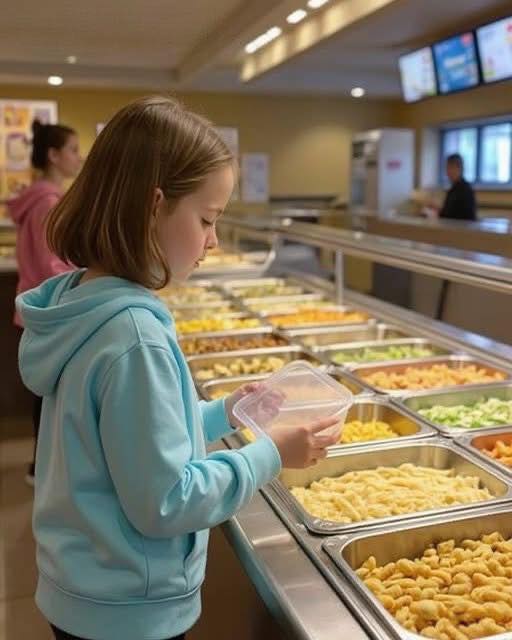
The cafeteria was its usual whirlwind: trays clattering, voices bouncing off the walls, the mingling aroma of pizza and applesauce. Teachers monitored lines, aides wiped down tables, kids laughed, traded snacks, and moved through the chaos. Among them, a small girl moved with unusual care.
Mia Turner was nine, small for her age, with chestnut hair that refused to stay tied. She wasn’t laughing or chatting. She was quietly slipping leftovers into her backpack: a wrapped sandwich, a sealed fruit cup, a slice of pizza folded neatly in a napkin. Every movement deliberate. Every glance measured. This was no impulse; it was habit.
Mr. Lewis knelt beside her table, lowering his voice so only she could hear.
“Mia,” he said gently, “can you tell me why you’re taking the food?”
Her hands froze. She clutched a half-eaten apple slice, eyes darting toward the exits. A whisper barely rose above the cafeteria din: “My mom works really hard… but sometimes we don’t have enough food.”
It was plausible. Reasonable. Yet something about it didn’t fully settle.
He nodded and let her go, offering no further questions. But the way she had looked toward the doors, instead of home, lingered in his mind.
That afternoon, after dismissal, Mr. Lewis made a decision he didn’t take lightly.
He followed her.
From a distance, he observed as Mia walked past familiar streets, past her mother’s duplex, without hesitation or pause, until she reached the edge of town. Behind overgrown hedges sat an abandoned house—peeling paint, cracked windows, and a yard thick with weeds.
Mia stopped. She set down her backpack, arranged the food neatly by the front door, then knocked twice. Immediately, she ducked behind a crumbling wall.
Mr. Lewis felt his chest tighten.
The door creaked open. An elderly woman emerged, thin, unsteady, gray hair pulled back loosely. Her trembling hands reached for the food, and her face softened with gratitude so raw it was almost painful to witness.
“Hi, Mrs. Callahan,” Mia said quietly.
The woman’s eyes glimmered. “You didn’t have to bring all this again, sweetheart.”
“I like helping,” Mia replied. “You need it more than I do sometimes.”
Recognition dawned. Mrs. Callahan—a widow whose struggles had quietly slipped past local aid. Support had been assumed, but it hadn’t arrived. A child had stepped in instead.
Over the following weeks, Mr. Lewis watched. Mia repeated the routine daily, sometimes including snacks for stray animals. Her mother provided food at home, so this was not about necessity—it was about compassion.
But it was compassion with risk.
Mia navigated empty streets and abandoned spaces alone, hiding her efforts, carrying responsibilities too heavy for a child. Mr. Lewis couldn’t simply stop her, yet allowing her to continue unsupervised wasn’t safe.
One afternoon, he met her at the school gate.
“I know what you’ve been doing,” he said softly. “And I know why.”
Her eyes widened. Fear flickered, then relief. “I just wanted to help,” she whispered.
“You are,” he replied. “But you don’t have to do it alone.”
“Am I in trouble?” she asked.
“No,” he said gently. “You showed kindness. My job is to make sure you’re safe while doing it.”
Within days, Mr. Lewis quietly coordinated support: local charities, organized food deliveries, proper aid for Mrs. Callahan. Nothing flashy, nothing public. He also established a small, voluntary outreach program at the school—students helping under supervision, low-key but consistent.
When he explained it to Mia, her face lit up—not with pride in herself, but in relief for Mrs. Callahan.
“She won’t be alone anymore?” she asked.
“No,” he said. “Thanks to you.”
Later, he handed her a notebook filled with ideas: food drives, letter-writing projects, neighborhood kindness initiatives.
“You’ve already shown leadership,” he told her. “Now we’ll do this the right way.”
Slowly, the effort spread. Classmates joined, families donated, teachers volunteered. Students visited Mrs. Callahan in small, supervised groups. The abandoned house remained physically the same, but its meaning had shifted—from neglect to care.
One sunny afternoon, Mr. Lewis watched Mia lead a small group of students, calmly organizing grocery bags with newfound confidence. She glanced back at him and smiled—not fear, not secrecy, but pride.
Kindness rarely announces itself. Sometimes it hides in backpacks. Sometimes it walks quietly past doors. Sometimes it belongs to children who act simply because they cannot stand by.
By the end of the school year, Willow Creek Elementary had a permanent community outreach program—not born of policy, meetings, or mandates, but from one child’s quiet compassion and one adult’s choice to notice.