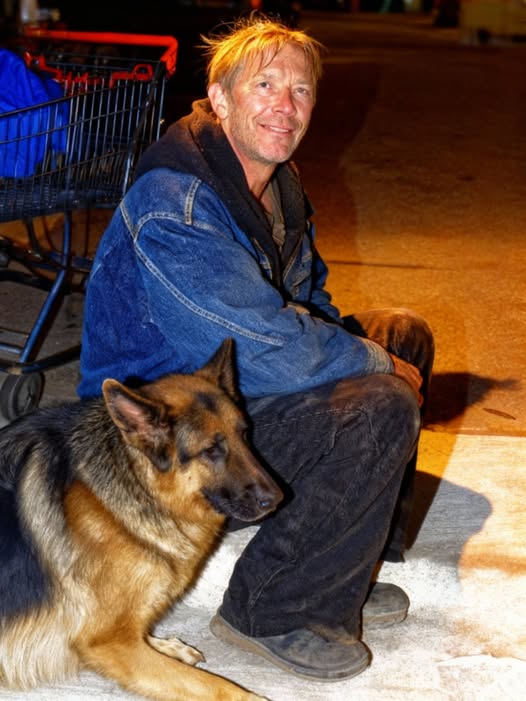
The night I lost everything began not with a grand, cinematic event, but with the most ordinary, human choice you can make: I decided to care. It was a quiet, unremarkable evening, the kind of night where the streetlights hum and the air feels heavy with the weight of unspoken stories. I was driving home, my mind drifting through the mundane worries of daily life—the grocery list I hadn’t finished, the stack of unpaid bills on my counter, the small but endless anxieties that seem to grow louder when the world goes dark. And then I saw him: a veteran, hunched against the cold, shoulders trembling not from age but from years of unseen battles, a dog pressed into his chest as if it were the only source of warmth left in the world.
Something inside me shifted in that instant. I didn’t calculate. I didn’t debate. I didn’t even consider the consequences. I stopped my car in the quiet of the street, rolled down the window, and dug into my wallet. I handed him an envelope. It wasn’t much—far less than I would have liked—but it was everything I could spare without completely unraveling my own fragile sense of security. The veteran’s hands, roughened and worn, closed over it. His dog pressed closer, eyes wide and grateful. I drove off immediately, heart hammering, convinced I’d done the right thing and that it would vanish into the night, unnoticed and unremarkable.
By morning, that quiet moment of human kindness had exploded into chaos. My phone vibrated incessantly, the first alert a prelude to the avalanche of messages, texts, and notifications I could barely keep up with. My name was trending on social media, splashed across feeds in ways I didn’t understand. What I thought was a private act of generosity had become a public spectacle, and the narrative spun faster than I could breathe. Somewhere along the line, a shaky, zoomed-in video of the handover had been recorded, weaponized, and circulated with malicious intent. Headlines accused me of theft, of misconduct, of irresponsibility. People I didn’t know were yelling at me online; friends and strangers alike weighed in, assuming they understood the motives behind a simple act they hadn’t witnessed firsthand.
Meanwhile, my boss—my professional anchor for years—saw the clip before hearing any explanation. There were no questions, no pauses to understand, no chance to defend myself. Just a swift, merciless severing of my employment. The sting of losing that job cut through me, not because of the paycheck alone, but because of what it represented: the life I had carefully built, the stability I had promised to myself and my children, now torn away in a single, irrevocable motion. My kids didn’t understand. Their eyes, wide and worried, followed the endless buzzes of my phone. My youngest kept asking, “Mom, what’s happening? Why are people saying that about you?” And there I was, grasping for words that could explain a truth so simple yet now tangled in rumor, fear, and public scrutiny.
The reality, though, was unambiguous. I had acted with my own hands, using my own money, guided by a desire to do good. Nothing more, nothing less. That truth became my anchor in the storm. The video was eventually fully revealed, showing my card, my cash, my intention—clear as day. In that clarity, I found the first glimmer of relief. A local veterans’ group reached out, first to verify, then to defend, and finally to open doors I hadn’t realized I’d been longing to walk through. They offered work, support, and acknowledgment that what I had done mattered—not because it was spectacular, but because it was right.
Looking back, losing that job didn’t shatter my life; it revealed the fault lines that had been there all along—the fragility of appearances, the volatility of authority, and the precarious balance between public perception and private reality. In the wreckage of my reputation, I discovered something resilient and unshakable: proof that doing the right thing, even when it costs you everything on the surface, has a power that no viral rumor or angry headline can erase. I learned that kindness, though sometimes punished in the moment, has a ripple effect far beyond what we can predict. It transforms, it heals, it ultimately guides you to work and purpose aligned with your values, rather than the expectations of others.
That night taught me about courage in its quietest form. It wasn’t about heroism or recognition; it was about the relentless, stubborn act of choosing compassion in a world that often penalizes it. I learned that integrity might leave you exposed, that generosity might leave you vulnerable, but the inner certainty of having done right carries a weight and a clarity that no external approval can replicate. When I finally calmed, after the calls, the texts, the social media storms, I understood something vital: my children had seen me act according to principle, my own conscience was intact, and a path forward had been illuminated—not because it was easy, but because I had made it real.
Even now, I can feel the pulse of that evening in my chest, a reminder that lives are intertwined in fleeting, fragile moments, that giving isn’t measured by recognition, and that sometimes the world will misinterpret your intentions. And yet, even amid the confusion, the judgment, and the fire of scrutiny, I know this: the right thing remains the right thing, whether anyone applauds or condemns, whether you profit or you lose, whether the world sees it or it disappears into the quiet night. My name might have trended, my job might have vanished, and the world might have questioned my choices—but in that envelope, in that small act of courage, I found a truth more enduring than any headline: humanity, at its core, is a force worth showing, even when it costs you first.