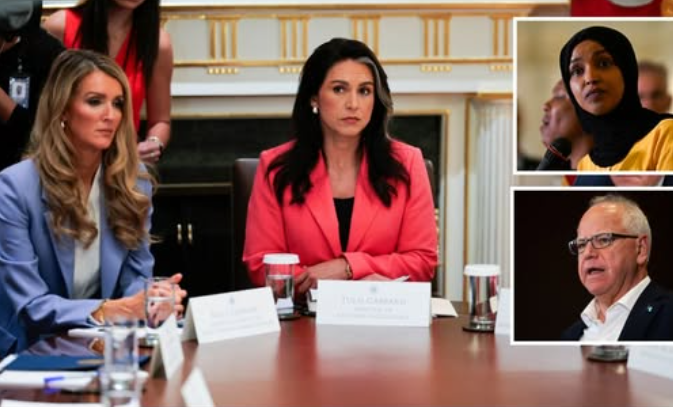
The warning was as stark as it was public — broadcast live to a national audience, impossible to ignore. SBA Administrator Kelly Loeffler didn’t mince words when she addressed the sprawling financial scandal unfolding in Minnesota. “This is just the tip of the iceberg,” she declared, her tone precise, measured, yet imbued with unmistakable urgency. The implication was clear: the revelations hitting the news were not isolated incidents, but rather the beginning of a far-reaching investigation that could stretch across the country. She didn’t stop there. With the authority of her office behind her, Loeffler promised that those responsible for defrauding the system wouldn’t escape accountability. She warned that arrests were imminent, that individuals would be prosecuted, and that the public could expect federal investigators to follow the money wherever it led. The televised announcement sent shockwaves not only through Minnesota’s political and business communities but across the nation, capturing the attention of local residents, lawmakers, and media outlets alike.
The specifics Loeffler revealed were staggering. Investigators had already uncovered thousands of fraudulent loans issued through the Small Business Administration’s pandemic relief programs — nearly 7,900 loans tied to some 6,900 individuals. Each number represented a story: business owners who claimed federal assistance they never intended to use, middlemen who orchestrated complex schemes, and entire networks of fraud that were exploiting the very systems designed to support struggling communities during the crisis. For Minnesota, a state already grappling with economic challenges and pandemic stress, the scandal was both a financial and moral shock, laying bare vulnerabilities in oversight, compliance, and trust. Yet Loeffler’s comments suggested that this was not merely a state-level problem. The implication was that similar patterns could, and likely would, emerge nationwide — a sprawling reckoning that could reshape how Americans perceive federal relief efforts, regulatory enforcement, and the integrity of institutions meant to protect them in times of need.
The administrator’s pledge went beyond simple rhetoric. She explicitly stated that those implicated in the scandal would be barred from future SBA programs, cutting off avenues for repeat exploitation. Federal prosecution was the next step, she said, signaling that criminal charges were likely on the horizon for anyone found culpable. The weight of those words resonated with both potential perpetrators and victims alike: Minnesota’s experience might be only the opening chapter in a larger national story of financial crime, oversight failures, and the long, painstaking process of holding wrongdoers accountable. For citizens who relied on these programs in good faith, Loeffler’s statement was both a reassurance and a warning — a signal that the federal government would act decisively to restore fairness and integrity to emergency relief efforts.
Against this backdrop of rising scrutiny and legal action, Representative Ilhan Omar found herself pulled into a maelstrom of political controversy. Omar, who represents a district at the heart of the scandal, faced allegations that were both immediate and explosive. Critics seized upon her legislative record, pointing in particular to the MEALS Act — her bipartisan initiative designed to ensure children had access to food during school closures. While the law itself was crafted with humanitarian intent, opponents now argued that it inadvertently created opportunities for abuse, linking the structure of the program to some of the fraudulent activity uncovered in the Feeding Our Future scandal. The narrative being constructed by her challengers painted a picture of legislative oversight gone awry, or worse, a system in which those close to Omar had benefited improperly from her work in Congress. The involvement of a former staffer with a criminal conviction only added fuel to the fire, providing tangible examples for those eager to tie Omar personally to wrongdoing, whether or not she had direct knowledge or culpability.
In political terms, this created a volatile and complex environment. Omar was forced to defend her record while the scandal continued to unfold, navigating the delicate line between legislative intent and administrative mismanagement. The public was confronted with a challenging question: how much responsibility does a lawmaker bear when a program they sponsored becomes exploited? Partisan pressures intensified every day, as opponents weaponized every angle of the situation, painting Omar as either negligent or complicit. Meanwhile, federal investigators and prosecutors moved deliberately, following evidence that could implicate a wide array of actors, from individuals exploiting loopholes to intermediaries orchestrating complex fraud schemes. Amid this storm, the nation watched as the distinction between deliberate criminal activity, bureaucratic failure, and good-faith policy implementation became increasingly blurred.
For Minnesota residents, the scandal’s human dimension was undeniable. Local communities were forced to confront the reality that some businesses and individuals had profited at the expense of others during one of the most challenging periods in recent history. Families relying on relief programs found themselves questioning the integrity of systems designed to help them. Business owners, some honest and struggling, watched as fraudulent claims siphoned away resources meant to sustain real livelihoods. The unfolding investigation promised to expose not just financial misdeeds but a deeper need for accountability, transparency, and reform in emergency assistance programs nationwide.
As federal prosecutors prepared to dig deeper and the political firestorm around Omar intensified, Loeffler’s warnings hung over the entire unfolding saga. “This is just the tip of the iceberg” was no casual remark — it was a prescient statement about the scope, scale, and seriousness of the issue. Across Minnesota and the nation, eyes were on the courts, the SBA, and congressional offices, waiting to see how far the scandal would reach, how many individuals would be held accountable, and what lessons would be drawn to prevent a repeat. Amid it all, the public grappled with questions about oversight, fairness, and the fragility of systems designed to help those in need during a crisis. The convergence of scandal, legislation, and political consequence made for a story that would resonate far beyond Minnesota, shaping discussions on federal relief, governance, and ethical responsibility for years to come.