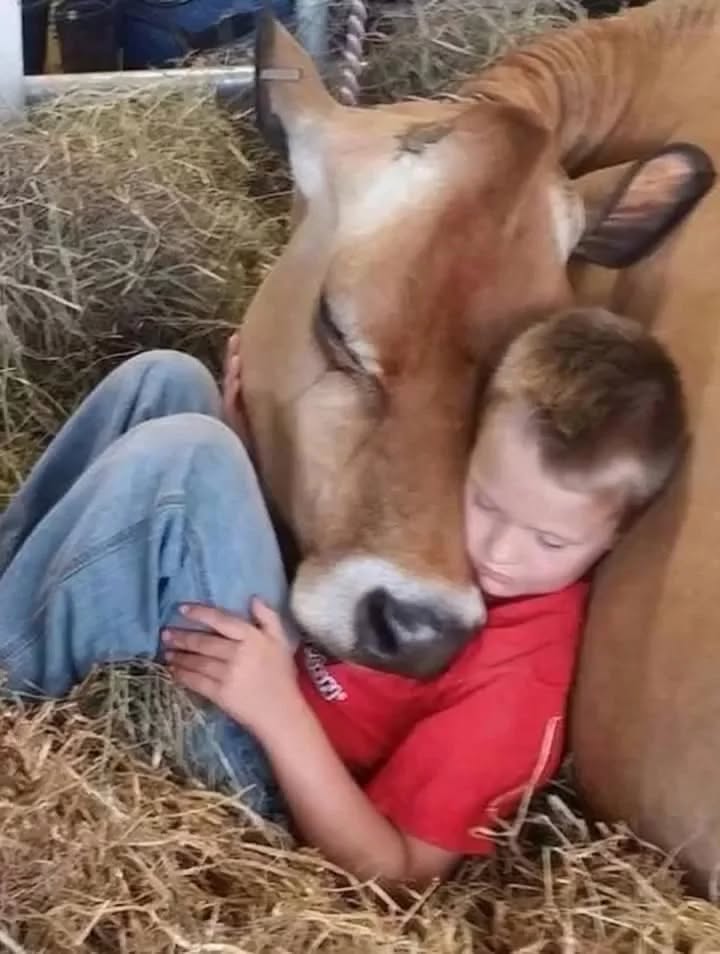
Silence has taken on a life of its own amid the vast, peaceful terrain of our family farm. Leo, my younger brother, used to be the type of kid that made a lot of noise in every room. He was a whirl of activity that neither our parents nor the farm’s borders could fully contain; he was wild, restless, and always moving. He was the child that yelled his victories to the breeze while scaling the tallest branches of the oak trees. However, that Leo disappeared last fall, to be replaced by a ghost of a youngster who can only communicate in a shaky, low murmur.
After we returned from the farm’s back acres in late October of last year, the shift was complete and instantaneous. Leo has since given up on the coziness of our shared bedroom and won’t put his head under a comforter or on a mattress. Instead, he has made the old barn’s hayloft his permanent home. He huddles up against our kindest Jersey cow, Daisy, at night. The image of him around her big, warm body in search of a comfort that the rest of us seem unable to offer is incredibly unnerving. My mother, who is always optimistic, believes that a guy and his animal have a charming, unique bond. With a shrug, my father brushes it off as a weird phase that will end with winter’s first frost. However, I’ve always felt that Leo’s banishment to the barn is about safety rather than love.
A few nights ago, when the house had gone dark, I sneaked into the barn out of a rising sense of dread and a nagging curiosity. The smell of dry alfalfa filled the air, along with the cattle’s heavy, rhythmic breathing. I remained in the darkness and observed Leo pressing his face on Daisy’s silky neck. I heard him mumble in the silence, but he didn’t see me. The voice had a crushing weight of desperation.
He whispered into the cow’s ear, “I didn’t tell them it was me.” “Daisy, I know you saw. You didn’t tell anyone, but I know you were there. I appreciate you retaining it.
Daisy remained still. She just slowly and deliberately blinked her big, liquid eyes, as though she were a silent confessor taking in a child’s transgressions. It wasn’t the night air that made me feel cold. Leo was hiding in plain sight, shielded by a witness who lacked the ability to speak, rather than merely sleeping in the barn.
I finally confronted him behind the grain silo the next afternoon. Instead of running or withdrawing into his typical stony silence as I had expected, he broke down. He cried out of genuine, worn-out relief rather than terror or the fear of being discovered. It seemed as though the secret had grown too much for his little frame to bear by itself. His eyes were wide with a desperate eagerness, his knuckles white, and he seized my hand with a strength that surprised me.
His voice cracked as he pleaded, “Don’t open the red toolbox.” Additionally, avoid showing them the picture at all costs. Please. Make me a promise.
I made the vow primarily to get him to release my arm, but throughout the remainder of the day, the phrase “red toolbox” kept coming back to me. The majority of my father’s dozens of toolboxes are dispersed across the tractor shed and the workshop. I searched all morning, sifting through the grease and rust of the farm’s mechanical past. At last, I discovered it concealed beneath a stack of moth-eaten burlap sacks in the crawlspace beneath the tool shed’s floors. The red paint was flaking off in jagged scales from an ancient, worn metal chest.
The first thing I saw when I eventually forced the lid open this morning was a Polaroid picture with twisted and yellowed edges. My fingers were shaking when I picked it up. The photo was taken in the back woods, next to the ancient stone well that had been sealed up for protection years before. The silhouette of a person standing at the brink of the hole was captured in the horribly tinted light. I recognized the jacket despite the film’s graininess. Leo’s favorite blue windbreaker was this one. However, it was what was on the ground at the figure’s feet—not the figure itself—that made my stomach turn.
A small, leather-bound diary that didn’t belong to anyone in our family, a set of keys to a car we don’t own, and a solitary silver cufflink were among the strange items hidden behind the photo, under a bulky set of iron wrenches.
I felt the understanding strike me like a physical blow. Daisy the cow was aware that the “truth” was neither a shattered glass or an accident that happened as a child. It was something far more long-lasting. I recalled the news stories from last fall about the missing hiker in the state park that borders our property, the fruitless searches, and the police’s eventual decision to move on due to the size of the wilderness.
Because of the deafening cacophony in his head, Leo has not been crazy or noisy since that day. He had witnessed—or even taken part in—something that had taken his voice and replaced it with a trembling, everlasting whisper. Daisy was the only animal on this farm that didn’t require an explanation, therefore he slept with the cow. Without the questioning of a human soul, she provided the warmth of a living body.
With the red toolbox open in front of me and the burden of my brother’s secret placed firmly on my shoulders, I sat on the shed’s dirt floor for a long time. I turned to face the barn, where I knew Leo was probably sitting in the hay, waiting for the sun to set so he could return to his silent protector. I now knew why he objected to the picture being displayed. The picture captured the precise moment my brother’s childhood came to an end, not simply a moment in time.
I became aware that I was now a part of the silence as I slid the red toolbox back into the crawlspace’s darkness and tucked the Polaroid back into the chest. I turned into a second Daisy—a silent witness, a guardian of the truth concealed beneath the floorboards and in the woods. Knowing that we would be murmurs in a once-loud world for the rest of our lives, I made my way back toward the home with heavy footsteps.