We are frequently taught that achieving greatness in the world’s inflexible hierarchy requires a gradual accumulation of prominent titles, academic credentials, and accolades. We are trained to search for it behind the lecterns of ivy-covered universities or in the corner offices of skyscrapers. But my own conception of greatness was destroyed and reconstructed—not in a classroom, but inside the small, sun-drenched walls of a two-bedroom apartment—by a young lady who had no formal education but an unending capacity for selflessness.
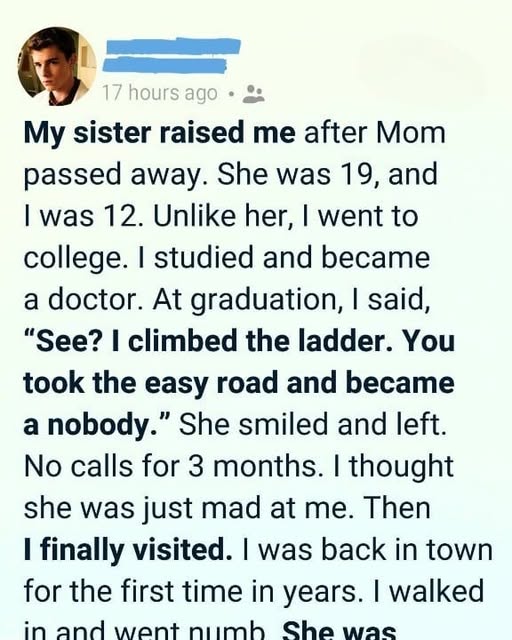
My world’s tectonic plates moved when I was just twelve years old, creating a void that seemed both empty and unnaturally weighty. Time hasn’t been able to erase the precision with which I remember the day our mother died. The bitter, sterile smell of antiseptic that pervaded the hospital hallways is still fresh in my memory; it became the smell that marked the end of my childhood. The future seemed like a wide, terrible expanse of grey in that clinical calm. However, I observed my sister at the funeral as the neighborhood came together to express hushed condolences and carry out the grieving rituals.
While most young people are navigating the exciting narcissism of early adulthood, fretting about social standing or midterms, she was barely nineteen. However, she seemed to have aged decades in a single afternoon as she stood next to my mother’s coffin. Her poise was the first indication of a granite-like resolution rather than an indication of emotional detachment. In that moment, she understood that she was more than simply a sibling; she was my lone pillar of support in a world that had abruptly become dangerously unstable.
The change that transpired was subtle and quick. My sister started to destroy her own dreams to make place for mine, without the publicity of a big announcement or the need to win over the public. She discreetly stopped attending her university classes, exchanging her textbooks and the prospect of a career in the workforce for the harsh realities of the service sector. She started two jobs and worked double shifts, leaving the house before the sun came up and coming back long after I had fallen asleep.
I saw her become an expert in the unseen art of survival. I came to understand that greatness was the capacity to turn a small bag of goods into a week’s supply of wholesome meals. It was the ability to stretch a diminishing bank account till it paid for electricity, rent, and the occasional, amazing indulgence of a brand-new pair of school shoes. She transformed into an architect of hope, painstakingly concealing her bone-deep fatigue with a grin so convincing that, as she tucked me in and whispered, “Don’t worry,” I actually believed her. We will be all right.
Her act of bravery was a slow-motion sacrifice. My sister was sitting at our kitchen table beneath a dim lightbulb, carefully balancing a checkbook that hardly ever added up, while her peers were sharing pictures of spring trips and college parties. She carried the burden of our mutual loss in private, never letting her own grief take precedence over my desire for security. She turned our hardship into a haven, making sure that even without our mother, our house continued to seem like a haven of warmth rather than a memorial to grief.
I can now clearly see the significant toll those years had on her. The calluses on her palms and the creases around her eyes are the rewards of a battle she waged on my behalf to defeat poverty and hopelessness. She showed me that the most effective leadership comes from being willing to take on the responsibilities of others rather than having a title. She demonstrated to me that true brilliance is found in the ingenuity of a heart committed to defending what it loves, not in a GPA.
The strength of her will alone kept us alive during those hard years, not a social safety net or an inheritance. She taught me how to walk with dignity even while the path was collapsing under my feet, in addition to keeping us on course. She gave me the luxury of childhood, insulating me from the harsh realities of our financial circumstances so that I could concentrate on my education and personal development.
I no longer perceive my own intelligence when I gaze at the framed degrees on the wall of my office. Her twelve-hour shifts at the diner are visible to me. To avoid paying the bus fee, I observe her walking home in the rain. I see the woman who chose to choose my future over her own. I came to see that my sister had attained a degree of excellence that no school could possibly bestow. The art of unselfish devotion was the hardest curriculum of all, and she had mastered it.
I learned from her that greatness is a decision taken when no one else is looking—in the quiet, desperate times. It is the choice to be a beacon of light in a dark world. It is the bravery to put your own life on wait in order to help someone else navigate life. Ultimately, the most significant lesson I’ve ever learned came from a nineteen-year-old girl who stood tall in a hospital hallway and concluded that everything would be alright—not from a professor or a CEO. Her legacy is inscribed in the life I am able to lead now because she decided to be my pillar of support, not in the pages of a magazine or on a trophy.