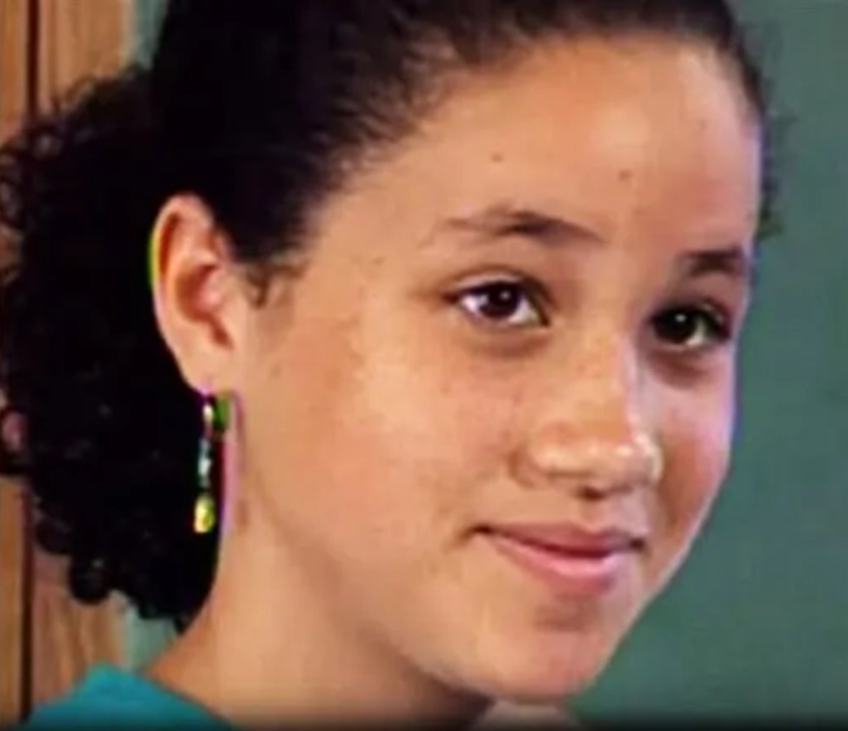
Meghan Markle was just a young girl growing up in Los Angeles, navigating a world that seldom allowed for complexity, before royal titles, international headlines, and unrelenting media scrutiny. Palace gates and privilege were hardly the beginning of her story. Microwave dinners, long afternoons spent by themselves after school, and the silent question that many kids ponder but few openly acknowledge—where do I belong?—were the starting points.
Meghan was raised with a keen awareness of how fast people are categorized by society because she was born to a Black mother and a white father. She has publicly discussed the ambiguity that accompanied being multiracial in settings that required straightforward classifications. Too frequently, outsiders assumed her mother, Doria Ragland, was a nanny rather than a parent, raising questions about her family. Meghan’s understanding of identity, bias, and visibility was impacted by those brief but frequent moments long before she had words to describe any of it.
Her early years weren’t glamorous; they were pragmatic. Being a latchkey child, she said she returned home to an empty house while her parents were out at demanding jobs. Her mother had a profession as a yoga instructor and makeup artist, while her father, Thomas Markle Sr., worked in television. Typically, dinner consisted of TV trays or fast food while Jeopardy! was playing in the background. These routines become lessons in independence and thankfulness rather than deprivation.
Regarding the specifics of those years, opinions differ. Meghan’s father has openly denied some of her memories, especially those pertaining to financial difficulties, claiming he gave her daily support and stability. The emotional experience of feeling different, invisible, and uncertain of her place in the world was what Meghan remembered most, not money or material comfort. However, recollection is subjective.
Meghan lived in two different worlds as her parents divorced. After the age of nine, she moved in with her father full-time, but she remained close to her mother, who moved to a neighborhood with a high concentration of Black people and found support in a close-knit group of women. Doria subsequently revealed that the community was crucial to her daughter’s upbringing. They didn’t always have a traditional relationship. Meghan reportedly told Doria that she felt more like an older, domineering sister than her mother when she was asked if she felt like her. Their mutual honesty served as a basis for trust.
Meghan’s insecurities became more acute during adolescence. She has stated unequivocally that she was “not the pretty one” as a child, identifying instead as the nerd, the overachiever, or the intellectual girl. She used intelligence as armor. She successfully pushed for change at the age of eleven by using a handwritten letter to criticize a sexist television commercial. Her voice had conviction even then.
Meghan gained an appreciation for simple pleasures in spite of her low resources. Sizzler’s salad bar meal seemed celebratory. Gratitude was weaved throughout Girl Scout trips, which visited cost-effective locations for families. Meghan was already resolved to follow this path, and it was accelerated when her father later won a sizable lottery sum, opening possibilities to elite school and training.
Her work ethic was evident at a young age. By the time she was thirteen, she was working two jobs at the same time—babysitting and working at a doughnut stand—while having lofty aspirations. On the set of Married… with Children, where her father was employed, she discovered her passion for acting. It was a strange place for a Catholic schoolgirl to hang around, she later quipped, but it introduced her to acting, staging, and storytelling in a way that seemed natural.
Nevertheless, the industry was unsure about how to handle her. Meghan was sometimes called “ethnically ambiguous” due to her status as a multiracial actress. She has stated that she wasn’t deemed white enough for some roles or Black enough for others. Her familiar in-between place from infancy followed her into maturity. It was both formative and draining.
It paid off to persevere. She openly remarked on progress, happiness, and self-kindness at the age of thirty-three. Her career took off at that time thanks to her portrayal of Rachel Zane on Suits. Although the show increased confidence, financial freedom, and visibility, it was not the last chapter.
Meghan first met Prince Harry in 2016. Under close observation, their relationship progressed swiftly. Millions of people around the world witnessed their 2018 wedding at Windsor Castle. The union brought about unprecedented media criticism, but it also represented transformation inside the British monarchy.
Being a mother was both exciting and risky. Prince Archie and then Princess Lilibet were welcomed by Meghan and Harry. Meghan experienced potentially fatal postpartum difficulties behind the scenes. She disclosed that she had experienced postpartum preeclampsia, a rare and dangerous illness, in her podcast Confessions of a Female Founder in 2025. She talked clearly and without drama about attempting to be there for her kids while dealing with a life-threatening medical condition.
Heartbreak followed survival. Later, Meghan revealed that she had gone through a miscarriage, which she described with raw vulnerability. The illusion of a life straight out of a fairy tale was destroyed by these times. Resilience was what was left.
Meghan Markle now holds a position that few women will ever have: she is influential, well-known, scrutinized, and fundamentally human. Her path from insecure teenager to global celebrity is a complicated one, influenced by race, class, ambition, love, and grief, rather than a clear path to success. She no longer waits for organizations that formerly attempted to confine her to understand her. She raises her kids with the hard-won knowledge of someone who has lived several lives in one, speaks for herself, and builds on her own terms.
Her tale has nothing to do with monarchy. It has to do with agency. And it goes on.