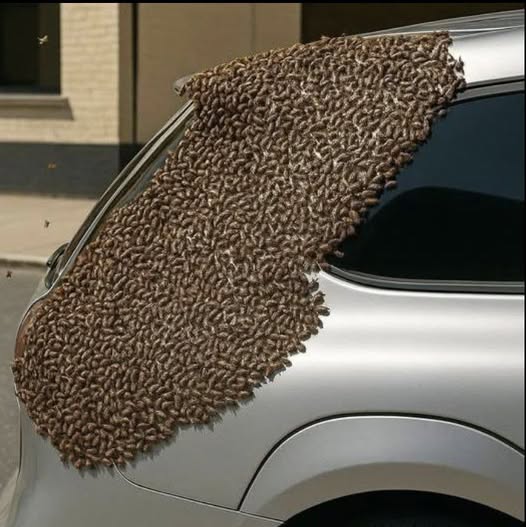
The air thickens in a way that makes your chest tighten before your brain even fully registers what’s happening. A dark, swirling cloud begins to descend slowly, almost impossibly, over your street, your yard, the playground outside your children’s school. The sound is an ominous hum, low and constant, vibrating through walls, rattling windows, and creeping under doors. Your first instinct is panic. It always is. That panic makes sense—it is ancient, wired into your survival instincts, but it is also exactly how disasters begin. People scream, phones ring endlessly, sirens blare in the distance, and the first reflex is to act—sometimes too quickly, sometimes with catastrophic consequences. One poorly timed spray, one swat too many, or a frantic call to the wrong authorities can wipe out thousands of vital pollinators in just a few short minutes. The consequences ripple far beyond your immediate fear; they extend into gardens, orchards, and farms that depend on the tireless work of bees for the fruits, vegetables, and nuts that fill dinner tables across the nation. Every misstep can cascade into a silent ecological tragedy that no one immediately sees.
In the face of such a terrifying spectacle, the most powerful tool is restraint—a quality that feels unnatural in the rush of adrenaline and instinctive fear. Swarming bees are not an army out for vengeance; they are focused entirely on their queen and the search for a new home. Their world is intimate and precise, and their attention is elsewhere. By resisting the urge to scream, swat, chase, or spray, you are not simply controlling your own impulses—you are preserving the life of a fragile, highly organized colony that contributes quietly but vitally to the ecosystems on which humans rely. Patience and calm, though difficult to summon in the first moments, protect both your family and one of the most important living allies in our food system. These bees, in almost all cases, will move on naturally within a day or two. They will leave no lasting mark, no danger, only the quiet hum fading into the sky once more. The scene that initially seemed threatening transforms into a fleeting, almost sacred glimpse of nature’s intricate choreography, a reminder that even the most intimidating phenomena often have an underlying logic.
If, however, the swarm chooses to settle in a location that presents genuine risk—on a roof, a tree overhanging a playground, or near a busy street—intervention becomes necessary, but the approach can still honor life rather than destroy it. Local beekeepers and bee rescue organizations have the knowledge, experience, and equipment to safely relocate the colony. With careful coordination, the bees are moved to a new home where they can continue their essential work pollinating plants, producing honey, and maintaining the balance of the ecosystems they inhabit. Choosing this patient, informed course of action transforms fear into curiosity, anxiety into education. By witnessing and participating in the relocation, people often develop a newfound respect for these creatures, learning how profoundly interconnected human survival is with the survival of species many take for granted.
The lesson extends beyond immediate encounters. Planting bee-friendly flowers, maintaining wild patches of native plants, avoiding the use of toxic pesticides, and creating awareness among neighbors and local schools can collectively help ensure that swarms are met with understanding rather than destruction. What begins as a moment of fear—a dark cloud of wings, the pounding of your own heart, the imagined danger to children and pets—can instead become the starting point for education, advocacy, and ecological stewardship. Each small choice builds a ripple effect: one backyard that remains hospitable, one school that teaches children about pollinators, one community that reframes panic into thoughtful action.
In this way, a frightening encounter evolves into a deep lesson about coexistence. It teaches that nature is neither cruel nor malevolent; it simply operates on rules that are often invisible to those untrained in observation. Bees are not monsters to be vanquished—they are engineers, pollinators, and architects of abundance. Their survival is tightly linked to human survival, from the almonds in California orchards to the apples in New York backyards. By resisting the initial impulse to destroy and choosing patience, education, and respect, a single terrifying moment becomes a gateway to awareness, a tangible demonstration of how life sustains life.
Ultimately, it is not just about the bees. It is about how humans respond to the unexpected, the unknown, and the beautiful complexity of the natural world. A swirling cloud of insects can teach more about patience, humility, and ecological responsibility than any classroom lecture or article. By choosing restraint over fear, observation over destruction, and action informed by knowledge over impulsive instinct, we not only save bees—we save the lessons they carry. We learn that moments of fear can be moments of transformation. We discover that respect for life, even in its most unsettling forms, preserves the delicate balance upon which all existence depends.
In every neighborhood, schoolyard, and backyard, there is the potential for this education to unfold. By approaching each swarm with calm, by calling in experts when necessary, and by fostering awareness and curiosity, we ensure that the story of fear and hesitation ends with wonder, insight, and life preserved rather than destroyed. A frightening afternoon becomes a lifetime of respect and care. Through patience and mindful action, what begins as panic becomes a rare opportunity to witness the extraordinary, intricate, and irreplaceable world of bees—and, through them, a profound understanding of the fragile threads that connect us all.