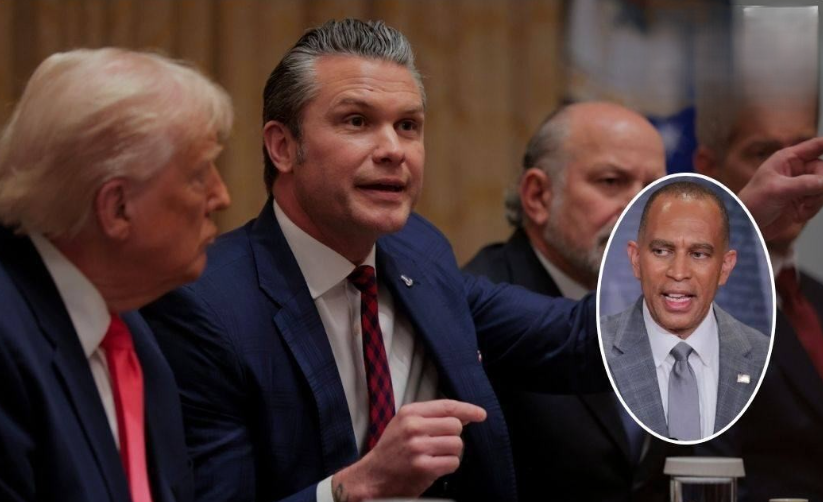
The footage itself is stark, almost unbearably vivid. Explosions ripple across the Caribbean waters, fire consuming the narco-terrorist submarine, smoke curling into the sky as if marking the gravity of the act in real time. Every detail is captured with precision: the vessel listing, splintering under the impact, crew members scrambling in a desperate bid to save themselves and their deadly cargo. But while the visuals shock, the reaction from certain corners of the political spectrum has been even more extreme — a predictable, performative outrage that falls into a familiar pattern. As the United States executed a decisive strike against operatives ferrying lethal drugs toward its shores, left-wing commentators and politicians erupted on cue. Headlines screamed “war crimes,” social media feeds flooded with moral condemnation, and even some public figures, like Pete Hegseth, were suddenly floated as targets for impeachment — as if questioning the legality of an action designed to prevent mass death were a matter of political theater rather than sober judgment.
Yet this display of moral fervor is strikingly selective. Where was the outrage when Barack Obama’s administration executed over five hundred drone strikes around the world, often in secret, often on intelligence that could not be fully verified in public, and frequently resulting in collateral civilian casualties? Where was the public hand-wringing as American forces carried out targeted killings of enemies on distant battlefields, often hidden behind classified operations? Where were the cries of moral indignation when names appeared on the administration’s so-called “kill list,” Americans among them, stripped of due process and summarily executed from thousands of miles away? The difference, it seems, is not in the scale of lethal action but in who the targets were and whether those targets fit into a politically convenient narrative.
The hypocrisy becomes even more apparent when we look at the present operation through a legal lens. The very same lawmakers and commentators who barely batted an eye at Obama’s secret “Disposition Matrix” — a sprawling bureaucratic system designed to decide who lived or died in distant lands — now rush to label Operation Southern Spear as criminal. Their outcry focuses on the moment when narco-terrorists, caught transporting fentanyl and other deadly narcotics intended to devastate American communities, attempted to return to their vessel after it had been damaged. They were not innocent survivors of a shipwreck; they were combatants, fully aware of their mission, actively attempting to re-engage with a platform designed to kill Americans by the thousands. Under the long-established laws of armed conflict, the fact that the vessel was partially wrecked does not absolve it from being a lawful military target until it is fully neutralized. The principle is clear: intent and ongoing mission, not optics or media framing, define the legality of a strike.
This distinction was underscored by former Trump Navy lawyer Tim Parlatore, who repeatedly emphasized that military law hinges on purpose and operational context. The question is never whether an action looks messy on video; it is whether the target remained a legitimate threat and whether the use of force adhered to established conventions. Historical parallels reinforce this understanding. At the Battle of Midway, for instance, crippled Japanese carriers, engulfed in flames and burning, were legally torpedoed by U.S. forces until they sank beneath the waves. The principle was identical: an enemy asset remains a valid target as long as it retains the capacity to harm or to support hostile operations. By the same logic, the drug-running vessel in Operation Southern Spear, though partially destroyed and damaged by earlier engagement, remained a lethal threat to American lives until it was fully neutralized. The strike was not an arbitrary act of violence; it was a calculated move to prevent the smuggling of tens of thousands of lethal doses of synthetic opioids into the United States.
The real scandal, therefore, is not the strike itself but the political narrative that has emerged around it. The outrage seems less focused on the lawfulness or necessity of the operation and more on optics, on the ability to weaponize public sentiment against a particular administration or its policies. Here is a lethal, tangible threat — narco-terrorists actively working to flood American streets with poison — and the focus of certain political elites is not on the lives saved or the societal catastrophe averted. Instead, they express more indignation over the deaths of the traffickers than the countless Americans whose lives would have been endangered or lost without decisive intervention. The skewed priorities are clear: dead traffickers are a crisis to some, while dead citizens barely register in the outrage calculus.
This selective moral panic exposes a deeper problem in modern political discourse: it is increasingly detached from principles and rooted in performance. Rules, precedent, and history are subordinated to the need to signal virtue, to attack opponents, and to leverage tragedy for political gain. Meanwhile, threats to public safety — in this case, an organized, militarized network of drug traffickers intent on mass harm — are treated as secondary, even optional, concerns. The law of armed conflict, the ethical justification for defensive action, and the practical imperative to save lives are drowned out by the roar of cable news anchors, trending hashtags, and politically motivated outrage campaigns.
In the end, the core lesson is simple, though politically inconvenient: legality is determined by objective criteria — intent, mission, and the ongoing threat posed by the target — not by selective outrage, media framing, or the political affiliation of those issuing judgment. Whether the target is a Japanese carrier in World War II or a narco-submarine in the Caribbean, the principle is the same: an enemy combatant or weapon platform that retains the ability to inflict harm remains a lawful target until it is fully neutralized. Operation Southern Spear adhered to this standard, and yet, predictably, those more concerned with optics than outcomes are willing to mislabel it a “war crime.”
Ultimately, the true scandal is the disconnect between real-world threats and the moral priorities of a political class that measures itself more by performative indignation than by protection of the populace. The operation saved lives, neutralized a direct threat, and upheld the long-standing principles of military engagement. But for those obsessed with appearances rather than outcomes, the narrative is already set: dead traffickers, no matter how dangerous, are a crisis. Lives saved, justice upheld, and legality respected — these are secondary concerns.