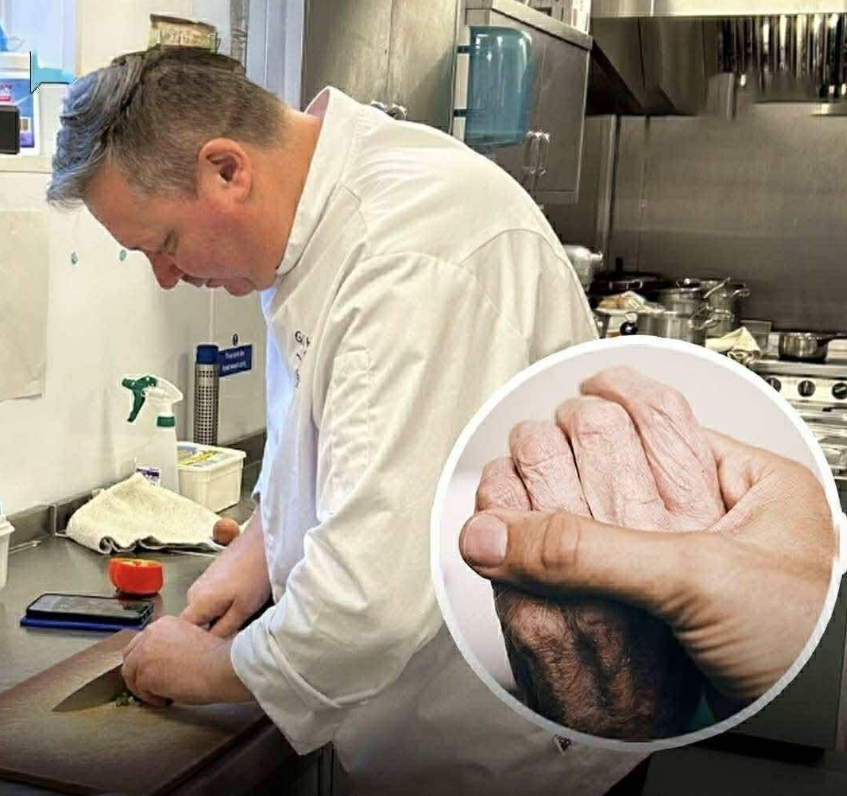
Food becomes much more than nourishment at a hospice in Oxfordshire, where time is measured in moments rather than years. It turns into connection, remembrance, solace, and dignity. Cooking for terminally ill patients is a calling characterized by empathy, compassion, and a profound awareness of what matters most at the end of life, according to Spencer Richards, the chef behind the kitchen at Sobell House Hospice.
Richards has been cooking for palliative care patients for years; these are patients whose bodies are deteriorating but whose minds are still very much alive. He has stated in interviews that preparing what might be someone’s last dinner is one of the greatest pleasures a chef can have. His kitchen runs on a completely different metric—human impact—in a culture fixated on Michelin stars, viral recipes, and opulent dining experiences.
Richards and his staff modify meals daily to accommodate patients whose tastes, appetites, and physical capabilities are ever-changing. Many people have trouble swallowing. Others suffer from nausea brought on by drugs or medical procedures. Some experience severe desires, while others completely lose their sense of taste. Technical proficiency is necessary for cooking in this setting, but emotional intelligence is even more crucial.
Richards told a story that better demonstrates this than any statistics. The typical hospice food did not appeal to a 21-year-old patient who was reaching the end of his life. There was no interest in traditional meals. Richards sat down with him and listened, rather than pressuring him to make a compromise. The young man had a passion for street cuisine. So the kitchen took a different turn. Burgers, strong flavors, comforting familiarity—made possible not because it was simple, but because it was important. The meals at that time had nothing to do with diet plans or procedures. It has to do with getting noticed.
Just as vividly, another memory comes to mind. A ninety-three-year-old woman who had grown up in a rigid, traditional home had never been invited to celebrate her birthday. Not a cake. Not a candle. Not a song. She sobbed when Richards and the hospice staff gave her a birthday cake as a surprise. Not in silence. Not courteously. She was really happy. Even though that cake was straightforward by culinary standards, it had greater emotional impact than the most ornate meal could.
Richards became aware of a pattern over time. Birthday cake is a common request made by those who are nearing the end of their lives. Not fine dining. Not exotic tastes. Cake. Soft, familiar, and sweet. It stands for festivities, youth, family, and secure times. It represents recognition to many patients, particularly those who are lonely or isolated. Evidence that, even in their last days, their life still mattered.
Clinically speaking, the requests are reasonable. According to Richards, a lot of cancer patients grow to love sugary foods. The perception of taste is altered by medications. The salt gets too much. Savory dishes become less appealing. The obscurity is broken by sweetness. It provides comfort without requiring a lot of work. The way meals are cooked has changed as a result of this realization, allowing patients to enjoy food rather than put up with it.
However, nutritional adaptation is not the only thing that takes place in that kitchen. According to Richards, one of the most potent emotional outlets available to people is food. Childhood memories can be unlocked by a scent. A lost individual can be resurrected by taste. Fear can be temporarily banished by a familiar meal. Choosing what to eat becomes a unique sort of agency in hospice care, where control over life is eroding.
This explains why readers looking for stories about compassionate hospice care, end-of-life dignity, comfort food psychology, and human-centered healthcare find the work so compelling. Richards’ method serves as a reminder that quality of life is just as important as longevity at a time when medical conversations are frequently centered on procedures and results.
It’s hardly a gorgeous hospice kitchen. Reviews, applause, and cameras are all absent. However, there is a huge emotional return. Richards talks candidly about how patients have influenced him and the lessons he has learned about presence, thankfulness, and resiliency. In this context, cooking reduces the profession to its most basic function: providing care for others.
Palliative care specialists frequently stress that comfort has multiple dimensions. Emotional health is just as important as pain treatment. At the nexus of both is food. Anxiety can be reduced by eating. Dessert has the power to start a dialogue. In an otherwise strange and unsettling setting, a shared snack can bring things back to normal.
The reason the stories coming out of Sobell House Hospice have resonated is because they go against contemporary notions of success and worth. This kitchen runs on empathy and care in a culture that values efficiency and productivity. Each dish is a silent gesture of gratitude.
A more general fact about aging, disease, and care is also highlighted by Richards’ work: little things are big. A piece of cake. A taste you know. A meal prepared with purpose. When time is of the essence, these gestures are extremely powerful. They serve as a reminder to patients that their humanity, not their condition, defines them.
Stories like this strike a deep chord as discussions about hospice care, end-of-life planning, and compassionate healthcare continue to expand. With warmth, they cut through dread. They substitute faces, names, and moments for abstraction. And they serve as a reminder that happiness can endure till the very end.
Food is not merely cooked in that Oxfordshire kitchen; it is served with affection, significance, and memories. And for a lot of people, that last taste becomes something they keep with them until they die.