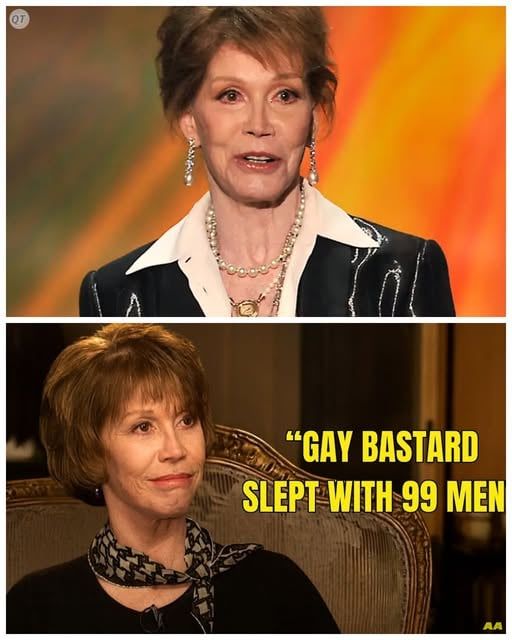
Mary Tyler Moore looked like comfort itself on screen—warm, approachable, effortlessly capable. Her smile suggested ease, and her presence felt reassuring, as if she belonged exactly where she stood. But the truth of her life and career was far more layered and deliberate than that surface calm ever revealed. Behind the familiarity was a woman quietly, persistently rewriting the rules of power, leadership, and success in an industry that rarely made room for women to do so on their own terms. There were no headline-grabbing scandals, no public implosions, no dramatic declarations. Instead, there was something far rarer: composure paired with conviction, and integrity practiced day after day in a system that often rewarded silence or submission.
Mary Tyler Moore’s influence was never loud, but it was precise. At a time when women on television were expected to orbit around others—to be helpers, wives, or decorative presences—she insisted on something more expansive. She understood that representation wasn’t only about visibility; it was about agency. Every role she accepted, every creative decision she supported, was guided by a clear internal standard: does this move the idea of women forward, even slightly? Does it allow complexity, independence, and dignity to coexist on screen?
Her magic, then, was never just in the characters she played. It lived in the choices she made about how those characters would exist in the world. In an industry built on spectacle and volume, she practiced a quieter kind of influence—measured, thoughtful, and deeply human. She recognized that power did not always need to announce itself. Sometimes it could simply take shape through consistency, professionalism, and an unwillingness to shrink.
Mary Tyler Moore paid close attention to nuance. She knew that a single line reading could reinforce an old stereotype or subtly undermine it. A pause could suggest self-respect. A smile could signal autonomy rather than submission. These were not accidents. They were acts of intention. By refusing to overplay or exaggerate, she left room for audiences to adjust their expectations, often without realizing they were doing so. Viewers weren’t being told what to think; they were being gently shown what was possible.
What made her especially powerful was that she did this without rejecting warmth or likability. She did not harden herself to be taken seriously, nor did she trade grace for authority. Instead, she demonstrated that competence and kindness could exist together—that a woman could be ambitious without cruelty, confident without arrogance, and successful without spectacle. In doing so, she challenged the false choice so often presented to women: be respected or be loved, but not both.
Her leadership extended beyond the screen. As a producer and collaborator, she modeled respect in rooms where ego often dominated. She listened. She prepared. She treated people as professionals, regardless of rank. That steadiness created environments where others could do their best work, and it quietly reshaped what leadership looked like in television. Younger performers and writers didn’t just see a star; they saw a standard. They learned that you could hold your ground without raising your voice, that boundaries could be firm without being hostile.
Mary Tyler Moore’s legacy endures precisely because it was never built on flash. It was built on trust—trust in her craft, in her values, and in the belief that doing things the right way mattered, even when shortcuts were available. She showed that success did not require self-betrayal. It could be constructed from discipline, emotional intelligence, and an unwavering commitment to authenticity.
For many who followed her, she became a blueprint. Proof that visibility did not have to come at the cost of privacy. That power did not require domination. That grace was not weakness, but a form of strength refined through self-knowledge. She made space for others simply by occupying her own space fully and honestly.
Long after the studio lights dimmed and the applause faded, what remains is not just a catalog of beloved performances. What remains is the example of a woman who changed television by refusing to contort herself to fit its limitations. Her greatest act was not confined to a scene or a script. It was the life-long practice of being exactly who she was—calm, capable, principled—and trusting that this, too, could be revolutionary.