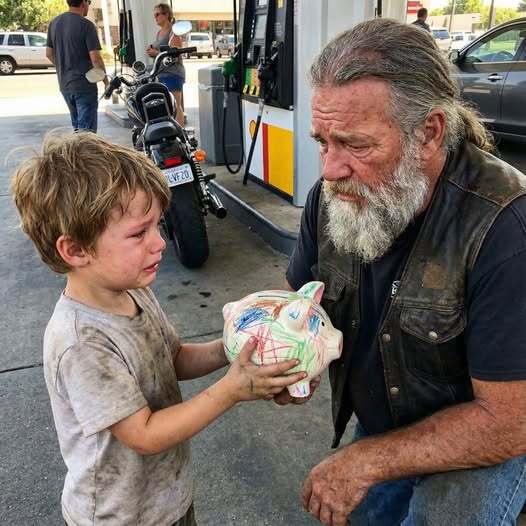
The boy’s voice shook like brittle glass as he held out his small hands, palms cupped, the contents of his life savings rattling inside a worn, cracked piggy bank. Each coin clinked against another with a hollow, pleading sound, almost like a tiny alarm bell that demanded someone—anyone—pay attention. He didn’t shout, didn’t gesture wildly. His courage was quiet, fragile, and contained entirely in that trembling offering. Across the lot, a truck idled, its engine rumbling low like a caged animal, rage coiled tight within the steel cab. The streetlights flickered against the darkening asphalt, their glow bouncing off the metal of the truck like warning lights no one wanted to heed.
No one moved. The adults who had gathered nearby exchanged uneasy glances but froze. It was easier to look away than to confront the truth of what was happening. It was easier to pretend that the world didn’t sometimes demand bravery from children far too small for such burdens. But he stood there, tiny in stature but immense in presence, a single figure carrying the weight of unspoken pain. His shoulders, though narrow and young, were squared with a dignity that no child should ever need to summon.
The coins inside the piggy bank were inconsequential in material terms, but what he was really offering could not be measured in dollars or cents. He offered his trust, his belief that someone might intervene, that the adult world could respond with protection rather than indifference. Every eye on him flicked to the truck and back, sensing the precariousness of the moment, the volatility that hung in the space between the boy and the machine. And yet, there he was, heart open and exposed, daring to believe that courage might make a difference.
I moved toward the truck slowly, deliberately, not as a hero but as a witness who refused to turn away. Each step carried a weight of responsibility I had not anticipated, and I felt the gravity of the child’s hope pressing on me, asking silently: Will you act, or will you let it go? Around me, others began to stir. They had been hesitant, frozen, unsure of how to intervene. But the boy’s quiet bravery called them forth, and one by one, they stepped forward. Together, we formed an invisible but unyielding line of accountability, a wall of human presence that even the man in the truck could not dismiss with a sneer.
The truck’s engine roared louder, a threat that vibrated through the pavement beneath our feet. The air smelled of gasoline and tension. Every second stretched, taut with possibility and fear. And yet, the boy did not falter. His eyes—wide, earnest, unwavering—met mine for a brief moment, and in them, I saw not just fear but hope, a fragile belief that adults could rise to their better selves.
When the truck finally tore out of the lot, tires screeching against asphalt, leaving behind a wake of displaced dust and shaken hearts, a collective exhale passed through those who had stood beside him. The boy’s mother emerged from the shadows, her face a raw map of terror, confusion, and delicate relief. She met my eyes, and in that fleeting connection, I glimpsed gratitude so deep it could not be spoken aloud. Help arrived later—resources, distance, the slow, painstaking work of healing—but the pivot, the moment that broke the cycle of silence, belonged to a five-year-old who had dared to hope that a stranger might stand with him.
His courage did not erase the danger that night. It did not immediately stop the threat or the pain. But it pierced the quiet, shattered the complicity of bystanders, and illuminated a truth often forgotten: even the smallest act of bravery, when done with integrity, can shift the trajectory of a life. That night, a child’s trust became a catalyst. It reminded every adult who witnessed it that choosing to act—truly act—can ripple outward in ways impossible to predict. The boy’s small hands, clutching a piggy bank, held more than coins; they held the capacity to remind the world that innocence and courage are not mutually exclusive, and that sometimes, simply refusing to look away can change everything.