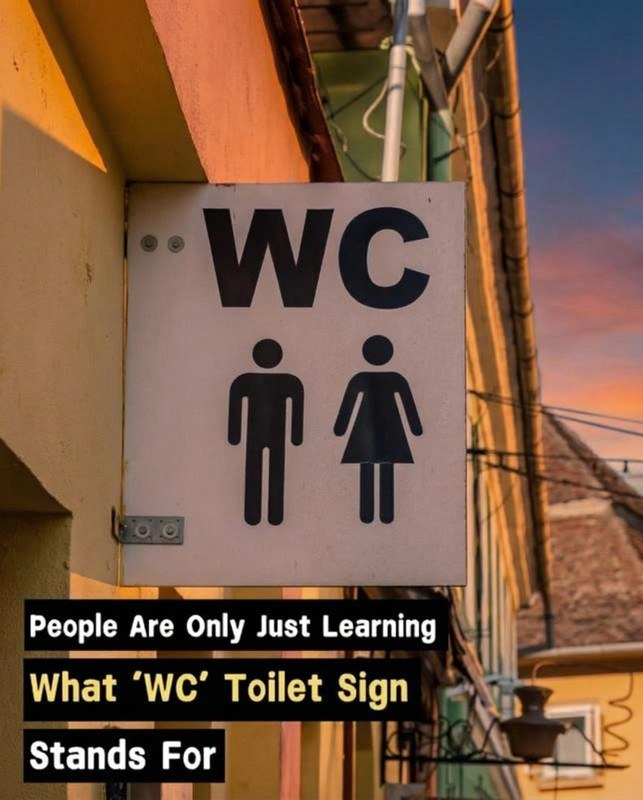
Almost everyone has come across it at least once while traveling—usually in a rush and with a brief moment of hesitation: the letters “WC” displayed on a restroom door. You pause, recognize that it signals something familiar, and keep walking. Yet behind those two simple letters lies a surprisingly rich history shaped by culture, language, technology, and social norms. What appears to be a plain, practical sign is actually a quiet reminder of how societies adapt language to everyday needs.
Across the world, the same type of space is labeled in very different ways. In the United States, people typically say “bathroom” at home and “restroom” in public places. Canadians often use “washroom.” In the UK, “loo” is casual and widely accepted. Meanwhile, in airports, hotels, and train stations throughout Europe, Asia, and parts of Africa, “WC” is far more common. All these terms point to the same function, yet none describe it very directly—which is part of what makes them interesting.
People don’t usually rest in a restroom, bathe in a public bathroom, or wash much more than their hands in a washroom. Language doesn’t always aim for literal accuracy. Instead, it evolves to sound polite, indirect, or socially acceptable. When it comes to toilets, this tendency becomes especially clear. Societies often prefer softer or vaguer terms to avoid addressing an uncomfortable topic too directly.
A humorous exchange that circulated online highlighted this perfectly. A couple jokingly questioned restroom terminology, pointing out how little the words match the actions. Their lighthearted confusion resonated with many viewers who had experienced similar moments while traveling—asking for a washroom in a country where the term isn’t used, or hesitating briefly in front of a “WC” sign while translating it mentally. These moments show how deeply ingrained regional language habits are, and how unfamiliar labels can feel surprisingly formal or foreign.
So what does “WC” actually mean?
The answer comes from history. “WC” stands for “water closet,” a term that dates back to the early development of indoor plumbing. Before modern sanitation became common, toilets were not standard inside homes. When they were introduced, they were often placed in small, enclosed rooms separate from bathing or living areas. These rooms contained a water-flushed toilet—a major technological advance at the time—and were known as water closets to distinguish them from outdoor toilets or chamber pots.
Originally, the word “closet” referred to a small private room, not a storage space. A water closet was literally a private space dedicated to a water-based sanitation system. At the time, this represented progress, cleanliness, and modern living. As plumbing became widespread, the term entered everyday language and was eventually shortened to “WC” on signs for simplicity and convenience.
Although “water closet” may sound old-fashioned today, the abbreviation remains practical. “WC” is short, neutral, and easy to recognize across languages. In international spaces—airports, hotels, shopping centers, and transportation hubs—clear communication matters. Two letters can convey meaning without relying on regional slang or English proficiency. From a design and navigation standpoint, “WC” is efficient and widely understood.
Its continued use also reflects changes in architecture and daily life. In the past, bathing areas and toilets were separate by necessity. Bathrooms were used for washing, while toilets were located elsewhere. As indoor plumbing advanced, these spaces were combined for convenience, creating the modern bathroom. Still, the language didn’t fully catch up. Older terms stayed in use, even as their original distinctions faded.
In some regions, “WC” still refers specifically to a room with only a toilet, separate from a full bathroom with a sink or shower. This distinction appears in floor plans, property listings, and architectural design, especially in Europe and parts of Asia. In real estate and luxury housing, labeling a space as a “WC” versus a full bathroom can signal efficiency, layout planning, and functional design.
Politeness also plays a role. In many cultures, discussing bodily functions openly has long been considered inappropriate. As a result, indirect language developed. “Restroom” avoids mentioning toilets altogether. “Bathroom” emphasizes cleanliness. “Washroom” focuses on hygiene. “WC,” by contrast, is neutral and clinical, avoiding discomfort by using an abbreviation rather than a description.
Bathroom terminology can even reflect social class and history. In older European homes, having a water closet was once a sign of wealth and modernity. Today, certain labels still carry subtle signals. A restaurant sign marked “WC” may feel more formal or international, while a hotel listing “en-suite WC” suggests European design sensibilities. In contrast, “full bathroom” conveys a different expectation in North American contexts.
Despite all these variations, the purpose remains universal. Whether it’s called a bathroom, restroom, washroom, loo, or WC, the space exists to serve a basic human need. The differences in wording don’t divide people—they quietly connect them, revealing how shared experiences are shaped by culture and language.
In an increasingly globalized world, shaped by travel and cross-cultural interaction, “WC” has become a kind of linguistic bridge. It doesn’t belong to any single country or dialect. It simply works. That practicality is why it has endured.
The next time you see those two letters on a door, you’re seeing more than a sign. You’re seeing the traces of technological progress, social etiquette, architectural change, and linguistic compromise—compressed into a simple, universally understood symbol. It’s a reminder that even the most ordinary parts of daily life carry stories shaped by history, habit, and our shared desire to speak comfortably about uncomfortable things.