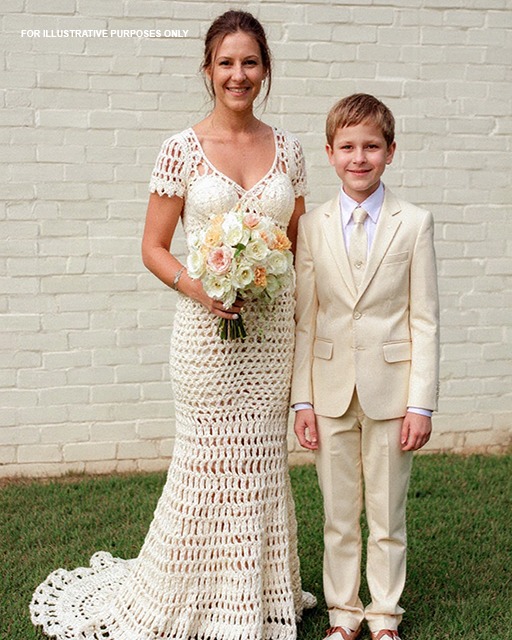
I never expected a ball of yarn to change anything in my life—let alone everything. But that was before my wedding dress, before the long months my son spent curled up on the couch with a crochet hook, and before the moment my mother-in-law shattered him with a few careless, cutting words. And it was before my husband reminded me, with quiet intensity, what kind of man he truly was, what kind of father and partner he had always been beneath the surface of ordinary days.
My name is Marissa, and my husband’s name is Joel. We had been planning our small backyard wedding for months—nothing lavish, nothing extravagant, just something intimate, filled with meaning, family, and the warmth that we always tried to bring into our home. We had envisioned a day that reflected us, a day that could feel timeless and personal without succumbing to unnecessary extravagance. I had a simple dress in mind: something soft and flowing, maybe with lace around the sleeves, a gown that would let me move freely and feel like myself. I had even pictured myself walking down the aisle barefoot, grass brushing my toes, sun falling gently on the backyard filled with eucalyptus garlands and white roses. But when I mentioned the dress one evening, while clearing the dishes after dinner, I had no idea that someone had been listening.
My ten-year-old son, Callen, had always been the artistic one in our house. He was not the rough-and-tumble, high-energy type that people often assumed all boys must be. He wasn’t drawn to sports or loud activities; he was quiet, thoughtful, contemplative. He noticed the smallest details, the subtle shifts in mood, the way sunlight hit a wall at a particular angle, or how colors blended unexpectedly in a drawing. His imagination was vast, his patience beyond his years, and his creativity could turn ordinary things into something magical. He liked to draw, paint, and build things from scraps he found in the garage. He was gentle, meticulous, and above all, deeply intentional about the things he chose to invest his energy in.
But crochet? That had been a surprise.
It all started innocuously. While I worked late shifts at the clinic, Callen spent afternoons with our neighbor, Mrs. Weston. She was in her seventies, a retired art teacher who had dedicated her life to encouraging children to explore their creativity. Each day with her was an opportunity to experiment: one day it might be watercolor painting, the next, clay sculpting. Sometimes, it was as simple as learning to fold paper in unusual ways or to mix colors to see what emerged. One afternoon in early spring, he returned home carrying a tiny, uneven crocheted square.
“It’s supposed to be a coaster,” he said, sheepishly holding it out. The yarn was navy, slightly twisted, and the square wobbled where the stitches didn’t line up perfectly.
“It’s perfect,” I said without hesitation, taking it from him as if it were a priceless gem.
His cheeks flushed as he always did with praise, but I could see it—the spark in his eyes, that little fire of determination that had been flickering for years. And the next day, he returned with another square, slightly larger, slightly neater. And the day after that, a little hat. Mrs. Weston chuckled, telling me that Callen had taken to crochet faster than any student she had ever taught in her decades of experience.
And then, one quiet evening, as I was scrolling through potential dress styles online, he approached me holding a skein of soft ivory yarn.
“Mom,” he said hesitantly, “could I… maybe try to make your wedding dress?”
I blinked, startled. “My… wedding dress?”
His nervousness was palpable; his eyes shimmered, almost afraid of my reaction.
“I know it sounds silly,” he said quickly. “You can say no. I just thought… since you said you wanted something simple and lacy, I thought maybe if I practiced a lot, I could try. It might not be perfect, but—”
I put my hands gently on his small shoulders, feeling a rush of warmth and love that made my chest ache.
“I would be honored,” I whispered.
From that night on, Callen dedicated himself to crochet with a level of focus I had never seen before. Each evening, he would sit curled up in the armchair, eyes narrowed, tongue peeking from the corner of his mouth as he concentrated. Tutorials played on his tablet, notes were scribbled into a notebook, mistakes were unraveled and carefully stitched again. Over five months, stitch by stitch, row by row, motif by motif, he built the dress of my dreams. The process became a part of our lives. The rhythmic sound of yarn sliding through his fingers became as familiar as the hum of the washing machine or the chatter of the birds outside our window.
I watched him silently sometimes, struck by the strange, beautiful way love could manifest—not in grand gestures, but in patience, dedication, and the persistent hands of a ten-year-old boy who simply wanted to make something meaningful for his mother.
When the dress was finished, it was nothing short of miraculous. Soft ivory flowed in delicate, interconnected patterns, a lacy tapestry of petals and vines. It wasn’t stiff or traditional; it seemed to move with a life of its own, warm and personal, imbued with the love that had created it. When I tried it on, tears fell freely.
“It’s beautiful, sweetheart,” I whispered to him. “I’ve never seen anything like it.”
Callen beamed, and Joel, standing behind me, wrapped one arm around my waist and the other around our son’s shoulders.
“This,” he said quietly, “is love made visible.”
We laughed and cried at the same time, overwhelmed by the magnitude of something so small in its beginnings—a single skein of yarn—becoming so extraordinary.
I wish the story had ended there.
Three days before the wedding, I invited my mother-in-law, Teresa, over to see the setup. The backyard was a bloom of white roses, eucalyptus garlands, and tables draped with rented linens. I was naive to hope that she would see what I saw: the extraordinary love and patience of my son, the care that had gone into every stitch.
Callen practically vibrated with anticipation. He bounced lightly on his heels, a mix of nerves and excitement.
Teresa walked in carrying a bag of mason jars and tealight candles, her face bright with the polite warmth she usually wore when visiting us. She kissed Callen on the cheek and set her things down on the dining table.
“So,” she said, “you said you had something special to show me?”
“Yes,” I said, smiling, “the wedding dress. And you’re not going to believe who made it.”
Callen stepped forward proudly.
“I did, Grandma,” he said, chest swelling with pride.
Teresa blinked, incredulous.
“You… made the dress?”
He nodded.
“Do you want to see it?” he asked, carefully holding it in both hands as if it were made of glass.
Teresa stared at it for a long moment, and then—she laughed. Not a small giggle or polite chuckle, but a full, incredulous laugh.
“Oh my goodness,” she said between breaths, “it looks like a tablecloth!”
Callen froze, shock and hurt flashing across his face.
“You’re really going to wear this?” she continued. “It looks like something you’d drape over a picnic table.”
I felt my stomach drop. I opened my mouth, but words failed me. Callen whispered, voice trembling, “It’s crochet… I made it for Mom.”
“Yes, dear, I see that,” she said dismissively. “But crochet? For a wedding dress? Boys shouldn’t waste time with yarn. That’s a hobby for old ladies…”
Before she could finish, Callen let the dress slip from his fingers. It fell to the floor. He fled the room in tears.
I rushed after him instinctively, but Joel was already in the hallway. He found Callen curled up on the floor, sobbing, hands over his face.
“He hates it,” Callen choked out. “He hates it. I shouldn’t have—”
Joel knelt beside him, pulling him into his arms without a word, holding him as he had when he was small.
“It’s beautiful,” Joel said fiercely. “Nothing she says will ever change that.”
I stood in the doorway, witnessing the raw, protective love pouring from my husband, a love that refused to let anyone harm our son emotionally.
When Teresa tried to interject, Joel turned to her, voice steady but sharp.
“Mom,” he said, “you need to leave. You humiliated him. You mocked months of work. You cannot be part of our wedding if you cannot respect him.”
Silence fell, thick and heavy. Eventually, Teresa slumped and apologized, both to us and to Callen directly. He accepted it cautiously, the tension easing but never forgotten.
On our wedding day, I slipped into the dress carefully, reverently. As I stepped into the backyard, all eyes turned. Whispers of awe passed among our guests. And when asked where the dress came from, I simply pointed to Callen.
He stood a little taller each time, pride radiating from him in quiet, steady waves.
During the ceremony, I caught sight of Teresa wiping her eyes. Perhaps finally, she saw him—really saw him.
After the vows, as golden sunlight spilled over the yard, Joel wrapped his arm around me.
“You look beautiful,” he whispered.
“This dress,” I said softly, “means more than anything money could buy.”
“I know,” he said, smiling down at our son laughing with cousins near the buffet. “Because love made it.”
I leaned into him, feeling the depth of what we had built together: not just a wedding, not just a home, but a family where love, patience, and protection mattered above all.
I realized then, in the warmth of that golden light, that I had married not only a good man but a man who would stand between our son and the world.
A man who protects what is gentle.
A man who knows what truly matters.
A man I love more fiercely every day.
And beneath the soft crochet lace of my wedding dress—the dress my son had made stitch by stitch—I carried that love with me. Always.