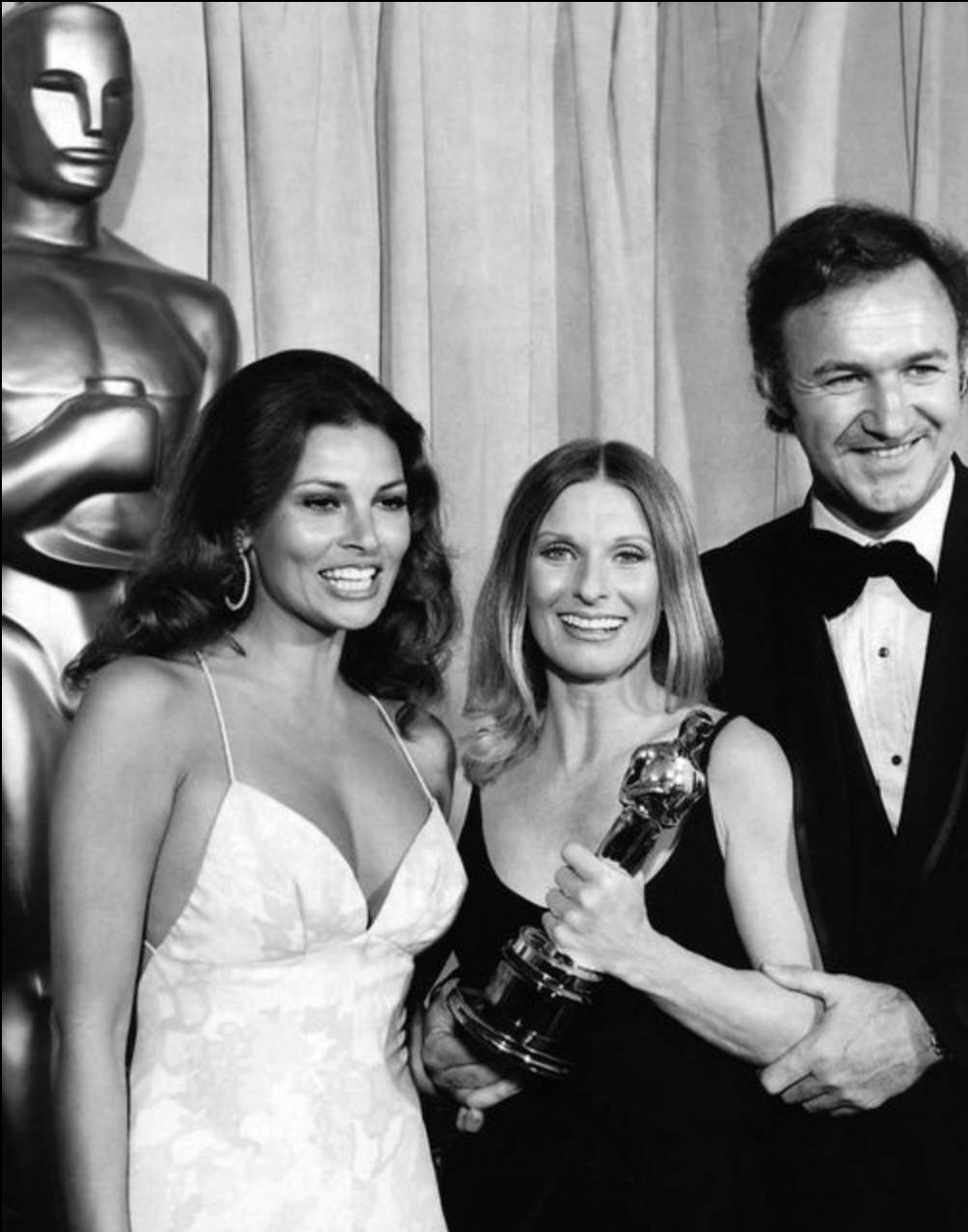
The room shook before anyone fully realized that history was quietly, irrevocably happening. The velvet curtains, the polished chandeliers, and the gleaming golden statuettes all whispered the kind of glamour audiences expected from Hollywood’s grandest night, but this was no ordinary evening. Old Hollywood arrived in impeccable tuxedos and gowns, faces carved with the patina of decades spent on screens that had shaped the public imagination. They brought with them the grace, polish, and ritualized elegance that had defined film culture for generations. And then, without warning, New Hollywood barged in—the era of grit, of rebellion, of messy ambition—shattering expectations with attitudes that were sharper than the tail of any Oscar-winning dress. There was a tension in the air, electric and unnameable, as if the room itself sensed that the old rules were being rewritten, that history was not just being celebrated but lived.
Gene Hackman’s presence alone was enough to anchor the night’s seismic tone. He moved with a quiet authority, every glance and subtle smirk a reminder that storytelling could be dangerous, morally ambiguous, and compelling. Beside him, Isaac Hayes—a man whose music was as revolutionary as his persona—radiated a confidence that transcended the usual Hollywood polish. Then, as if to punctuate the evening with something both surreal and sacred, Charlie Chaplin walked onto the stage, the ghost of cinema’s silent era made flesh. His body, frail yet animated with years of hard-earned charm, commanded attention without effort. Each step, each gesture, carried the weight of decades, of artistry that had survived wars, persecution, and the relentless march of time. When Chaplin raised his hand, the room erupted—not out of obligation, not out of formality, but from a collective acknowledgment of what he represented: the bridge between Hollywood’s mythic past and the restless, raw, exhilarating present.
This wasn’t merely an awards ceremony. The 44th Academy Awards of 1972 became a fulcrum in film history, a night when the polished veneer of show business cracked to reveal the tectonic shifts below. The triumph of The French Connection sent a message louder than any speech or music cue: Hollywood was hungry for realism, for danger, for stories that didn’t just entertain but unsettled, provoked, and interrogated the very structures of society. At the same time, films like The Last Picture Show, A Clockwork Orange, and Fiddler on the Roof demonstrated that serious cinema had fractured into multiple directions. No longer confined to traditional morality tales or neat narratives, these films explored the spectrum of human experience in ways that demanded audience engagement, reflection, and sometimes discomfort.
Even outside the Dorothy Chandler Pavilion, the pulse of the nation made itself felt. Protesters carried placards, chanting in rhythm with societal unease, reminding everyone that cinema could not exist in a vacuum. This was a country grappling with war, civil rights, generational conflict, and cultural upheaval, and the Oscars that night, whether intentionally or not, mirrored the uncertainty, tension, and promise of the broader moment. Inside, the show oscillated between performance and real emotion, never allowing the two to separate completely. When Isaac Hayes transformed a Blaxploitation anthem into an Oscar-winning performance, it wasn’t just a musical moment—it was cultural commentary, a claim staked firmly in a space long denied to Black artists in mainstream Hollywood.
And then came Chaplin. Time seemed to pause. The room collectively exhaled as applause built, unbroken, stretching into the kind of ovation that would become legend. It was not simply admiration for a man; it was recognition of a lifetime, a reminder that every frame, every story, every silent expression of laughter and sorrow carried the weight of decades of human endeavor. The applause became a living bridge between eras, connecting the ghosts of silent film, the golden age, and the uncharted future of the industry. Chaplin, fragile yet commanding, embodied the tension of the night: a world rooted in nostalgia yet propelled by unstoppable change.
The evening unfolded as a dance of contrasts. There were speeches that touched on social change, on personal triumph and pain, and on the responsibility of storytellers to reflect and challenge society. There were moments of levity, as the glamour and wit of Old Hollywood collided with the irreverence of New Hollywood. The tension was palpable, but so was the exhilaration—the sense that something essential was being rewritten. The awards themselves, the statuettes handed to deserving actors, writers, and directors, were secondary in significance. What the 44th Academy Awards truly celebrated was a metamorphosis: a film industry caught mid-molt, oscillating between the world it mourned and the one it could no longer avoid.
Looking back, the night stands as more than a historical footnote. It is a symbol, a crystallized moment when the glitz of Hollywood could not hide the raw, electric pulse of change. It reminds us that cinema is alive, constantly reshaping itself, and that the most profound impact of film is not in glittering ceremonies but in the way it mirrors and challenges the society from which it emerges. The 1972 Oscars captured this perfectly: a world on the cusp, where music, acting, and story collided to create a space that was not only celebrated but remembered, studied, and revered. It was a night when Hollywood paused long enough to honor the past while acknowledging that the future would be unrecognizable, unstoppable, and, above all, brilliant.