Some stories last because they’re clever; others endure because they quietly reveal something human beneath the humor. These old-fashioned jokes, passed down like well-worn tools, do both. They don’t depend on trends or shock value—they succeed because timing, logic, and human nature never go out of style.
Take the old farmer and the state trooper.
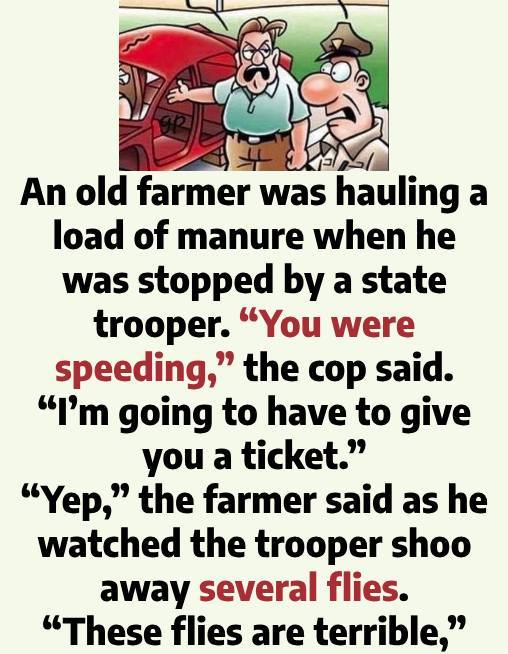
The farmer was doing what farmers have done for generations—hauling a load of manure down a country road, minding his own business, moving at a pace dictated more by experience than speed limits. That’s when the flashing lights appeared. A state trooper pulled him over, stepped out, and delivered his verdict without ceremony.
“You were speeding,” the trooper said. “I’m going to have to give you a ticket.”
The farmer didn’t argue or plead. He simply nodded. “Yep.”
As the officer wrote the ticket, he swatted at flies buzzing relentlessly around the manure truck, landing on his hat, his arm, and his notepad.
“These flies are terrible,” he muttered.
“Yep,” the farmer replied calmly. “Those are circle flies.”
The trooper frowned. “Circle flies?”
“Yep,” said the farmer. “The flies that circle a horse’s rear. Them are circle flies.”
The trooper stiffened. “You wouldn’t be calling me a horse’s rear, would you?” he snapped.
The farmer looked him straight in the eye. “Nope. But you just can’t fool them flies.”
It’s humor that lands softly and then sinks in—subtle, sharp, and devastating without raising its voice. Rural wit at its finest.
The same understated intelligence appears in another classic, this time in a classroom.
A student, Jacob, asked his teacher a question with complete seriousness:
“How do you put an elephant in the fridge?”
The teacher paused. “I don’t know. How?”
“You open the door and put it in,” Jacob answered confidently.
She laughed, thinking the moment was over. But Jacob wasn’t done.
“How do you put a giraffe in the fridge?”
The teacher smiled. “I know this one. You open the door and put it in.”
Jacob shook his head. “No. You open the door, take the elephant out, and then put the giraffe in.”
Now she was paying attention.
“All the animals went to the lion’s birthday party. One animal didn’t go. Which one?”
“The lion?” she guessed.
“No,” Jacob said. “The giraffe. He’s still in the fridge.”
Finally, he asked, “There’s a river full of alligators, and you need to get across. How do you do it?”
“Walk across the bridge?” she answered cautiously.
“No,” Jacob said with a smile. “You swim across. All the alligators are at the lion’s party.”
The punchline lands—not because it’s loud, but because it’s consistent. The humor isn’t just in the answer; it’s in the logic, the discipline, and the satisfaction of seeing someone outthink authority with nothing but patience and reasoning.
These jokes endure because they mirror real life. The farmer doesn’t confront power directly; he lets reality speak. Jacob doesn’t mock; he follows logic further than anyone expects. Both reward attentiveness over force.
In a world dominated by viral content, short attention spans, and instant gratification, these stories feel almost luxurious. They take their time, trust the audience, and assume intelligence rather than demanding laughter.
They’re comforting because they don’t rely on cruelty or spectacle. They gently expose arrogance, reward curiosity, and remind us that cleverness doesn’t require malice.
Today, amid algorithm-driven entertainment and extremes, there’s renewed interest in traditional humor, clean jokes, and smart storytelling that transcends generations. Shared between grandparents and grandchildren, coworkers and friends, teachers and students, these stories survive because they are flexible, universal, and rooted in human behavior.
Whether it’s a farmer on a back road or a student in a classroom, the lesson is the same: pay attention, think things through, and never assume authority equals wisdom.
That’s the quiet power of stories like these. They don’t chase relevance—they earn it.