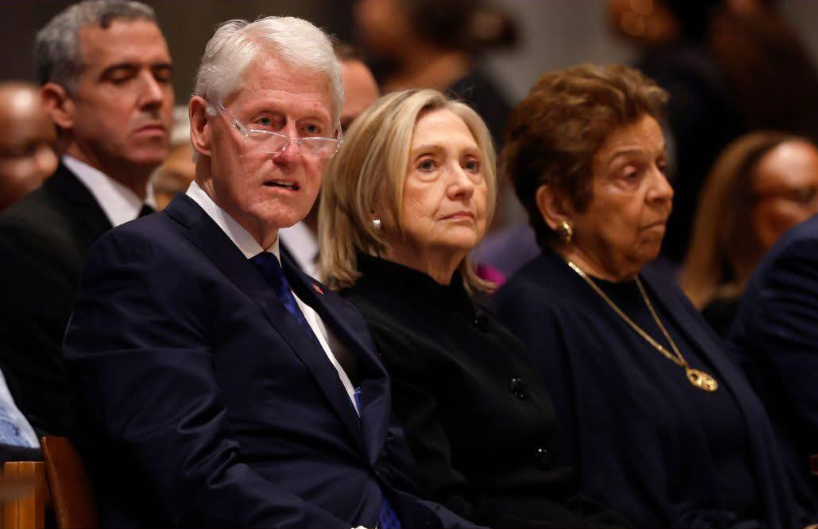
The political landscape in Washington has reached a boiling point as the House Oversight Committee intensifies what many observers are calling one of the most volatile and consequential investigations in recent memory. At the center of this escalating storm are former President Bill Clinton and former Secretary of State Hillary Clinton, both now confronting the real possibility of being held in contempt of Congress. After nearly four months marked by procedural disputes, stalled negotiations, and mounting frustration, Committee Chairman James Comer has made it clear that patience has worn thin. His recent statements signal a firm pivot away from informal cooperation and toward aggressive legal enforcement, raising the temperature of an already charged political environment.
The backbone of the inquiry lies in the Clintons’ long-documented historical associations with the late financier Jeffrey Epstein. While these connections have circulated in public discussion for years, the committee’s current effort goes well beyond rumor or speculation. Investigators are now immersed in a painstaking review of tens of thousands of digital files, photographs, travel documents, and physical records recovered from Epstein’s extensive estate. This material is being systematically analyzed to identify patterns of movement, timelines of interaction, and communication networks, as well as any evidence suggesting coercion, influence, or leverage over prominent individuals. The scope and depth of this forensic review represent a level of scrutiny that previous investigations never fully achieved.
Importantly, the probe is not confined to the Clintons alone. The Oversight Committee has deliberately widened its reach, issuing subpoenas to an unusually broad and bipartisan group of current and former officials. Among those drawn into the investigation are former attorneys general from different administrations, past FBI directors, and senior law enforcement figures who once held key decision-making authority. This expansive approach reflects a growing consensus within the committee that Epstein’s operations were not isolated incidents but part of a broader systemic failure. The investigation has increasingly come to be viewed not as a partisan maneuver, but as an institutional reckoning with how such a network could exist, operate, and remain shielded within the highest levels of American power for so many years.
Behind closed doors, the strain of the investigation is reportedly exposing deep divisions within federal institutions themselves. Accounts from inside Washington describe tense and sometimes explosive confrontations between competing factions of the law enforcement and intelligence communities. One particularly notable dispute allegedly involved FBI Assistant Director Dan Bongino and centered on a controversial memorandum tied to the long-rumored existence of an Epstein “client list.” These clashes underscore a deeper conflict over transparency and accountability, as agencies grapple with how much information should be released, what must remain classified, and who ultimately controls that decision.
For the Clintons, this moment represents a critical stress test of the political resilience that has defined much of their public life. In the past, they have weathered numerous investigations and controversies, often emerging without lasting legal consequences. This time, however, the circumstances are different. The inquiry is driven by a massive cache of physical and digital evidence that was unavailable during earlier periods of scrutiny. The Oversight Committee has repeatedly emphasized its intent to follow the documentary trail wherever it leads, regardless of political stature, party affiliation, or legacy.
As the committee edges closer to a potential contempt vote, the stakes for everyone involved continue to rise. Additional disclosures are expected in the coming weeks as investigators process more of the Epstein estate records and cross-reference them with testimony and subpoenaed documents. Whether the investigation ultimately results in concrete legal action or becomes a prolonged political standoff, its impact is already undeniable. It has once again forced public attention onto the shadowy intersections of wealth, influence, and governance, and raised uncomfortable questions about how power is exercised—and protected—at the very top of the American system.