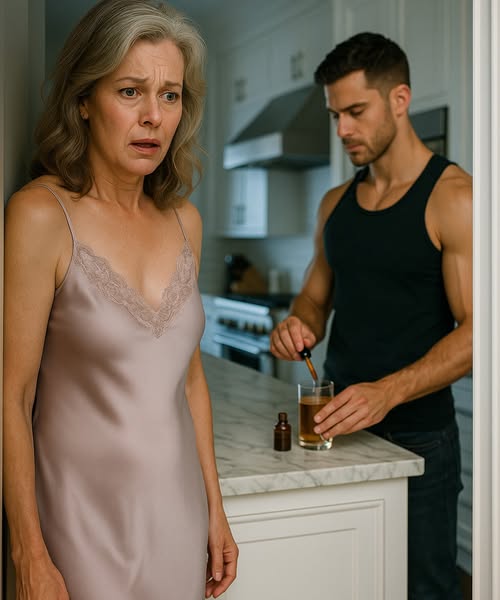
My name is Lillian Carter, and the year I turned fifty-nine, I committed what many of my peers considered an act of late-life madness: I married a man thirty-one years my junior. Ethan Ross was not the volatile, impulsive youth the world expected him to be. When we met in a sun-drenched yoga studio in San Francisco, a place that perpetually smelled of rain-dampened earth and lavender, he seemed to possess a preternatural stillness. I was a recently retired teacher, weary from decades of service and hollowed out by the lingering silence of widowhood. Ethan, however, was different. He was the calm after a storm I feared would never end, the kind of peace I hadn’t known I needed.
From our first encounter, Ethan was the architect of a life that felt effortlessly light. He was disarmingly kind, moving through my townhouse with a gentle grace that made the shadows of my grief retreat. While my friends whispered warnings about “fortune hunters” and “lonely hearts,” I pointed to the reality of our domestic life. Ethan never asked for access to my inheritance or the deed to my coastal villa. Instead, he gave. He was the man who folded the laundry into perfect squares, who massaged the tension from my shoulders, and who filled the house with the scent of slow-simmered meals.
Our nights always ended with a specific, tender ritual. Ethan would appear at my bedside with a glass of warm water infused with honey and chamomile. “Drink it all, sweetheart,” he would murmur, his voice a soothing velvet. “You’ve worked so hard. I can’t rest until I know you’re sleeping soundly.” I called him my protector; he called me his little wife. For six years, I leaned into that softness, convinced I had found a rare sanctuary where age was irrelevant and devotion was absolute. I trusted him completely.
But the human instinct for survival is a quiet thing, often drowned out by the noise of our desires. One evening, Ethan stayed in the kitchen to prepare “herbal desserts” for his friends. I retired early, but sleep eluded me. A sudden, cold prickle of intuition—a “look again” moment—compelled me to slip from the bed. I moved like a ghost down the hallway until I reached the kitchen door.
There, in the soft glow of the stovetop light, I saw the man I loved performing a different kind of ritual. He poured the water, stirred in the honey, and then reached into a hidden corner of a drawer to produce a small, amber bottle. With clinical precision, he tilted it. One, two, three drops fell into the glass. He stirred it again, his face wearing the same calm, careful smile he gave me every morning. My heart hammered against my ribs, a trapped bird in a cage of sudden, terrifying clarity. I retreated to bed and feigned sleep. When he brought the glass, I managed a faint smile and told him I’d finish it once I felt drowsier. As soon as his breathing deepened into sleep beside me, I funneled the liquid into a thermos and hid it in the depths of my closet.
The next forty-eight hours were a blur of clinical white walls and whispered consultations. I took the sample to a private toxicology lab. When the doctor finally sat me down, his expression was grim. “Mrs. Carter,” he began, “this isn’t an herbal supplement. This is a potent, unprescribed sedative. Taken over six years, it explains the intermittent memory fog and the chronic lethargy you’ve reported. It wasn’t designed to help you sleep; it was designed to keep you subdued.”
The world as I knew it collapsed. The warmth of the last six years was revealed to be a chemical illusion, a slow-motion theft of my autonomy disguised as a grand romance. That night, I sat in bed, the untouched glass on the nightstand between us. When Ethan noticed it, his eyes—usually so soft—sharpened into something cold and predatory.
“Why haven’t you finished your water, baby girl?” he asked. The nickname, once so sweet, now felt like a shackle.
“I’m not sleepy tonight, Ethan,” I replied, my voice steadier than I felt.
“You’ll feel better if you drink it,” he insisted, leaning closer. “Trust me.”
For the first time, I saw the shadow behind the gentleness. It was the face of a man who didn’t want a partner, but a captive—a high-end piece of property that didn’t talk back or ask questions.
The following week was a strategic masterclass in reclaiming a life. Under the guidance of a lawyer, I transferred my accounts, changed the locks, and secured the amber bottle as evidence. When I finally confronted him, I didn’t scream. I simply laid the laboratory report on the kitchen island.
“The doctor tested the tea, Ethan,” I said. “It’s filled with sedatives.”
He didn’t flinch. He didn’t even deny it. Instead, he looked at me with a profound, chilling disappointment, as if I were a child who had broken an expensive toy. “You don’t understand, Lillian,” he sighed. “You think too much. You worry. I just wanted to keep you calm. You were happier when you weren’t so… present.”
“You didn’t want me happy,” I countered. “You wanted me absent.”
Ethan vanished shortly after the annulment was finalized. He left no forwarding address and no apologies, moving on to find a new “storm” to calm with his amber bottles and lavender-scented lies. But while he was gone, the residue of his deception remained. The recovery wasn’t just about clearing the chemicals from my system; it was about rebuilding a fractured sense of self.
Now, at sixty-two, I live permanently in my beach villa. The Pacific Ocean, with its honest, crashing power, is my only companion. I’ve turned my trauma into a curriculum, teaching yoga to women over fifty. We don’t just focus on the flexibility of the body, but on the strength of the spirit—the ability to set boundaries that are as immovable as the cliffs. I teach them that kindness without honesty is merely a manipulation, and that care without freedom is just a prettier word for control.
Sometimes, a student will see the silver of the waves reflected in my eyes and ask if I still believe in love. I smile, take a deep breath of the salt air, and tell them that I believe in love more than ever. But I’ve learned that true love isn’t something someone gives you to make you feel small or safe. True love is the one thing that never takes your freedom away.
Every evening, I still make a glass of warm water with honey and chamomile. I stand by the window, watching the moonlight dance on the tide, and I stir it myself. I raise the glass to my reflection—to the woman who survived, the woman who learned, and the woman who finally woke up.