For years, I harbored the comfortable delusion that I knew my daughter’s soul as well as I knew the layout of our own home. After a bruising divorce, it had been just the two of us in our quiet Massachusetts house—a sanctuary of calm mornings, shared dinners, and the predictable rhythms of a life rebuilt. My thirteen-year-old daughter, Lily, was the pillar of that peace. She was polite, academically disciplined, and seemingly immune to the turbulent rebellions of adolescence. I told myself I was lucky. I told myself that because she never caused trouble, there was no trouble to be found. I was living in a masterpiece of parental denial.
The first crack in the glass appeared on a mundane Thursday morning. As I jingled my car keys, heading out for my commute, my elderly neighbor, Mrs. Greene, signaled me from across the driveway. Mrs. Greene was a woman whose primary occupation was the quiet observation of our street’s geography. She noticed the arrival of the mail, the departure of the trash, and the subtle shifts in the neighborhood’s pulse.
“Olivia,” she said, her voice dropping to a conspiratorial whisper that chilled me. “Is Lily coming home early from school again?”
The word “again” landed like a physical blow. I forced a smile that felt tight and artificial. “No, Mrs. Greene. She’s at school all day. You must have seen a neighbor or a delivery person.”
Mrs. Greene hesitated, her eyes searching mine with a pity that made my stomach turn. “I’ve seen her, Olivia. During school hours. And she’s not always alone.”
I drove to work in a fog, the engine’s hum sounding like a low-frequency warning. Throughout the day, I replayed the last few months of Lily’s life. I saw her through a new, harsher lens: the way she had become increasingly quiet, the way she pushed food around her plate without eating, and the persistent, heavy exhaustion that hung over her like a shroud. I had attributed it all to hormones and the general malaise of being thirteen. Now, I realized I had been ignoring the smoke while the house was beginning to smolder.
That evening, I watched Lily across the dinner table. When I asked about her day, she offered the usual, “Fine.” When I casually mentioned Mrs. Greene’s “confusion” about seeing someone who looked like her at the house, Lily laughed. It was a perfect, melodic sound, but it arrived exactly one second too late. Her eyes remained flat, devoid of the mirth her mouth was mimicking. By 2:00 a.m., as I stared at the ceiling fan’s shadows, I knew I couldn’t simply ask her for the truth. She had become too adept at protecting me from it.
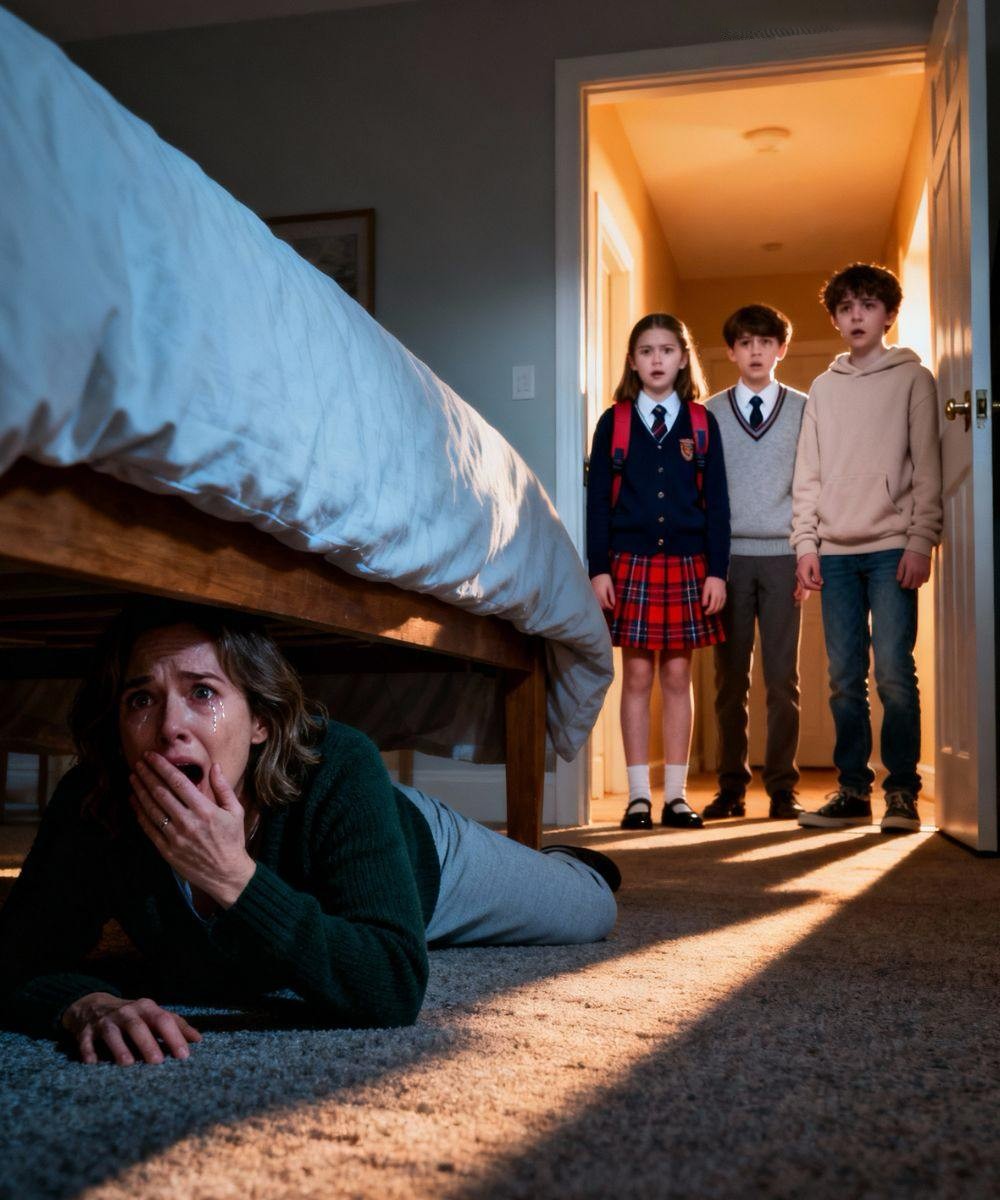
The next morning, I performed the familiar theater of our routine. I kissed her goodbye, listened to the school bus rumble down the street, and waited until the neighborhood fell into its mid-morning lull. Instead of driving to the office, I parked three blocks away and slipped back into the house through the basement door. My heart thundered against my ribs, a frantic, accusing rhythm. I crept into Lily’s bedroom and, driven by a desperate, illogical urge to be a fly on the wall, I slid beneath her bed.
The dust motes danced in the slivers of light. At 9:00 a.m., there was nothing but the hum of the refrigerator. At 9:20 a.m., I felt a wave of shame so profound I almost crawled out. I was a mother spying on a child who had never given me a reason to doubt her. Then, I heard the front door click open.
There were footsteps—soft, hesitant, and multiple. They weren’t the heavy, arrogant thuds of teenagers looking to party. They were the hushed, careful movements of people trying to disappear.
“Quiet,” I heard Lily whisper. “The neighbor is always watching.”
I held my breath, my face pressed against the hardwood floor. They entered Lily’s room. I could see several pairs of sneakers—worn-out Vans, scuffed Nikes, and a pair of boots held together by silver duct tape. They sat on the floor and the edge of the bed, the mattress sagging just inches above my head.
“My dad was angry again this morning,” a boy murmured, his voice cracking. “I couldn’t go back there. I just couldn’t.”
“They pushed me into the lockers yesterday,” a girl whispered, followed by the jagged sound of a suppressed sob. “The teacher saw it happen and just kept walking. She just kept walking, Lily.”
“They took my lunch money and threw my bag in the trash,” another voice trembled. “Everyone laughed. I spent the afternoon in the bathroom stall so they wouldn’t find me.”
The realization hit me with the force of a tidal wave. These weren’t “bad” kids skipping class to smoke or rebel. They were refugees. They were a small, broken congregation of children who had found the one place in town where the world couldn’t reach them. My daughter hadn’t been truant; she had been running an underground railroad for the bullied and the battered.
“You’re safe here,” Lily said, her voice echoing the same soothing tone I used when she was a toddler. “My mom works late. She doesn’t know. We have at least six hours.”
“Shouldn’t you tell her?” the boy asked. “She seems nice.”
There was a long, agonizing pause. “I can’t,” Lily whispered, and her voice was the heaviest of them all. “When Dad left, she fought so hard to keep us afloat. I saw her crying in the kitchen every night for a year. She finally thinks we’re okay. She finally thinks she won. I can’t tell her that the world is still trying to break me. I don’t want her to hurt again.”
I couldn’t stay under the bed a moment longer. The weight of her protection was more than I could bear. I slid out, the movement causing the children to scramble back in terror. Lily froze, her face turning a ghostly, ashen white. She looked at me not with guilt, but with a profound, soul-deep exhaustion.
“Mom,” she breathed, her voice failing.
I didn’t yell. I didn’t lecture. I stood up, ignored the dust on my clothes, and opened my arms. Lily collapsed into me, a year’s worth of held breath finally escaping in a series of violent, racking sobs. The other children watched us, wide-eyed and trembling, like birds waiting to see if they should take flight.
“You don’t have to be the one who carries this,” I told her, my voice thick with my own tears. “Protecting you is my job, Lily. Not the other way around.”
That afternoon, our modest home became a different kind of sanctuary. I called the parents of every child in that room. Some were defensive, but many were as blindsided and heartbroken as I was. We gathered in the living room—a circle of adults who had been too busy surviving to notice that our children were merely enduring.
The stories that surfaced were a grim indictment of a school system that had allowed “boys being boys” and “girl drama” to mask systemic cruelty. We brought the proof. We brought the truth. And because we stood together, change—real, institutional change—began to move through the district like a slow but inevitable tide.
Months later, I walked past Lily’s room. She was on her bed, her laptop open, laughing at something a friend had sent her. It was a real laugh this time, one that reached her eyes. She looked up and saw me, and for the first time in a long time, there was no shadow between us.
“Real strength isn’t hiding the pain, Mom,” she said later that night as we tucked into a shared bowl of popcorn.
“No, it isn’t,” I agreed. “It’s having the courage to share it so you don’t have to face it alone.”