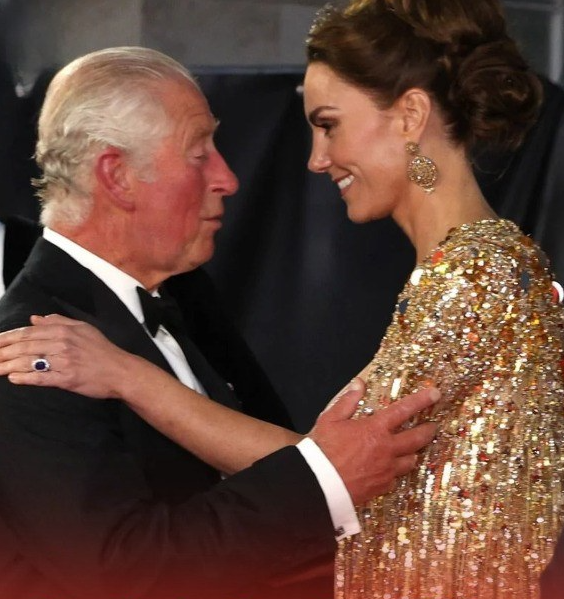
The corridors of Buckingham Palace have long echoed with the ghosts of eclipsing popularity. For decades, the central tension within the British monarchy has been the shadow cast by a spouse whose charisma outshone the crown itself. The most famous casualty of this dynamic was, of course, the late Princess Diana, whose radiant public persona famously sparked deep-seated jealousy in the then-Prince Charles. However, as the House of Windsor navigates the complexities of the modern era, King Charles III seems to have made a radical departure from his past. In a move signaling a profound evolution in both his character and reign, the King has reportedly given Kate Middleton his personal blessing to do the one thing he could never tolerate from Diana: to take center stage.
Royal experts and palace insiders have revealed that King Charles has officially sanctioned the Princess of Wales to assume a leading public role, effectively allowing her to “steal the limelight.” This marks no small concession for a man whose early life was marred by the sting of being sidelined during royal tours. In the 1980s, the world watched as a young Charles grew increasingly resentful of crowds that gathered, not for the future King, but for the fashion and flair of Princess Diana. Diana herself famously confirmed this friction in her 1995 Panorama interview, acknowledging how her popularity strained their marriage.
Yet, as the crown now rests upon his head, Charles seems to have recognized that the survival of the monarchy demands a shift in strategy. While initial reports suggested concern within the palace over Prince William and Kate’s surging popularity potentially overshadowing the King and Queen Camilla, the reality of 2025 presents a different perspective. Charles, now a seasoned monarch focused on legacy, appears to understand that Catherine is not a threat to his authority, but rather the monarchy’s most powerful asset.
Royal biographer Robert Jobson suggests that the King has reached a level of personal and professional maturity that enables him to embrace the limelight-stealing power of his daughter-in-law. Charles understands that, in order for the monarchy to remain relevant in a rapidly changing world, it must bridge the gap between ancient tradition and modern celebrity. While he holds the constitutional power, the natural focus of public adoration and media interest will inevitably gravitate toward the younger generation—the Wales family.
This evolving dynamic was perhaps most evident during Kate’s surprise appearance at the Chelsea Flower Show. While such an unannounced visit might have once been considered a breach of royal protocol—upstaging the principal royals of the day—it was instead met with an implicit nod of approval from the King. It was a strategic masterstroke, ensuring that the monarchy remained at the forefront of the national conversation, regardless of who was wearing the crown at that particular moment.
King Charles’s approval of Kate’s prominent role is rooted in the pragmatic need for the monarchy to adapt. The King is keenly aware that the institution must appeal to younger generations who feel little connection to the rigid hierarchies of the past. William and Catherine have mastered this modern landscape, utilizing social media to share polished, cinematic updates and behind-the-scenes glimpses of their philanthropic work. Their approach is less about the distance of “the firm” and more about the accessibility of a modern family. By allowing Kate to lead, Charles is essentially future-proofing the throne, ensuring that the public remains emotionally invested in the people who will one day occupy it.
Furthermore, this decision marks a shift in the internal family dynamics of the Windsors. Unlike the competitive atmosphere that defined the 1980s and 90s, the current relationship between the King and the Princess of Wales is one of mutual respect and shared responsibility. Kate has proven herself as a steady, unflappable presence, navigating her role with a grace that has earned the King’s genuine affection. In many ways, she has become the bridge between the old guard and the new—something Diana was never allowed to fulfill.
The King’s decision to let Kate shine also serves as a subtle act of redemption for his own past. By encouraging Catherine to take the spotlight, he is effectively breaking the cycle of jealousy that once tore apart his personal life. Charles is choosing to lead with wisdom rather than ego, prioritizing the stability of the crown over personal vanity. It is a sign of a King who is secure enough in his position to allow others to bask in the glow of public adoration without feeling diminished by it.
As we look toward the future of the British monarchy, King Charles’s blessing of Kate Middleton marks a pivotal turning point. It signals a transition from an era of competition to one of collaboration. The “limelight,” once a source of bitter contention, has now become a shared tool for the preservation of the House of Windsor. The King wears the crown, but he has entrusted the Princess of Wales with the heart of the people—a partnership that may very well be the key to the monarchy’s longevity.
In the end, Charles has learned a lesson that took decades to master: the sun does not lose its light by allowing the moon to shine. By giving Kate his blessing to be the face of the modern monarchy, he has ensured that, when the time comes for William to ascend the throne, he will do so with a consort already embraced by the world. It is a gift of grace, a legacy of foresight, and a quiet acknowledgment that the greatest strength of a leader is knowing when to let someone else lead the way.