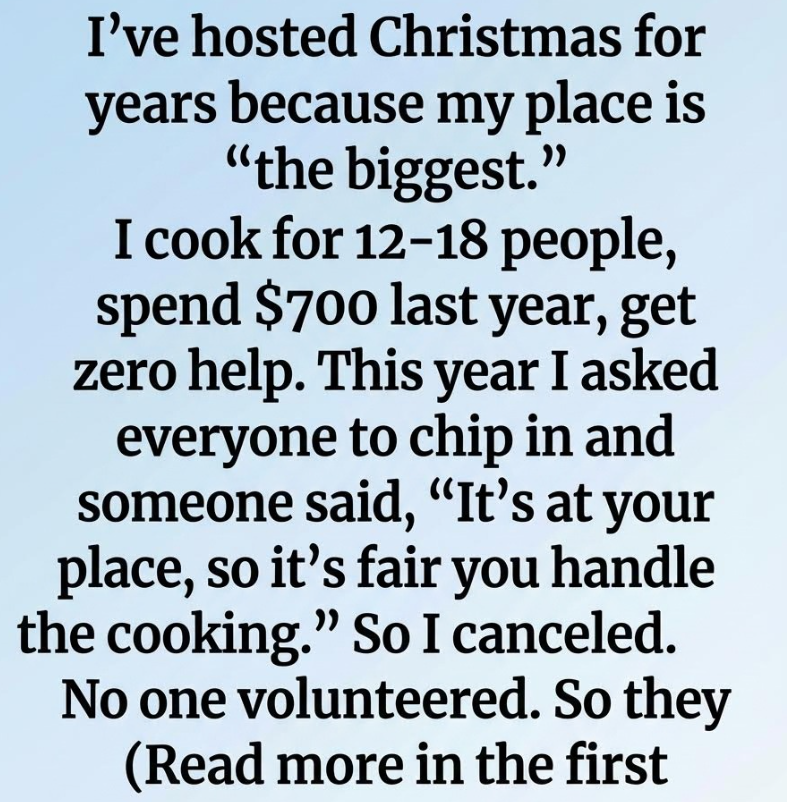
For many years, when December arrived, I felt a familiar, growing sense of fear rather than awe. In my extended family’s unwritten hierarchy, hosting Christmas had become a strict, unavoidable requirement rather than a choice. My house became the default venue for our yearly holiday show because it was the biggest and most conveniently located. I embraced the position year after year, rearranging furniture to make room for everyone, creating elaborate dinners, and spending weeks negotiating packed shopping aisles. The sight of a dozen or more relatives laughing around my table made the physical, financial, and emotional toll worthwhile, I assured myself.
But behind the scenes, things were much less idyllic. I was a ghost in my own house, confined to the kitchen and the sink, while my visitors relished the warmth of the fire and the plenty of the spread. The celebration from the previous year seemed like the last straw. I prepared the meal for three full days, spending hundreds of dollars on a prime rib roast, organic sides, and good wine. Nobody offered to assist with the expense, and when the evening came to an end, I spent two hours by myself at the dishwasher while everyone else unwinded in the living room. Eventually, I left with Tupperware containers full of the leftovers that I had prepared and paid for. By the time I sat down at midnight, I felt taken advantage of rather than joyous.
This year, as the holidays drew near, I noticed a change in my mood. I came to see that I truly enjoy being hospitable, thus I wasn’t sincerely upset about the act of hosting itself. I was fed up with the effort’s lack of visibility. I was sick of bearing the burden of a whole family’s customs without a single hand reaching out to support me. I made the decision that the arrangement needs to change this year to something more fair.
In early November, I sent a message to the group chat. I acknowledged that the logistics were getting too much for one person to manage, but I also said how much I liked seeing everyone in a kind but straightforward manner. I suggested a cooperative strategy—a real potluck in which each person contributed a special dish, or maybe a pooled budget to pay for the skyrocketing price of goods. In order to assist me with the last preparations, I even proposed that a few individuals arrive an hour early.
There was an uncomfortable, deafening stillness in response. When the responses did come in, they were excuses rather than offers of assistance. The climax of the conflict occurred over the phone with a sibling who expressed the general opinion: “Well, since the party is at your house, it’s only fair that you do the cooking.” It has always been like way.
It was shocking how casual that statement was. It proved that my family viewed me as a service provider rather than a host. The luxury of being catered to without making any personal sacrifices was the “tradition” they loved the most, not the event itself. The years of invisible work suddenly became brutally apparent to me in that moment, and I understood that I had taught them that I didn’t need aid by never asking for it.
I made the hardest choice of my adult life after a few days of introspection. I let everyone know in a follow-up mail that I would not be hosting Christmas this year. I said that I needed a year to recover, and that I would be more than happy to come with a bottle of wine and a side dish if someone else wanted to take charge.
I thought there would be a rush of activity, maybe a terrified realization that would prompt someone else to step up, or a genuine apologies and a new offer to assist me. Rather, there was nothing. Nobody offered their house. Nobody recommended a dining establishment. No one put forward a revised plan. The family holiday get-together would have just vanished without my complete, unpaid labor as the motor.
The remorse felt like a thick, oppressive blanket at first. I felt like the antagonist of the tale, the one who had “ruined” the elders’ and kids’ Christmas on my own. I was concerned that I was wasting a couple hours of dishwashing time or that I was being petty. However, a distinct sensation started to surface as the days went by and the typical December craze did not materialize: a deep, crystal-clear sense of relief. When I saw a commercial for holiday hams, my heart rate didn’t increase for the first time in ten years.
The house was quiet on Christmas Day, but it wasn’t lonely. There was no pile of jackets on the bed, no desperate oven timer checks, and no awkward small conversation at a table that seemed too small for the egotistical people seated around it. For one person, I prepared a straightforward, excellent supper that included only the items I enjoyed. I put on a song I hadn’t listened to in years, lit a beeswax candle, and let the hours pass with a blissful lack of intention.
I thought about the true meaning of this silence all afternoon. I came to see that a custom that ends the instant one person quits going above and beyond is actually an obligation rather than a tradition. Mutual care and effort are meant to be the foundation of true family customs. We had a convenience rather than a community if the only thing keeping us together was my readiness to die as a martyr.
Stepping aside was a vital act of self-preservation, not selfishness. It was an affirmation of the worth of my time, money, and tranquility. By establishing that limit, I was regaining my right to enjoy the holiday rather than ruining it. Being the “strong one” or the “provider” usually just means that you’re the one whose demands are easiest to overlook, and I discovered that “no” is a whole statement.
I didn’t miss the mayhem as I sat by the window and watched the snow fall. I had a profound, contented calm. I was aware that if we ever got together again, it would have to be on different terms. I would no longer take a seat at a table where everyone else feasted and I was supposed to do all the work. I learned this year that sometimes, even if it’s a little quieter, making room for something far healthier means letting go of what is expected of you. Christmas was the most honest holiday I’ve ever had because I rescued myself rather than ruining it.