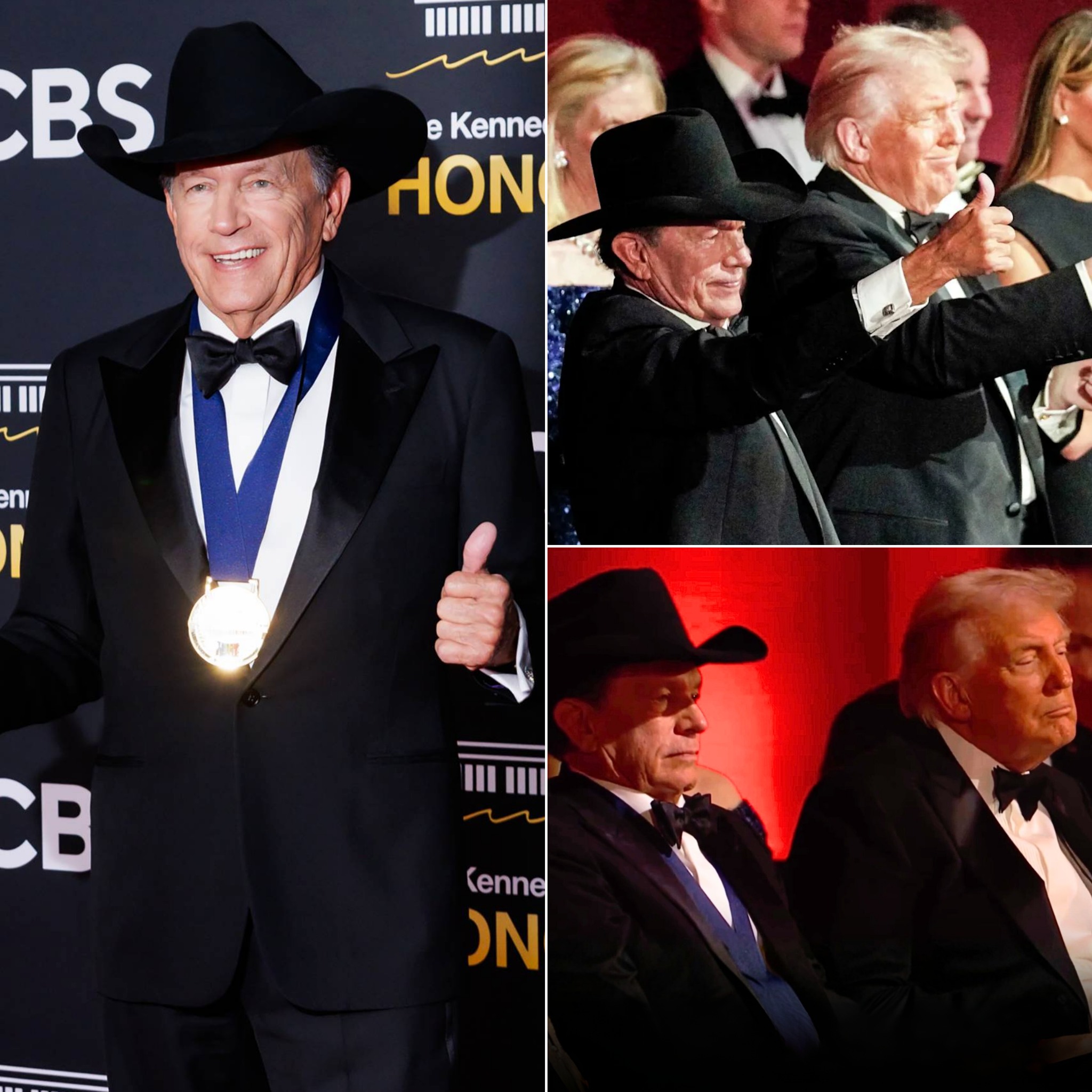
The room was electric before anyone even noticed them, charged with the usual anticipation of a grand evening filled with music, applause, and the kind of reverence reserved for legends. Then, quietly, almost imperceptibly at first, two unmistakable figures appeared in the balcony. They sat side by side—saying nothing, doing nothing, yet somehow altering the entire atmosphere of the night. George Strait, the ever-steady icon of country music, and Donald Trump, the polarizing former president, shared a moment that required no announcement, no explanation, yet immediately commanded attention. Cameras caught them, viewers froze, conversations paused mid-sentence, and arguments sparked across social media. The sight was surreal: the juxtaposition of music and power, calm tradition and political gravity, coexisting in the same frame, without confrontation, without fanfare, without ceremony.
What lingered in the minds of viewers was not a clash, not the expected fireworks, but its curious absence. George Strait, long regarded as the embodiment of steady country tradition, sat perfectly at ease in the role he has inhabited for decades: present, respectful, and entirely uninterested in turning the evening into a referendum or a spectacle. His calm, almost stoic demeanor radiated reassurance. For decades, fans have trusted him not just for the music he delivers but for the consistency of his presence, the way he honors the art and the audience alike. In that balcony shot, his quiet confidence stood in stark contrast to the buzz surrounding the rest of the room. He did not need to wave, to gesture, or to declare his allegiance; his mere presence, unassuming and composed, spoke volumes. It was a masterclass in poise, a lesson in how to occupy space without dominating it.
Trump’s presence, on the other hand, carried all the weight of political history and expectation, even in the absence of words or grand gestures. While some anticipated tension, the scene at the Kennedy Center Honors unfolded with subtlety, insisting on a different kind of priority. The spotlight belonged to the artists, to the work that outlasts election cycles, social media storms, and headlines. In that moment, power and artistry shared a frame without competing, as though the universe had agreed to a temporary truce. Observers couldn’t help but note the fragile equilibrium: the music commanded attention, the artists were celebrated, and yet the presence of a former president reminded everyone that history, influence, and culture are intricately intertwined, even in the quietest corners of a room.
That stillness was striking precisely because it was so rare. The evening was a reminder that for a few hours, the world could exist in a suspended state where art takes precedence over politics, and where personalities, no matter how prominent, defer to creativity and talent. Social media commentary erupted, but it did so with a sense of awe rather than outrage; discussions focused less on confrontation and more on the unexpected serenity of the moment. In the balcony, George Strait and Donald Trump became, almost unintentionally, symbols of restraint, of the subtle ways individuals can occupy power and presence without disrupting what truly matters. It was a lesson not just in celebrity etiquette, but in the enduring authority of art itself: when music, performance, and respect align, even the most polarized figures can coexist, if only for a moment, without discord.
Finally, the image has endured because it is a testament to the quiet power of observation and perspective. In an era where every public appearance is scrutinized and politicized, here was a moment that defied expectation. The applause, the cameras, the accolades—all of it faded slightly in comparison to the simple act of being present, witnessing, and honoring the work of others. George Strait’s calm, measured presence and Trump’s silent acknowledgment reminded viewers that for one evening, the arts claimed the stage entirely on their own terms. And that, in itself, became the story: not controversy, not spectacle, but the delicate, almost sacred recognition that some things—music, performance, creativity—transcend politics, headlines, and even history, if only for a fleeting, unforgettable moment.