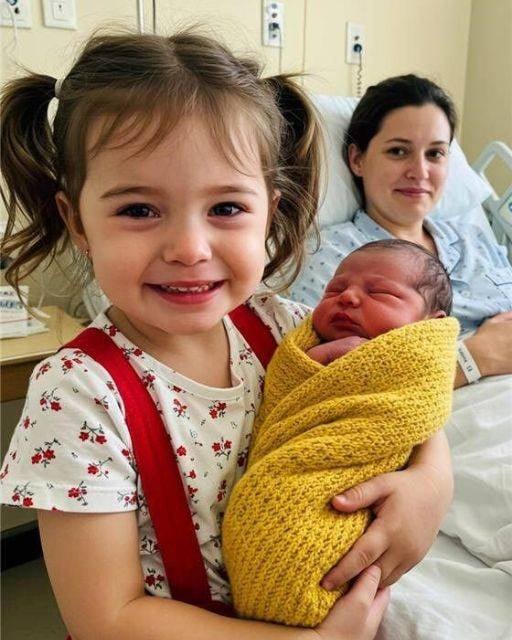
The hospital room was filled with the heavy, humid warmth of a freshly arrived life and the odor of antiseptic. The dull agony of stitches and the fatigue of labor weighed down my limbs as I sat braced against the pillows, yet my full attention was on the edge of the bed. My four-year-old Lina was sitting there, looking so tiny in her go-to red suspenders, her ponytail a little unbalanced from spending the entire day waiting in the corridor. Her baby sister, a bundle of white linen, rested in her lap.
The typical worries of a second-time mother had paralyzed me for nine months. I was concerned about the potential for a simmering, childlike bitterness, the displacement of the firstborn, and the split attention. However, those worries appeared to vanish as I observed Lina. Her hands held the baby with a remarkable level of reverence, despite their quivering from the strain of remaining motionless. Her eyes had a deep, ancient depth that I couldn’t quite put my finger on, and they sparkled with more than just the usual excitement of a new gift. She was shaking a little and making rhythmic “shh” noises that seemed more like a ritual than a mimic of me.
It seemed like the pinnacle of domestic perfection. I experienced an intense wave of thankfulness that made me cry. “Don’t you think she loves her?” Leaning back to enjoy the quiet, I pondered. Then, however, there was stillness.
Lina leaned closer, her face just inches from the forehead of the sleeping baby. Her voice was a thin, hardly perceptible thread. “I have someone now,” she muttered.
My heart swelled as I grinned. “Baby, someone to what? Someone with whom to play dolls? Someone who can show me how to skip?
Lina didn’t raise her gaze. She continued to stare at the baby’s fluttering eyelids while her swaying motion become more purposeful and rhythmic. She muttered, “To keep the secrets with.”
The room’s warmth was chased away by a sudden, unexplainable shiver that crept up my spine. Coming from a young girl who still had assistance tying her shoes, the word “secrets” felt awkward and heavy. “Secrets?” I asked, raising my voice to a high pitch and cheering nervously. “Lina, what kind of secrets?”
At last, she raised her gaze to me. It was a sudden transition. The wide-eyed toddler I knew was gone, replaced by a person whose eyes were too knowing and too heavy with a burden that shouldn’t have been in a four-year-old’s spirit. Slowly, she nodded. “Such as the ones I keep from Daddy.”
The room’s air seemed to becoming thinner. I believed I knew my husband, Mark, from the bottom of my heart. He was a man of loud laughter and wide gestures. However, the way Lina spoke the word “Daddy” made my heart race. She bent back down toward the infant before I could ask her what she meant or reach out to pull her away or bring her closer. The heart monitor next to me skipped a beat when she spoke this time, its steady beep-beep-beep faltering in the abrupt silence.
She said, “I told her where the quiet places are.” “So when the voice gets loud, he won’t find her.”
A nurse who had been approaching to check my vitals halted in the doorway, her fingers lingering over the doorframe. Like a physical blow, the words lingered in the air. The façade of our “perfect” house fell apart in that one heartbreaking discovery. It dawned on me then that Lina had been surviving while I had been busy nesting and getting ready for a new life. She had created a map of safety that I was unaware was required by paying attention to the small changes in tone and the atmosphere of a home where “the voice gets loud.”
The months that followed were a torturous trip through the rubble of my life as I had imagined it. The metamorphosis involved more than just moving on; it involved the gradual, agonizing process of recovering the aspects of ourselves that had been hidden by fear. We relocated to a little apartment in a town three hours away, where the nighttime quiet was serene rather than menacing.
My oldest, who now goes by Jaden, a name he came up with for himself as he grew older and tried to shed the skin of his past, started to really come into his own in this new environment. The youngster who used to hide under a baseball cap, shielding his eyes from the world with its brim, started to move with a quiet, hesitant confidence. At his new middle school, he joined the track team because he felt a peculiar sense of relief from the demanding, repetitious nature of the activity. Every lap around the dirt oval represented a tiny act of resistance against the agony that had previously imprisoned him. The roar of his teammates when he eventually crossed the finish line in first place at a regional meet didn’t scare him; rather, it seemed like a promise that he was at last a member of a pack that would guard him rather than harm him.
Something happened later that year that affected me more than any sporting accomplishment. Jaden received the “Kindness Award,” which was chosen by his peers. He had absorbed the agony of those early years and directed it outward as a deep feeling of empathy, I thought as I stood in the back of the auditorium and watched him traverse the stage with his head held high and no hat.
When a classmate was eating lunch by themselves, the boy who used to know the “quiet places” was the one who noticed. When a locker slammed too forcefully, he was the one who noticed a younger student’s slight flinch. He had turned into a sentinel for the wounded. His tale served as a real-world reminder that even the tiniest acts of resistance, such as a youngster refusing to remove a hat, a quiet “I understand,” or a timid inquiry to a teacher about if it was typical to be afraid to return home, can be the precise things that save a person’s life.
I remembered the day in the hospital when Lina, who is now Jaden, had hugged his sister and murmured secrets. His refusal to show the world how profoundly he had been injured until he was certain his sister was secure enough to share the burden was, I thought, the bravest thing he had ever done. Before he even knew her name, he had shielded her.
Sometimes a child’s ability to survive long enough to speak the truth is the most courageous thing they can do. Jaden had finally allowed us both to breathe when he decided to quit concealing the secrets. Our house was no longer a site of secret passageways and muffled voices; instead, light was permitted to enter every room, and “the voice” was only ever raised in laughter or a cry from a track’s sidelines.
I turned to see my two kids playing in our new life’s yard. They had stopped maintaining secrets. They were creating a world in which the only things they whispered to one another were hopes for the future and secrets were not vital for survival.