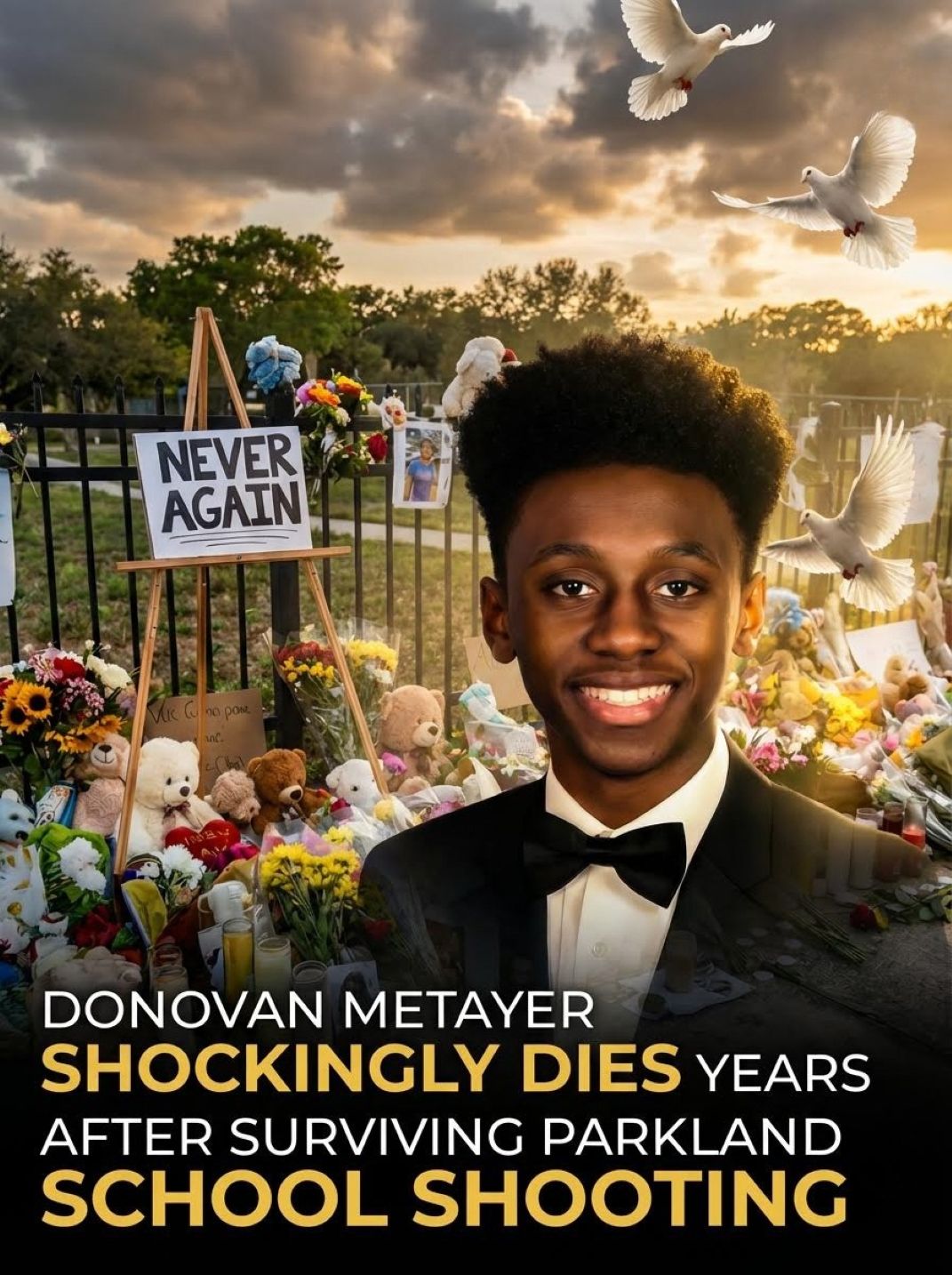
The tragic reminder that the effects of mass violence are rarely limited inside a news cycle is provided by the death of 26-year-old Donovan Metayer…. The reality for those who survived the Marjory Stoneman Douglas High School massacre in 2018 is much more complicated, despite the fact that the world frequently sees survival as the ultimate goal—a victorious conclusion to a tragic chapter. Donovan saw the events of that Valentine’s Day as a lingering, atmospheric weight that altered the course of his early manhood rather than a far-off memory to be tucked away. His passing in December 2025 has sparked a vital national dialogue on the “long reach” of trauma and the pressing need for ongoing, lifetime care for individuals who bear the unseen scars of catastrophe.
Donovan was a young man with a sweet, curious personality and a deep intellectual depth, according to those who knew him best. He was a student with a bright future who had a natural flair for technology and a desire to develop before the world recognized him as a “Parkland survivor.” He viewed the world with the youthful optimism of a child, seeing a vast array of digital opportunities just waiting to be discovered. But the Parkland campus massacre, which killed seventeen people, caused a seismic breach in his life. The future he had previously imagined was still there in those corridors, even if he left the building that day.
After graduating in 2018, the initial rush of survival subsided and was replaced with the hard, silent reality of Post-Traumatic Stress Disorder (PTSD). His relatives saw a slow but noticeable change in his personality. Under the heavy weight of his experiences, the intelligent, aspirational young man they knew started to struggle. Donovan experienced severe mental health issues as a result of the emotional toll, which made the typical milestones of early adulthood—further education, stable work, and social consistency—seem unattainable. His path turned into one of frequent hospital stays and rigorous treatment, a never-ending loop of struggling to survive in a sea of trauma.
Even with these tremendous obstacles, Donovan’s narrative was one of remarkable fortitude. He refused to let his victimization define him. When he had more clarity, he focused his mental energy on obtaining professional credentials and looking for employment that would give him a sense of direction and connect him to the computer industry he loved. He was a young man in dire need of contributing, being “okay,” and establishing a normal routine. However, his family noted that a disjointed healthcare system made the task even more difficult. Finding long-term, reliable mental health care with a focus on mass casualty trauma proved to be a difficult task in and of itself. His story reveals a structural weakness: while the world is usually prepared to offer crisis intervention right once, it usually falls short when the healing process takes years or even decades.
Policy and legislative reform are frequently debated in relation to the historical background of the Parkland shooting. Florida’s gun laws and school safety procedures were significantly altered as a result of the tragedy, and the state finally felt legally at peace when the offender was ultimately sentenced to life in prison without the possibility of parole. Donovan’s passing, however, compels an examination of the “human” chronology of these occurrences. Psychological tranquility is not the same as legal closure. Survivors like Donovan had to make their way through a ghostly internal landscape while the cameras moved on to the next big story and the school buildings were either refurbished or replaced. His death serves as a sobering reminder that the “aftermath” of a shooting is a dynamic fight rather than a static time.
Donovan’s experience is similar to those of other school shooting survivors, such those from Sandy Hook and Columbine, who ultimately passed away from the aftereffects of their trauma. Advocates and mental health experts alike are being called to action by these “collateral deaths.” They contend that people who pass away from sadness, hopelessness, or the long-term physiological deterioration brought on by ongoing stress should be included in the description of a “victim” of mass violence. Respecting a survivor’s journey entails acknowledging that their needs do not go away with time; on the contrary, as society forgets, the loneliness of their experience may grow.
Donovan’s family has been outspoken in the wake of his death about the need for a change in the way that trauma is handled in our country. They want his memory to serve as a springboard for a “continuum of care” paradigm rather than just being a footnote in a tragedy. This method makes the case that people who have experienced severe trauma ought to have access to a long-term, publicly funded network of mental health services without having to repeatedly demonstrate their need or deal with the maze of insurance rejections. They contend that our presence in the five hundredth week following a tragedy, rather than just the first, is a measure of true compassion.
There is a noticeable sense of exhaustion as the Parkland community grieves another of its sons, but there is also a renewed dedication to advocacy. Donovan Metayer’s death is a biting critique of a culture that frequently puts the “quick fix” ahead of long-term healing. His life was a monument to the beauty of the human spirit under duress. His loved ones are carrying out a final act of service by disclosing the specifics of his battle, exposing the world to the harsh, unvarnished reality of what it’s like to live after the unimaginable.
Donovan Metayer’s story serves as a reminder that empathy is a constant emotion. It is a pledge to support the wounded until they are restored, even if it takes a century. It shows us that every survivor we see in a picture is a person engaged in a struggle we are unable to completely understand. Looking back on his 26 years, we see a life that was both enlarged by the bravery required to keep going on and abbreviated by tragedy. Even though Donovan is no longer with us, his tale continues to protect those who are currently engaged in their own silent battles. It serves as a reminder that although trauma has a long-lasting impact, our empathy must also endure throughout time to guarantee that no sufferer is ever genuinely left behind in silence.