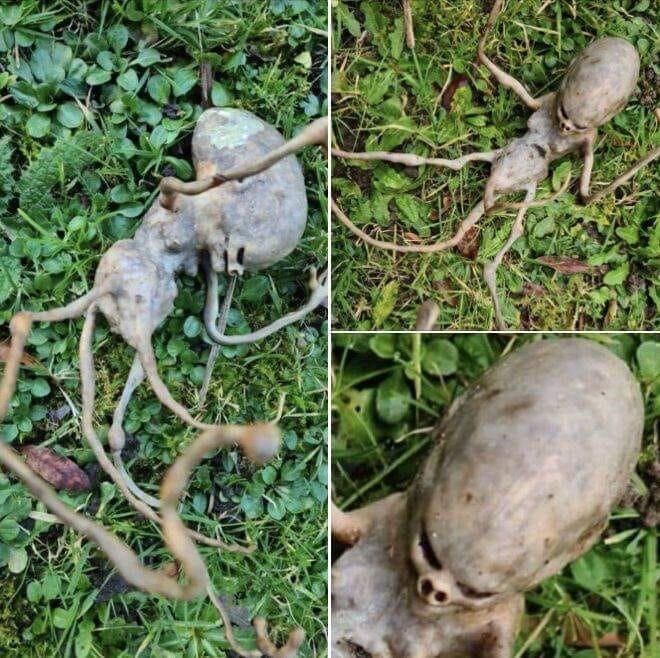
A truly peculiar discovery in a suburban garden recently left internet users around the world scratching their heads in disbelief. What appeared at first glance to be something pulled straight from the pages of a science fiction novel or the storyboard of a low-budget alien film was actually found nestled among the rose bushes and begonias of a woman’s carefully tended backyard. The object’s form was both familiar and unnervingly alien: an oblong skull that seemed disproportionate to its body, a slender torso that tapered unnaturally, and limb-like extensions where one would normally expect arms and legs. The combination created a figure that was neither fully human nor convincingly animal, and it immediately triggered a cascade of questions in the mind of its discoverer.
The woman, understandably bewildered by her find, initially mistook the object for a strange kind of mushroom. After all, the garden had been damp from the recent rain, and peculiar fungi had occasionally sprouted among the flower beds before. Yet, upon closer inspection, the object’s details suggested something far more unusual. Its “skin” appeared oddly textured, and there were anatomical features that defied classification in the natural world. Unsure of what she was looking at, the woman first consulted friends and neighbors, describing the bizarre figure in hushed tones and even sending photos. Their reactions were a mixture of amusement, confusion, and genuine concern, none of them able to provide a satisfactory answer.
With the mystery deepening, she turned to Reddit, a platform known for crowdsourcing answers to the strangest phenomena. She posted the images in multiple forums, including ones dedicated to mushroom enthusiasts, cryptid hunters, and communities fascinated by extraterrestrial life. The responses were immediate and overwhelmingly varied. Some users expressed alarm, cautioning her against touching the object and referencing classic episodes of “The X-Files” where seemingly harmless discoveries harbored deadly secrets. Others analyzed the anatomy with a meticulous attention to detail, noting the presence of tiny breasts and other subtle features that suggested a more humanoid origin than an ordinary fungus. Online sleuths debated whether the figure was a biological specimen, an elaborate hoax, or a piece of artistic craftsmanship.
The speculation didn’t end there. A faction of users proposed that the object might have been artificially constructed, perhaps as a prop from a nearby novelty shop or as part of an art installation designed to test reactions. Others, however, were quick to point out inconsistencies in that theory, noting the way light and shadows fell across the figure, the organic-looking curves of its body, and the minute imperfections that suggested natural formation rather than manufactured intent. Even more voices chimed in, proposing theories that ranged from the plausible to the absurd: could it be the preserved remains of a fetal animal from a rare species? A taxidermist’s experimental work? Or, in the more conspiratorial corners of Reddit, a genuine extraterrestrial entity accidentally deposited in a suburban garden?
Adding to the intrigue, the original poster emphasized that the object was not digitally manipulated. It was not an AI-generated image, a CGI creation, or a staged photo intended to fool the public. This clarification only intensified the online discussion, as users tried to reconcile the object’s bizarre anatomy with the reality of a tangible presence in a real garden. Experts in mycology, anatomy, and even art history were called upon to weigh in, each offering interpretations shaped by their own fields of knowledge, yet none providing definitive answers.
The debate escalated further when some commentators noted that the object’s limb-like protrusions were oddly flexible, almost as if they could move under their own power, and the proportions of its torso and head seemed to follow an uncanny pattern not typically found in terrestrial biology. Discussion threads grew to hundreds of comments, with Reddit users theorizing endlessly, dissecting the object’s features through shared photographs, magnified images, and digital sketches. Every new observation seemed to produce yet another theory, adding layers of complexity to what had begun as a simple garden curiosity.
Despite the torrents of speculation, the true nature of the object remained entirely elusive. Even after days of scrutiny, debates, and professional consultations, no one could definitively classify what it was or explain how it came to be in the woman’s garden. Its appearance, anatomy, and inexplicable presence continued to capture the fascination of those online who followed the story. The mystery lingered, sparking curiosity, humor, fear, and awe in equal measure. For some, it was a reminder of the limits of human understanding; for others, a thrilling brush with the unknown.
As discussions continue and new observers chime in with theories, photographs, and amateur analyses, the peculiar garden discovery shows no sign of losing its grip on the public imagination. Whether ultimately explained as a hoax, a natural anomaly, or something that defies classification altogether, the object has cemented itself as an enduring enigma in the digital age. Its strange, oblong head and delicate, limb-like extensions remain a symbol of wonder and confusion, prompting internet users to ask: in a world where most things are cataloged and explained, can something truly alien—or merely strange—still exist quietly in someone’s backyard? For now, the answer remains just out of reach, and the garden continues to hold its secret.