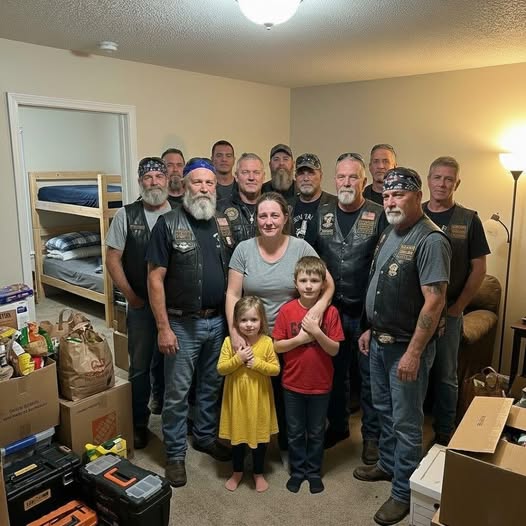
The neighborhood was used to the familiar rhythms of a suburban morning—the distant spray of a garden hose, birdsong drifting through the air, the low hum of a passing car. But that Tuesday, the calm shattered. A deep vibration rippled through the street, swelling into a thunderous roar as thirty motorcycles surged forward like a single, metallic force. Chrome and leather filled the road as they pulled into the driveway and spread across the lawn of a small, weather-beaten house. One by one, the engines cut off, leaving behind a ringing silence that felt ominous. Watching from behind her thin living room curtains, Elena felt her chest tighten. After a year marked by relentless loss, she was certain this was the end—the landlord’s final, unmistakable message to enforce the eviction she could no longer outrun.
Fear hung thick in the air. Elena stood frozen in the foyer, her fingers wrapped tightly around her young son’s hand, as the heavy sound of boots climbed the porch steps. The knock that followed was firm and commanding, not the hesitant tap of paperwork and procedure. When she opened the door, she faced a man who seemed carved from stone—broad-shouldered, with a sweeping gray beard and eyes shaped by long roads and hard truths. His leather vest bore patches she didn’t recognize, symbols of a brotherhood far removed from her world. His name was Marcus, and he had come expecting to clear the house.
But the moment Marcus stepped inside, something shifted. The professional detachment he carried dissolved as he took in the hallway—not a space of neglect, but one that had become a quiet memorial. Among packed boxes and strips of tape hung framed military uniforms, medals encased in glass, and a carefully folded American flag. It was the same flag Elena had been given on a rain-soaked afternoon at Arlington National Cemetery. The silence in the home wasn’t just the hush of financial hardship; it was the heavy stillness of grief that lingers long after the rest of the world moves on.
Marcus stopped in front of a photograph of Elena’s late husband—a soldier whose quiet dedication mirrored a life Marcus himself once lived. In that instant, the story of the morning changed. Shared sacrifice erased the boundary between stranger and intruder. Marcus turned back toward the men waiting outside, men who hadn’t come prepared for conversation, yet found themselves in one. He spoke to Elena not as an enforcer, but as a brother. He listened—to the story of a fallen soldier, of benefits trapped in endless bureaucracy, and of a landlord who saw a grieving family as a burden instead of a legacy.
What should have been a confrontation became an act of solidarity. Marcus and his brothers didn’t challenge the legality of the eviction; they changed its outcome entirely. They stood between Elena and the street—literally and figuratively. Without ceremony, they pooled their resources. The check they handed over didn’t just halt the eviction; it erased the debt and created breathing room for the months ahead. Yet the money was only the beginning.
In the weeks that followed, the sound of motorcycles no longer signaled fear—it meant safety. The bikers returned, not to intimidate, but to help. They arrived with tools and lumber, repairing the sagging porch and the leaking roof that had been ignored for years. They stocked the pantry until it overflowed, bringing smiles of disbelief to the children’s faces. More than anything, they showed up—again and again—ensuring Elena never had to grieve alone. They treated her husband’s memory as sacred, listening as she spoke of him with a respect that allowed her to say his name without pain swallowing her whole.
The most powerful moment came on a quiet Sunday afternoon. Marcus sat on the porch beside Elena’s son, a boy struggling to find his place in a world without his father. With solemn care, Marcus removed a small silver badge from his vest—a symbol of their brotherhood—and pinned it to the boy’s shirt. It wasn’t charity, and it wasn’t symbolic emptiness. It was a vow.
“Your father mattered,” Marcus said, his voice rough but steady. “And because he mattered, you matter to us. You have thirty fathers now.”
From grief and roaring engines, a new family was forged—one built on respect, loyalty, and shared understanding. The fear that once surrounded the house vanished, replaced by a shield no eviction notice could penetrate. Neighbors no longer watched the leather-clad men with suspicion; they saw them as protectors, guardians of a widow’s peace. Elena, who had braced herself to lose everything, discovered she had gained something far stronger—a fortress made of people.
The eviction that never happened became a local legend, a reminder that human connection is the only currency that never loses value in a crisis. Loyalty, once a word tied only to her husband’s service, found new meaning. Through listening, standing firm, and choosing to stay, thirty bikers taught an entire community that fear fades when you stop seeing someone as a problem—and start seeing them as a person. When the motorcycles eventually rolled away, their engines humming a gentler tune, they left behind more than a saved house. They left a home strengthened by the truth that no one should have to carry the weight of the world alone.