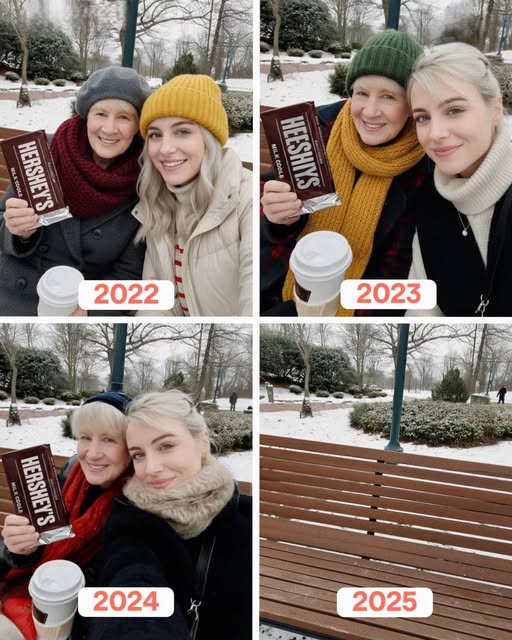
Grief has a way of turning the most cherished traditions into jagged reminders of what has been lost. For Caitlin, December had always been anchored by a single, sacred ritual shared with her mother. Every December 20th, no matter the weather or the season’s chaos, they would buy a giant milk chocolate Hershey’s bar and two steaming coffees before making their pilgrimage to a weathered bench beneath an ancient oak tree in the local park. It was a simple ceremony of presence—dividing the chocolate, sipping the coffee, and taking a ridiculous, freezing selfie to mark another year of showing up for one another. But this year, the bench was silent. Her mother had passed away in October after a swift and brutal battle with cancer, leaving Caitlin to face the first holiday season in a world that felt fundamentally broken.
In her final hospital days, Caitlin’s mother had laid the groundwork for a mystery Caitlin wasn’t yet ready to solve. As the machines hummed with indifferent rhythm, her mother gripped her hand and asked for a promise—not of an action, but of a mindset: “When the time comes, promise me you’ll listen to your heart. Not your anger, not anyone else’s guilt. Do what you think is right.” At the time, Caitlin brushed it off as the wandering thoughts of a woman at the end of her life, but the gravity of that request weighed on her as December 20th approached.
When the day arrived, Caitlin moved through the motions of their tradition almost mechanically. She walked the familiar grocery aisles, her fingers trembling as she grabbed the oversized chocolate bar and two coffees—one for her, one for a ghost. The walk to the park was a gauntlet of memories; every Christmas light and festive display felt like an affront to her mourning. But as she rounded the bend toward their oak tree, the sight she encountered froze her. A man was already sitting on their bench. He shivered in a thin, worn jacket, his face etched with exhaustion. In his lap, he held a giant Hershey’s bar.
It was no coincidence. As Caitlin approached, the stranger looked up with relief bordering on desperation. “I feared I had missed you,” he whispered. When Caitlin asked why he was there, he delivered a revelation that shattered her understanding of her own history. “Your mother kept a secret from you,” he said, voice shaking. “I’m your father.”
Caitlin’s father had been a figure of myth, a man her mother had said was dead long ago. To see him clutching the talisman of her mother’s favorite tradition was a cognitive dissonance she couldn’t process. He explained he had left when Caitlin was an infant, led astray by another relationship and the pressures of sudden fatherhood. He hadn’t been dead; he had been absent—an absence her mother reframed as death to shield Caitlin from the sting of abandonment.
Yet the altruistic veneer of his return soon faded. He hadn’t come for reconciliation or paternal love alone. He was dying—his liver failing—and he had come to the bench seeking a donor. Earlier that year, he had met with Caitlin’s mother, and in a moment of extraordinary compassion—or perhaps a final test of her daughter’s character—she had told him about the December 20th ritual.
The choice facing Caitlin was staggering. This man, a stranger in her life, was asking for a literal piece of her to save a life that had never been part of hers. The Hershey’s bar, once a symbol of uncomplicated love, now felt like a lure drawing her into a transactional drama she never asked to join.
Her mother’s final promise echoed in her mind. To “do what is right” was not a command to self-sacrifice, nor a justification for coldness. It was a challenge: to see beyond anger and grief and find a truth she could live with. The decision was more than medical; it touched the fundamental question of what we owe to those who share our blood but not our lives.
Organ donation is a rigorous process, often requiring months of testing to ensure the donor acts freely and is healthy enough for surgery. Thousands of people are on liver transplant waitlists in the United States, and living donation is a critical, though intense, alternative. For Caitlin, the technicalities were secondary to the moral weight of the request.
As she walked away from the bench that day, leaving her father shivering in the cold, Caitlin felt the full burden of her mother’s legacy. Her mother had anticipated this moment, knowing her daughter would face the choice between past bitterness and a potential future she had never imagined. By entrusting Caitlin with the decision, her mother had given her the ultimate agency—the power to define her own morality.
Caitlin’s path forward remains unwritten. Whether she agrees to the surgery or preserves her own peace, the truth revealed on that bench has forever altered the meaning of December 20th. The ritual is no longer just chocolate and coffee; it is the messy, complicated reality of family, the secrets we keep to protect those we love, and the choices we make when those secrets are finally revealed. In the silent winter park, Caitlin realized that while her mother was gone, the strength she instilled was alive, guiding her through a decision that could redefine the rest of her life.