I once believed weddings revealed the best in people. I had grown up watching relatives marry in our quiet Virginia town—flower-filled aisles, joyful tears, families united, at least for a day. I assumed my wedding would be the same. Maybe not flawless, but kind. Respectful. Free from the bitterness that had shaped my childhood.
That belief shattered the night before my wedding—torn apart, quite literally, by the very people meant to love me most.
My name is Lieutenant Commander Sarah Mitchell, United States Navy. Fourteen years in service. Two deployments to the Persian Gulf. Years stationed in Japan. Now assigned to naval intelligence at the Pentagon. I was raised in a home where my achievements only mattered if they enhanced my parents’ image. My younger brother, Kyle, was praised no matter what. I was criticized no matter how hard I tried. Enlisting at eighteen wasn’t rebellion—it was survival. The Navy became the place where I learned discipline, worth, and self-respect—things my family never taught me.
When I returned home for the wedding, I hoped for a temporary ceasefire. Just one weekend of civility. My fiancé, David, stayed with his parents nearby, unaware of how fragile the atmosphere in my childhood home truly was. My mother busied herself with lists and details. My father kept his emotional distance. Kyle lounged around scrolling on his phone, throwing out barbed jokes disguised as humor. Everything felt staged, like a performance of a family that functioned only on the surface.
In my old bedroom upstairs, four wedding dresses hung neatly in garment bags. I hadn’t been able to choose just one, so I brought options: a vintage satin gown that once belonged to David’s grandmother, a lace mermaid dress, a simple crepe gown, and a tea-length retro style. I wasn’t attached to any of them—I simply wanted the freedom to choose. To feel like myself.
I checked on them before dinner. They were untouched. Perfect. Waiting.
Dinner was tense, filled with shallow conversation. My father complained. My mother doted on Kyle. Kyle took subtle shots at me. I ignored it all and went to bed early, convincing myself tomorrow would wash it away.
Sometime around two in the morning, I woke to soft voices and footsteps. My door had been locked—but someone unlocked it. The click of it closing jolted me fully awake. The room felt off. Heavy.
I turned on the light.
Every dress was destroyed.
One sliced clean through the bodice. Another shredded mercilessly. A third cut straight through the waist. The fourth reduced to unrecognizable scraps.
I collapsed to my knees, surrounded by ruined fabric, shock stealing my breath.
The door opened again.
My father stood there—not ashamed, not startled—satisfied.
“You deserve this,” he said flatly. “You think wearing a uniform makes you better than this family? Better than your dead sister? Better than Kyle? Better than me?”
My mother stood behind him, silent and unmoved. Kyle smirked.
“No dress, no wedding,” my father added. “It’s over.”
Then they left, closing the door as casually as if they’d finished a household chore.
That was the moment something inside me finally stopped bending.
I didn’t scream. I didn’t cry. I didn’t plead. I sat there breathing until the shock hardened into clarity.
At three in the morning, I opened my closet and pulled out the one garment they didn’t know existed—the uniform I had earned through fourteen years of sacrifice.
My Navy dress whites.
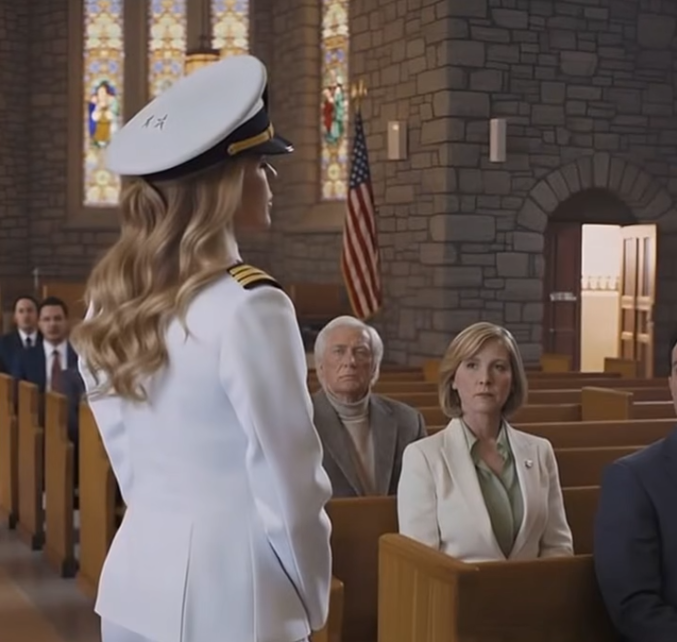
They fit like armor. Immaculate. Shoulder boards gleaming with the two gold stars of a Lieutenant Commander. By sunrise, I was packed and driving toward Naval Station Norfolk. At the gate, I was greeted with respect. On base, I felt calm—something that house had never given me.
Master Chief Hollander found me near the chapel and immediately understood something was wrong. When I told him what happened, he didn’t soften the truth.
“They tried to break you because they don’t understand you,” he said. “But that uniform—what you earned—they can never take that away.”
He gave me support, space, and a place to prepare.
When I arrived at the church later that morning, the parking lot fell silent. Veterans rose instinctively as they recognized the uniform. David’s mother hugged me tightly and whispered, “Whatever they did—you look powerful.”
David looked at me with pure pride. “You’re extraordinary,” he said.
Inside, my family sat in the front pew. My mother stiffened. My father turned pale. Kyle scoffed, asking what my ribbons even meant.
A veteran stood and answered for him:
“They represent honorable service to this country—something you clearly don’t understand.”
I walked toward them.
“You’re embarrassing us,” my father hissed.
“Not as embarrassing as destroying your daughter’s wedding dresses,” I replied calmly.
The church gasped.
Before they could respond, the doors opened again.
Vice Admiral Thomas Caldwell—my mentor—entered in full dress whites. He approached me, offered his arm, and said, “Ma’am, may I escort you?”
My parents looked shattered.
I met their eyes once more. “You chose cruelty over love. You no longer control me.”
Then I walked down the aisle, the entire church standing.
David and I exchanged vows built on equality and respect. When the ceremony ended, people thanked me—not just for my service, but for what I had shown them that day.
My parents left early. They couldn’t face the truth.
Three years later, I keep my distance. I have boundaries. The uniform still hangs in my closet—but the strength it gave me no longer depends on wearing it.
They tried to destroy my wedding dresses.
Instead, I walked into that church wearing exactly who I had become.
And I’ve been standing tall ever since.