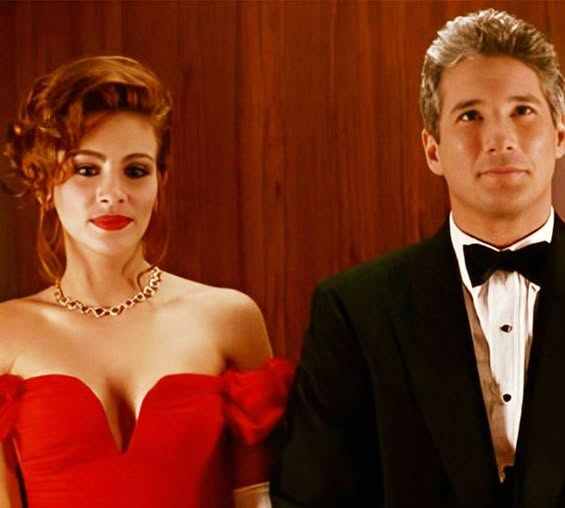
A cinematic fairy tale that reimagined the “Cinderella” cliché for a contemporary, neon-lit Los Angeles, the 1990 classic Pretty Woman is still regarded as one of the most enduring foundations of the romantic comedy genre. The movie has become a cultural landmark thanks to its recognizable red gown, the high notes of its soundtrack, and the unquestionable connection between Richard Gere and Julia Roberts. But beneath the glossy exterior of high-stakes polo matches and Rodeo Drive shopping sprees, the film is a fascinating mosaic of contradictions, technical errors, and a tragic, abandoned past that almost kept it from becoming the joyful romance we enjoy now.
The ghost of the movie that was supposed to be made must be examined in order to comprehend why Pretty Woman feels so distinctive. The project’s original title, 3,000, alluded to the amount Vivian Ward would receive for her week with Edward Lewis. The original J.F. Lawton script was a nasty, gritty drama about the terrible realities of sex work and drug addiction in Hollywood, far from the Disney-backed fairytale it became. There was no final rescue or white knight carrying roses up a fire escape in that version. The story ended with Edward brutally tossing the cash at Vivian, a cocaine addict, as she lay in the street, leaving her exactly where he found her.
At the margins of the finished piece, this dark DNA continues to flash. A certain grounded realism persisted even after Disney’s Touchstone Pictures bought the script and demanded a drastic tonal shift toward romance. It is evident in the opening sequences on Hollywood Boulevard, when the desperation seems a bit more acute and the shadows seem a bit longer than in a normal romantic comedy. This internal conflict may be the source of the picture’s ongoing impact; it is a film that is continuously attempting to forget its own cynical beginnings, and that battle lends it an emotional weight that is typically absent from pure fluff.
In addition to the change in tone, Pretty Woman is well-known among movie scholars for a startling amount of continuity mistakes that have contributed to the film’s mythology. Because they occur so frequently, these technical “mistakes” nearly seem like a stylistic decision. One of the most well-known instances shows Vivian eating a croissant at the hotel during breakfast. For a brief moment, the camera shifts to Edward, and then it returns to Vivian, who is clutching a pancake. After a few nibbles, the pancake comes back whole. In another scene, items disappear off tables and then resurface seconds later in new locations, while money appears to teleport between hands.
Some observers consider these lapses to be a sign of carelessness, while others regard them as evidence of the intensity of improvisation on set. Director Garry Marshall was infamous for putting the “feel” of a show ahead of technical mastery. Even if the food on the plate didn’t match the preceding photo, he would use a take if it had the correct emotional spark. Because of how captivating the main relationship is, most viewers aren’t distracted by these mistakes and aren’t concerned about the changing breakfast menu.
Another issue that almost caused the project to fail was the film’s casting. Although Richard Gere and Julia Roberts were far from the initial selections, it is nearly impossible to picture anyone else in those roles now. Many big-name actors, such as Christopher Reeve, Burt Reynolds, and Al Pacino, declined to play Edward Lewis. Before concluding that the part wasn’t for him, Pacino even went so far as to screen test Roberts. Richard Gere himself declined the role several times, believing that Edward was merely a personalityless “suit.”
Gere didn’t change his mind until he met with a young, little-known woman named Julia Roberts. After a number of more well-known actresses, including Michelle Pfeiffer and Molly Ringwald, declined the role of Vivian, Roberts was frightened. Roberts allegedly gave Gere a Post-it note that read, “Please say yes,” after noticing his reluctance. Gere was persuaded to sign on by that real-life vulnerability, which served as the basis for their on-screen romance.
The jewelry box snap, the movie’s most well-known scene, was actually an example of this off-camera relationship. Roberts was worn out and had trouble finding the correct enthusiasm during the filming of the scene where Edward shows Vivian the diamond necklace. As a practical joke to wake her up, Marshall told Gere to snap the box shut on her fingers. The team was taken aback by her real and loud laugh, but Marshall recognized right away that it was the main focus of the film. It embodied the “magic” that made viewers fall in love with the movie and was a moment of genuine joy in a world of manufactured splendor.
But there was more to the production than just laughs. The actors had to figure out how to make the main conceit—a commercial deal blossoming into genuine love—believable as the story changed from a brutal drama to a beautiful fairytale. While adhering to the studio’s “fairy tale” standards, they had to handle the morally difficult plot. In order for the audience to support Vivian’s change, Roberts in particular had to strike a balance between her streetwise toughness and her innocence. The leads were able to direct the high-wire performance into the core of the cultural zeitgeist despite the fact that it could have easily come across as exploitative or corny.
Pretty Woman has been under a lot of contemporary critique in the decades since it was first published. Its “capitalism-as-salvation” ideals and its sanitized portrayal of a risky profession are frequently cited by critics. However, the film continues to be a popular because it effectively promotes a concept that many want to believe in: that everyone can be “seen” and appreciated for who they are underneath their outward appearance, regardless of their circumstances.
In the end, Pretty Woman’s “hidden mistakes”—the pancakes that were once croissants, the abandoned dark conclusion, and the nearly absent actors—only serve to heighten its enigma. It’s a survivor movie. It made it through a production beset by technical issues, a challenging casting process, and a crisis of tonal identity. It succeeds because it is a human film rather than a flawless one. The imperfections provide as evidence of the reality behind the camera, serving as a reminder that even the most well-crafted Hollywood tales are based on joyful accidents and spontaneous giggles. The film demonstrates that although you can purchase a red dress and a week of someone’s time, the truly “pretty” aspect of the narrative is the spontaneous, unplanned bond that arises when the heart takes over and the cameras are rolling.