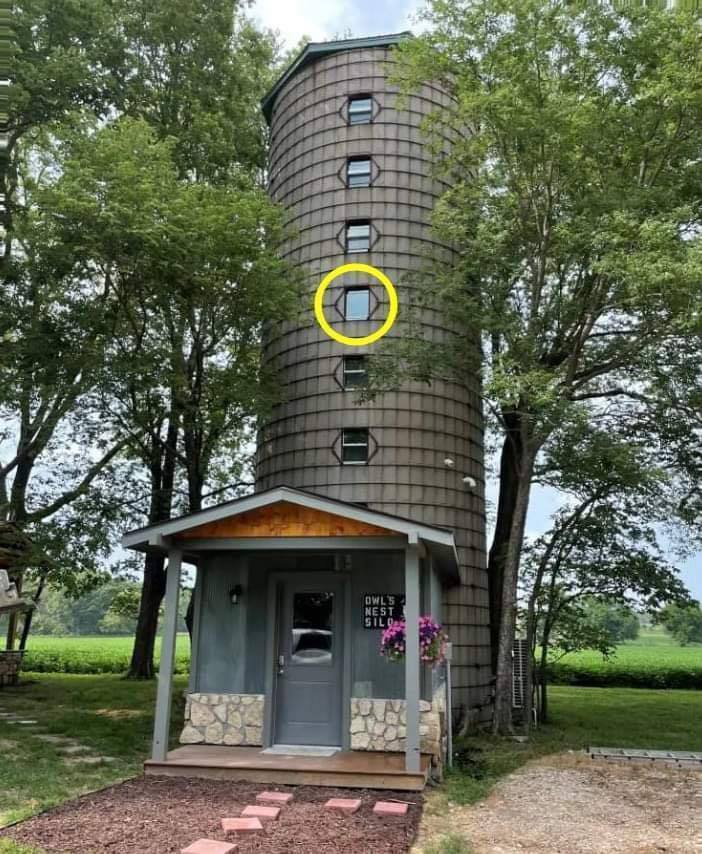
In the competitive landscape of alternative real estate investment and the burgeoning sustainable architecture movement, the “Owl’s Nest Silo House” has emerged as a benchmark for innovation, creativity, and strategic market positioning. Nestled in the pastoral serenity of West Chase County, Kansas, a scenic ninety-minute drive from the urban bustle, this project exemplifies how industrial salvage can be transformed into a high-yield luxury vacation rental that appeals to design enthusiasts, eco-conscious travelers, and investors alike. What initially began as a modest aspiration—a weekend log cabin tucked among soybean fields and rolling hills—has evolved into a four-story vertical marvel, a feat of architectural ingenuity that commands attention on a global scale.
The visionary behind this transformation, Gerald Wiens, first ventured into short-term vacation rentals with the Paw Print Cabin, a traditional log structure completed in 2019. This property, set against the tranquil backdrop of Kansas farmland, served as a proof of concept for Wiens’ growing focus on remote work retreats and “isolated luxury” accommodations. When the global pandemic dramatically increased demand for secluded getaways, the cabin’s occupancy rate surged to an impressive 180 nights in a single year. This early success provided not only financial capital but also the confidence to embark on a far more complex and ambitious undertaking: converting a towering, 45-foot decommissioned grain silo into a fully functional, two-bedroom luxury residence.
The Art and Science of Vertical Living
Transforming a circular industrial structure into a habitable domestic space is a formidable challenge that requires a delicate balance of structural engineering, spatial planning, and interior design optimization. Unlike conventional “stick-built” homes, the cylindrical form of a silo imposes unique constraints on insulation, natural light, and furniture placement. Wiens tackled these challenges through meticulous architectural modeling, iterative sketching, and careful material selection, ensuring that every vertical inch of the 45-foot cylinder contributed to both aesthetic and functional value.
Upon entering the ground floor of the Owl’s Nest, guests are welcomed into a seamless entryway that flows naturally into a bespoke circular living room. The use of curved lines throughout the interior promotes a sense of organic flow, psychological calm, and spatial continuity, a principle well-regarded in high-end interior design. The focal point is a stone-framed gas fireplace, which serves the dual purpose of visual grandeur and efficient climate control—keeping the space comfortably warm during harsh Kansas winters while complementing the rustic-modern aesthetic. Surrounding the fireplace, plush leather seating, textured rugs, and strategically placed lighting fixtures create an environment that is both inviting and luxurious.
The ground floor’s ingenuity extends to the subtle integration of contemporary amenities. A flat-screen TV mounted above the hearth allows for a seamless blend of rustic charm and modern entertainment, while a winding staircase incorporates a cleverly tucked half-bathroom beneath its treads—a masterstroke of spatial efficiency that maximizes usability without sacrificing the experience of openness and comfort.
Ascending the Vertical Sanctuary
Guests navigating the silo’s vertical design are rewarded with a journey that transforms a simple climb into an experiential ritual. The rhythmic ascent of 45 stairs leads to the crowning fourth-floor master bedroom, where panoramic views of undisturbed soybean fields, meandering creek valleys, and the limitless Kansas sky unfold. This loft, marketed as the property’s “hero feature,” combines privacy, acoustical separation, and unobstructed vistas, offering an immersive retreat from the social spaces below. The elevation naturally enhances insulation from ambient noise while providing guests with a rare connection to the surrounding natural landscape.
Wiens describes the Owl’s Nest as a “labor of love,” emphasizing that its construction demanded custom-fabricated materials, specialized labor, and a painstaking attention to detail that far surpasses conventional residential developments. While these factors increase upfront costs and time investment, the ROI for unique, highly photogenic properties remains disproportionately high. Platforms like Airbnb and niche vacation rental marketplaces provide access to travelers who prioritize experiential stays, authenticity, and a narrative that connects them to the local environment—a demographic willing to pay a premium for properties that offer more than just shelter.
Sustainability as Design Philosophy
Beyond aesthetics and marketability, the Owl’s Nest Silo House embodies principles of sustainability and ecological responsibility. By repurposing a decommissioned metal silo, Wiens significantly reduced the carbon footprint associated with the extraction, manufacturing, and transportation of conventional construction materials such as concrete and steel. This adaptive reuse not only minimizes environmental impact but also situates the project within the larger framework of the “Circular Economy,” which prioritizes resource efficiency, waste reduction, and creative reuse.
Moreover, the silo’s vertical layout aligns with the growing interest in minimalist living and downsizing. As modern homeowners increasingly seek to reduce their ecological footprint, the Owl’s Nest demonstrates that a small land footprint need not compromise functionality, luxury, or comfort. Each level of the structure accommodates distinct living zones, from communal gathering spaces and kitchen facilities to private sleeping quarters and study areas. This efficient spatial stratification serves as a model for both rural and urban design, illustrating how vertical living can offer versatility and privacy within constrained footprints.
Crafting a Narrative-Driven Experience
In addition to its architectural and ecological merits, the Owl’s Nest succeeds by telling a story. Travelers today are no longer simply seeking accommodation; they are in pursuit of narrative, heritage, and authenticity. The property’s design pays homage to Kansas’ agricultural roots while integrating modern luxury elements, creating a narrative that resonates with both domestic and international visitors. From sunrise breakfasts overlooking amber waves of crops to starlit evenings in the fourth-floor loft, each guest’s experience becomes a part of the property’s ongoing story, amplifying its appeal on social media and review platforms.
The Owl’s Nest joins the Paw Print Cabin as a cornerstone of Wiens’ curated collection of vacation rentals. Together, these properties represent a fusion of vision, craftsmanship, and market insight. They illustrate the potential for high-yield investment in non-traditional lodging while simultaneously promoting sustainable tourism and community engagement. For investors, the project is a blueprint in niche branding, “place-making,” and the cultivation of experiences that cannot be commodified.
Legacy, Luxury, and Lessons Learned
Ultimately, the Owl’s Nest Silo House proves that the most successful real estate ventures occupy the intersection of innovation, history, and sustainability. By honoring the agricultural heritage of West Chase County and leveraging contemporary design techniques, Gerald Wiens has created a sanctuary that is simultaneously environmentally responsible, commercially viable, and profoundly beautiful. The silo is more than a structure; it is a testament to the transformative power of adaptive reuse, the potential of vertical living, and the enduring appeal of thoughtfully curated experiences.
In every meticulously designed detail, from the ergonomic stairwell to the fourth-floor panoramic loft, Wiens has reinforced a central principle: that the best “labor of love” yields both tangible returns and intangible legacies. Guests leave with memories, stories, and a sense of connection to the land and the property. Investors gain not only a profitable asset but a model of innovation that challenges conventional wisdom.
In conclusion, the Owl’s Nest Silo House is not simply a vacation rental. It is an architectural narrative, a study in adaptive reuse, and a template for the future of sustainable, experiential living. It exemplifies how vision, craftsmanship, and strategic thinking can elevate even the most utilitarian structures into landmarks of design, comfort, and environmental stewardship. For the world of real estate, it is proof that opportunity lies not in replicating the ordinary, but in reimagining the extraordinary.