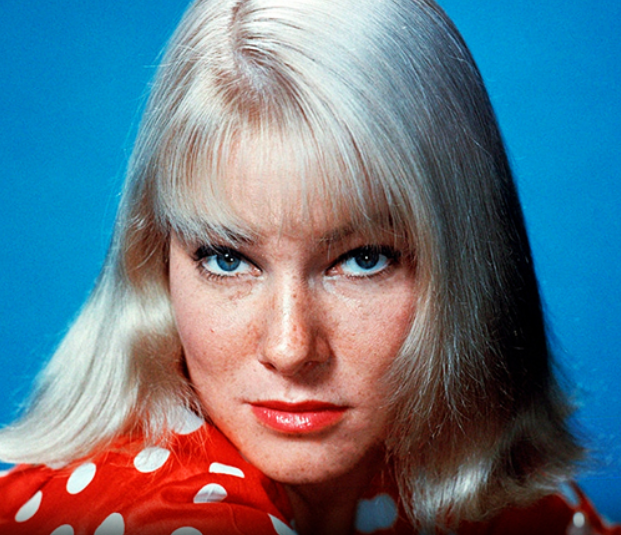
When Swedish actress May Britt fell in love with Sammy Davis Jr., she didn’t just marry a man—she stepped into the eye of a cultural storm, a whirlwind of prejudice, expectation, and relentless scrutiny. Hollywood, which had once seemed open and welcoming, suddenly turned cold. Doors closed, contracts disappeared, and whispers followed her wherever she went. The wider world of America was no kinder. A country still grappling with deep racial divides recoiled at the idea of their union. Yet through it all, May Britt refused to back down. Even when threats arrived, even when the world seemed poised to punish her for following her heart, she held firm, demonstrating a courage that would come to define her life far beyond the silver screen.
May Britt began as a shy, almost self-effacing young woman in Sweden, discovered in a small photography studio and quickly thrust into the world of European cinema. The transition to Hollywood promised glamour and fame. Sharing the screen with giants like Marlon Brando and Robert Mitchum, she seemed destined for a glittering, uncomplicated stardom. But her path was never meant to be simple. Her love for Sammy Davis Jr., a man of extraordinary talent and determination, became a test of everything she had learned about courage, resilience, and the strength of her own convictions. In a world that demanded conformity, she chose love—a love that challenged societal boundaries and demanded bravery in ways few could understand.
The cost of that love was immediate and brutal. Studio contracts vanished almost overnight, opportunities evaporated as if they had never existed, and invitations that might have elevated her career were quietly withdrawn. Even the White House reportedly kept its distance, a symbolic gesture that underscored the extent to which their union unsettled the establishment. Yet amid this turbulence, inside their home, May Britt and Sammy Davis Jr. carved out a space of tenderness and defiance. They built a family grounded in love rather than fear, laughter rather than judgment, proving that courage is not only about grand gestures but also about the quiet, everyday acts of living true to oneself.
Over time, as the pressures of fame and prejudice weighed on them, their marriage eventually ended, but May Britt’s story did not. She quietly reinvented herself, stepping away from the relentless spotlight that had once both elevated and constrained her. She became an artist, a mother, and later, a wife again, forging a life defined by authenticity and creativity rather than the narrow definitions Hollywood had imposed. Her choices were deliberate, a testament to the fact that true courage is measured not only by standing against public scrutiny but by the willingness to build, rebuild, and live on one’s own terms.
Today, at 91, May Britt leaves behind more than the films she made or the screen presence she once commanded. She leaves a legacy of quiet, stubborn bravery—a reminder that the true measure of courage often comes not in the applause or accolades, but in the refusal to surrender one’s heart and one’s principles to fear. Her story endures as a lesson in resilience, love, and the profound impact of choosing authenticity over conformity. Through her life, she shows that stars are not only made by beauty or talent but by the courage to love boldly, even when the world stands against it.
Her journey also reminds us that the cost of doing what is right can be high, yet it is the choices we make in those moments of resistance that define who we truly are. Hollywood may have turned away, society may have questioned her decisions, and the spotlight may have dimmed, but May Britt’s legacy shines undiminished—a testament to love, courage, and the quiet heroism of living life on one’s own terms.