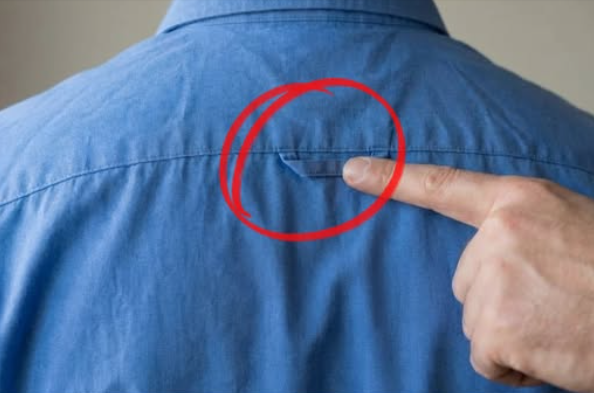
You’ve seen it a thousand times—glanced at it on the back of a shirt, perhaps tugged at it absentmindedly when hanging clothes, or noticed it catching the light for a brief second—and yet, most of us never truly look. That tiny loop, often stitched neatly into the collar or just below it, sits there like a quiet secret, a hidden detail that almost no one questions. It isn’t random. It isn’t simply decoration. Every shirt that carries it is, in some sense, carrying a piece of history, a small but deliberate signal from another era. Once you know what it really means, you’ll never be able to see a shirt—or that little loop—the same way again. It’s a clue, a code, and even, in some circles, a kind of forgotten love signal, a tiny reminder that clothing has always been about more than fabric.
The story begins over a century ago, in the tight, storage-starved world of early 1900s Navy ships. Sailors had very little room for their belongings, and their uniforms had to be kept neat, functional, and ready at a moment’s notice. Closets were a luxury they didn’t have, and drawers were scarce. Into this cramped environment came a clever solution: the “locker loop.” This simple fabric tab, sewn into the back of a shirt, allowed sailors to hang their shirts on hooks instead of tossing them over a bunk or onto the floor. It was functional, practical, and perfectly suited to life aboard a ship. A small detail, yes—but one that spoke to ingenuity and the simple need to keep life organized amid the chaos of the ocean.
From naval necessity, the loop quietly made its way into civilian fashion. By the mid-20th century, it appeared on crisp Oxford shirts and preppy wardrobes, particularly in Ivy League schools. There, it was less about practicality and more about subtle style, a tiny badge of detail that signaled craftsmanship and attention to nuance. Some even imbued the loop with secret codes and social meanings. Rumors circulated that students would cut off the loop to signal that they were in a committed relationship, a kind of wordless, unspoken signal understood only by those in the know. Girlfriends, it was said, sometimes wore pins or accessories to acknowledge the message. It became a thread connecting function, fashion, and flirtation, a tiny reminder that clothing often carries stories that are invisible until someone explains them.
Over the decades, the loop’s meanings evolved and multiplied. Today, it serves practical purposes again, particularly in travel. It’s the perfect little hook for hanging a shirt in a hotel bathroom, keeping it wrinkle-free and off of surfaces. Designers also use it as a signature flourish, a subtle mark that communicates a brand’s attention to detail without needing logos or labels. Yet the loop remains a small time capsule, connecting the decks of naval ships, the halls of Ivy League dormitories, and the everyday closets of people everywhere. It’s a reminder that even the tiniest piece of fabric can carry stories about practicality, culture, and human behavior.
So the next time your fingers brush that small strip of fabric on the back of a shirt, take a moment. You’re touching more than cloth—you’re touching history, ingenuity, and perhaps a little social intrigue. That tiny loop links sailors and students, style and function, past and present. It may seem insignificant, but in its quiet way, it tells a story that stretches across decades, across oceans, and across wardrobes everywhere. That loop is not just a piece of fabric; it’s a thread connecting lives, traditions, and even a little bit of mystery.