For fourteen years, my life revolved entirely around my family. Not in a romanticized, cinematic sense, but in the quiet, exhausting, relentless rhythm of everyday existence. Every morning before the sun rose, I was awake, packing lunches, checking homework, and brushing hair into place. Every night, past midnight, I folded heaps of laundry that somehow multiplied overnight, a silent monument to the life I had built.
I knew each dentist appointment, school spirit day, soccer game, and piano recital by heart. I could recite which child hated crusts, which needed their socks turned inside out, and which would cry if their sandwich was cut incorrectly. I knew every little quirk, every pattern, every need—and I met them all with devotion and exhaustion in equal measure.
I scrubbed dried macaroni from car seats, balanced stirring sauces while signing permission slips, and functioned on coffee and sheer determination. Somewhere along the way, I stopped noticing myself, the version of me that existed outside of lunchboxes and homework folders. And somewhere along the way, my husband stopped noticing me, too.
His name was Michael. We married young, full of dreams, promises, and that naïve confidence that love alone could make everything work. We believed we were a team. For a long time, we were. But as fourteen years and four children passed, everything shifted. Michael’s career became unpredictable, demanding, and all-consuming. My ambitions and schedule bent around the children’s needs and his work, until I realized that in holding everything together, I had disappeared from my own life.
The moment my world shattered came on an otherwise ordinary afternoon. I was in the laundry room, sorting socks from the second load of the day, humming absently, when my phone chimed. A text from Michael appeared:
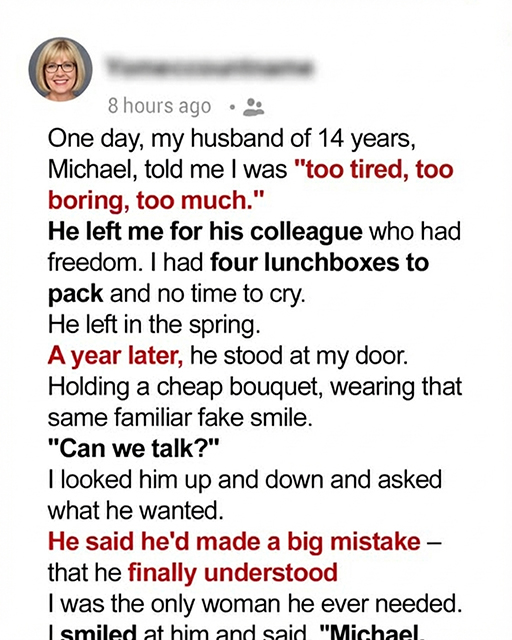
“I can’t do this anymore. I’m sorry. You’re too tired. Too boring. Too much. I need more from life.”
No warning. No discussion. Just those words, brutal and final.
The phone slipped from my hand. The room felt impossibly small. My chest tightened. He hadn’t just walked away from me—he had walked away from the life we had built together, from our four children, from the everyday moments that knit a family together.
Michael missed the important things—Owen’s final basketball game, Lily’s dance recital, bedtime stories, late-night math homework crises. He was gone. And the absence was deafening.
The next morning, social media brought the rest into focus. There he was, arm around Vanessa, a glamorous colleague, smiling against a city skyline, captioned Starting Fresh. My heart broke in half. My phone went flying across the room as Owen appeared, concerned:
“Mom? Are you okay?”
I forced a smile, pushed down my despair, and told the children the truth. Gently, honestly, but without sugarcoating the pain. I held them as they cried, reassured them it wasn’t their fault, and promised I wouldn’t leave. The work of living didn’t stop for grief—there were lunches to pack, homework to check, and little hearts to protect.
Days blurred. Wake up. School. Work. Pickups. Homework. Dinner. Baths. Bedtime. Repeat. Grief had no time to breathe. Nights became a private war, tears drowned in the shower, whispered apologies to the children that had no audience.
Eventually, I found myself again. I sold the piano Michael never touched and converted the guest room into a home office. I returned to full-time teaching, joined a book club, and laughed without guilt. Life slowly became mine again. The children stopped asking about Michael. I stopped checking my phone. Surviving became living.
Then, a year later, he came back.
I was alone in the house, grading papers, when the doorbell rang. There he stood—older, tired, apologetic, holding a cheap bouquet.
“Can we talk?” he asked.
I measured my response, wary but composed. “What do you want?”
“I made a huge mistake,” he said. “I see now what you held together. I want to come back.”
I gestured to the kitchen, and he stepped in. I let him speak, poured tea in the good cups my mother had given us. He spoke about Vanessa, the breakup, his regrets. I listened, silent but present.
Then I placed a folder on the table.
“What’s this?” he asked, curiosity tinged with fear.
“Open it,” I said. Inside were receipts, calculations, records—a year of absence, unvarnished and undeniable.
“I assumed you meant coming back as a father,” I said. “Not to undo a year of choices you made.”
Michael tried to protest, but the words didn’t matter. Choices had consequences. Every day of his absence was accounted for, every moment he missed, every memory he abandoned.
I walked him to the door, unshaken. He hesitated, then left.
The next morning, I dropped the wilted bouquet into the compost beside the garden my children and I had planted together, a small but symbolic act: the end of something broken, and the beginning of life reclaimed.
I had survived. I had rebuilt. And for the first time in fourteen years, I was fully, unapologetically, me.