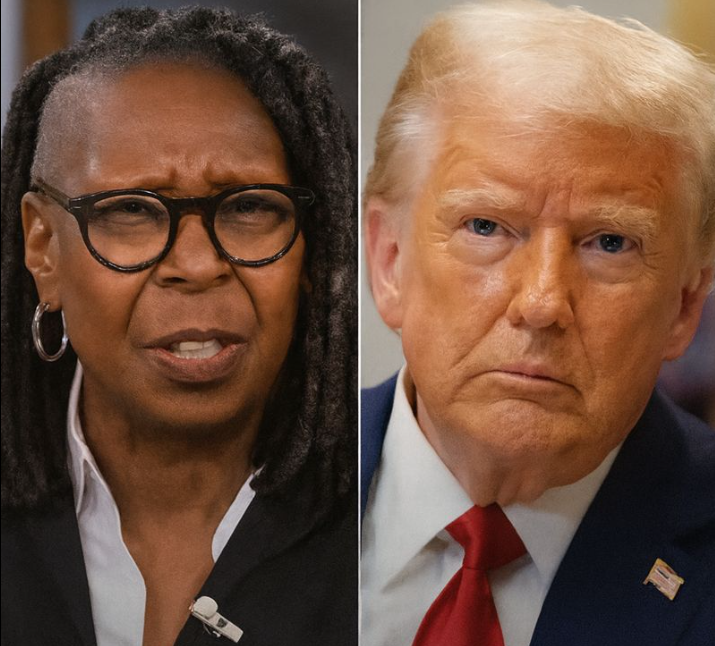
Whoopi Goldberg didn’t just disagree — she detonated. The moment she spoke on The View, her voice was raw, sharp, and unyielding. She accused President Donald Trump of reaching “a new low” with his reaction to the shocking deaths of Rob Reiner and Michele Singer Reiner. The weight of Hollywood’s grief collided with the chaotic frenzy of Washington politics, and in the center of it all, Trump’s words, Whoopi’s fury, and a grieving family created a spectacle that was both painful and revealing. The public watched as outrage and sorrow intermingled, leaving no room for neutrality. For many, it wasn’t just a disagreement over politics—it was a moral reckoning, a moment when the expectations of human decency were laid bare for all to see.
Whoopi Goldberg’s anger did not come from a place of performative outrage; it came from somewhere deeply personal. Rob Reiner was not just a famous director to her. He was a friend, a mentor, and a collaborator who had given her one of her most significant roles in Ghosts of Mississippi, a role that showcased her talent and reinforced her place in Hollywood. The news that Rob and his wife Michele had allegedly been killed by their own son was already unimaginable, a grief too raw for words. But then, she saw the president reduce that private horror into a political jab, a quip about “Trump Derangement Syndrome,” turning someone’s devastating loss into a punchline. For Whoopi, this was not merely wrong—it was a moral violation, a disregard for empathy and humanity that crossed a line she could not ignore.
On live television, she demanded what many of us hope for in moments of tragedy: empathy, reflection, and respect from the nation’s leader. She did not ask for partisanship or political debate; she asked for a recognition of the pain, for acknowledgment that some human experiences—especially those of loss and grief—transcend politics. She tied the Reiners’ tragedy to a larger context: a country on edge, recent mass shootings, and a society wrestling with fear and uncertainty. Co-host Ana Navarro amplified the critique, calling Trump’s post “shameful” and “disgraceful,” while even Marjorie Taylor Greene broke ranks with her usual rhetoric to insist that this was a family catastrophe, not a political weapon to be wielded for partisan advantage. The debate was fierce, but the central truth remained unassailable: a family shattered, friends mourning, and a nation forced to confront the boundaries of decency in public life.
Beyond the television cameras and social media outrage, the incident speaks to a larger conversation about leadership and human morality. In a moment meant for private mourning, a public figure used tragedy as a platform for mockery, and the backlash illuminated the gap between political opportunism and the responsibilities of empathy. Whoopi Goldberg’s response was not merely anger—it was a moral alarm, a declaration that some moments in life demand more than commentary or partisan posturing. They demand compassion, acknowledgment, and recognition of the irreducible humanity in every grief-stricken family. In the middle of the noise, one fact stands clear: behind every headline, every political jab, and every viral clip, there are real people suffering. And for them, basic decency is not optional—it is essential.