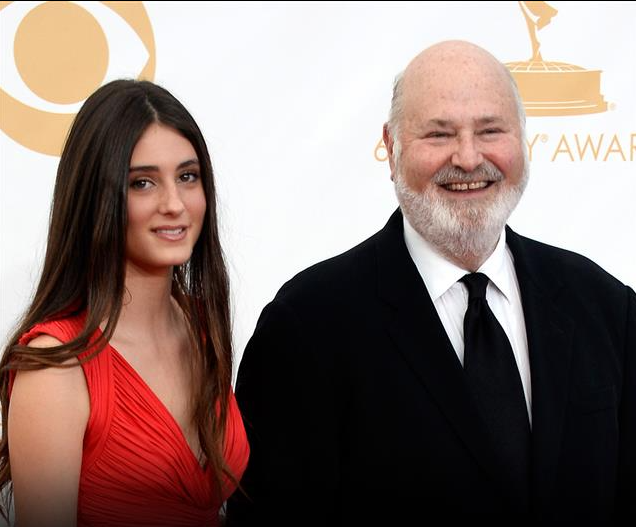
Tracy Reiner’s voice cracked as if the world itself had splintered into fragments too sharp to hold. In a single, unthinkable weekend, the life she knew was obliterated. Her father, the acclaimed director Rob Reiner, a man whose films had shaped generations with their tenderness, humor, and moral complexity, was gone. So was her stepmother, Michele, the quiet anchor who had kept their family grounded through decades of fame, scrutiny, and private trials. The circumstances of their deaths were cruel and jarring, a shocking rupture that no one could have anticipated. Headlines screamed the tragedy first, breaking across screens and papers like waves of disbelief. Details trickled in later, each more harrowing than the last, yet even the most careful reporting could not capture the depth of what Tracy felt. And yet, it was her words, uttered softly amid the chaos, that carried the raw human truth no news outlet could convey.
She did not speak like a celebrity issuing a rehearsed statement, nor did she offer platitudes designed to comfort a public audience. She spoke like a daughter whose world had collapsed, a woman standing at the center of grief so profound it threatened to undo her very being. Tracy described her family with the kind of awe and reverence reserved for legends or fairy tales, calling them “the greatest ever.” Those words—simple, almost childlike—rang against the backdrop of horror, carrying the innocence of someone attempting to make sense of a universe that had suddenly become unrecognizable. Her shock was not just for the violence or the tragedy itself, but for the abrupt erasure of ordinary, sacred family rhythms: the quiet breakfasts, the shared jokes, the small gestures of love and care that are often taken for granted until they vanish.
Behind the yellow crime scene tape, beyond the flashing cameras and the relentless questions of reporters, there had been a household alive with presence and devotion. Rob Reiner, known to millions as a filmmaker capable of crafting deeply human stories, had been a father whose pride in his children was palpable in every conversation, every quiet encouragement, every lesson about courage and kindness. Michele, devoted and protective, had safeguarded their family’s privacy, quietly managing the balance between public life and intimate connection. Their Brentwood home had been more than a residence—it had been a living archive of memories. Scripts lay scattered across tables, evidence of Rob’s lifelong devotion to storytelling. Photo albums lined shelves, capturing birthdays, holidays, and ordinary nights when laughter filled the rooms. Arguments and reconciliations, triumphs and disappointments, all coexisted in the intimate spaces of their life together. These details, invisible to the outside world, now became fragments of a narrative interrupted mid-sentence, a story that would never be fully told.
Tracy’s brief, trembling statement became more than news; it became the emotional epicenter of a tragedy that stunned a city, a nation, and the fans who had loved Rob Reiner’s work for decades. In her words, the ordinary and the extraordinary coexisted—the recognition of extraordinary loss intertwined with the ache for the ordinary moments that no one would see again. Her grief was a lens through which the world could begin to understand the private dimensions of loss: how it feels not just to lose people, but to lose the invisible structures of family, the rituals that shape identity, the quiet patterns of daily life that give meaning and safety.
As investigators moved silently through the shadowed halls of the Reiner home, tracing what had occurred, the public watched and speculated. Yet, it was not speculation, nor the brutal facts of a crime scene, that resonated most; it was the sense of life interrupted, the realization that a family’s story had been abruptly halted. Tracy’s voice, shaking but clear in its love and sorrow, reminded everyone that beyond the celebrity, beyond the fame and the films, there existed a human constellation—a father, a mother, a daughter—whose bond had been brutally severed. She became the conduit for collective mourning, the vessel through which private grief was rendered visible to a world struggling to comprehend it.
In that brief moment in front of the cameras, Tracy captured the fragility and resilience of family alike. Her words were small, but they echoed large: love is what binds us, laughter is what sustains us, and grief is the reminder of all that could be lost in an instant. Beyond the scripts and the awards, beyond the public persona of Rob Reiner the director, there was Rob Reiner the father, Michele the protector, and Tracy the daughter left holding memories too vast and too vivid to be fully contained. Theirs had been a life of stories—some shared with the world, others lived quietly behind closed doors—and now, in the wake of tragedy, the unfinished story demanded attention, reflection, and remembrance.
Even as the media cycles churned and headlines faded from public consciousness, the essence of the family’s life persisted in the details Tracy spoke of, in the invisible moments that had defined them. It was a story of love interrupted, yes, but also of love eternal—a love that could not be erased by violence or by time. And it was in that love, in the fragile, trembling, human voice of a daughter, that the true heartbeat of the Reiner family lingered, insisting on being remembered, even amid a world that can often seem indifferent to such quiet, profound grief.