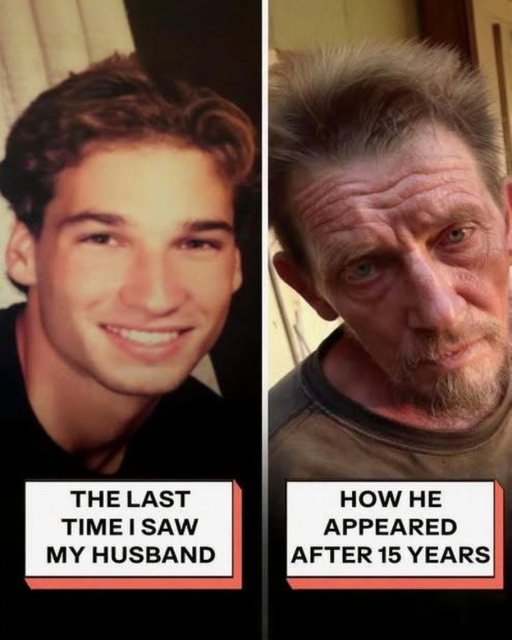
The morning after my grandmother left her last $2,600 for baby Liam, I woke to a silence that shattered everything — my husband was gone, and so was the money. Fifteen years later, the man who abandoned us returned with a threat that froze my son in place.
Sometimes, when I look back at the hardest parts of my life, the moments that felt like walking barefoot on broken glass, I realize just how quickly everything can change.
One day, you’re daydreaming about your future, and the next, you’re drowning in a reality you never asked for. For me, the crack that split my world in two happened when my son, Liam, was just a few months old.
My husband and I were young, sure, but mostly we were just exhausted. We stumbled through sleepless nights, smelling faintly of sour milk and desperation. I spent my days moving between motherhood and the faint, institutional smell of my grocery-store uniform. It wasn’t glamorous, but it was honest work.
But Derek wasn’t handling the sharp, sudden edges of adulthood well. He spiraled — and his anger wasn’t aimed at the universe for dealing him a rough hand. No, it was aimed squarely at me. He looked at me and saw the reason his life felt small. He spoke to me like I had robbed him of the success he believed he deserved.
Then came an unexpected moment of grace. My grandmother died, and amidst the grief and paperwork, I found an envelope. Inside was $2,600 and a handwritten note:
“For little Liam. Use it to give him something better.”
It wasn’t a fortune, but to a young mother drowning in overdue bills and a constant, low-grade fear, it felt like a lifeline.
When I showed Derek the money, his reaction caught me entirely off guard.
He grinned. “Great! Now I can finally get a set of golf clubs.”
Golf clubs. A luxury he’d been obsessing over for months, convinced carrying a fancy bag of clubs would make him look like a big shot at work. He needed to look successful, far more than he needed to actually be successful.
“That money is for Liam, Derek.”
He scoffed. “A baby doesn’t need it. He won’t even know the difference. I do. I’m tired of being a nobody.”
And that was the start of the fight that changed everything.
At first, we kept our voices down, a low, poisonous murmur in our cramped apartment. But soon, the words cut through the silence like knives. He blamed me. He blamed the baby. He blamed the whole world.
Finally, he backed me into a corner in our dimly lit kitchen, his eyes burning with a staggering sense of entitlement. It was terrifying. Down the hall, Liam cried from his crib. He needed me, needed protection. And in that raw, desperate moment, the choice wasn’t only about money anymore. It was about who I was and what was right for my son.
“I won’t give it to you.”
Derek’s hands flew up in frustration, and he stormed out of the kitchen. That night, I sat by the crib, rocking my newborn, and cried. Tears fell hot and fast, not just for the money, but for the future that seemed to dissolve around us.
The next morning, I woke to a different kind of silence. Cold. Empty. Derek was gone. My first instinct was to check on Liam. He was in his crib, soaked, hungry, screaming. I changed him and searched the apartment for a note — only to realize the envelope with my grandmother’s money was gone, too.
Hours later, Derek texted me:
“I’m done carrying dead weight. YOU AND THE BABY ARE NOTHING BUT ANCHORS. You’ll thank me someday.”
Thank him? For stealing his son’s future? For leaving us to face the storm alone?
He walked out of our lives that day. But fifteen years later, he returned in the most unexpected way.
Those fifteen years without him weren’t easy. They carved themselves into me, leaving lines of worry and strength around my eyes. I worked until my bones ached: waitressing shifts that ended at 2 a.m., cleaning offices before sunrise, checking groceries at the local market. I did whatever it took to keep a roof over our heads and food on our table.
We moved a lot, but each apartment was slightly better than the last. Sometimes, late at night, I would hold a stack of unpaid bills and feel failure wrap around my lungs like wire. Would we ever make it? Did he take the only chance we had?
Through it all, Liam was my light, my purpose, my impossible miracle. He never missed a chance to hold my hand walking to school, curled into my side during thunderstorms, a comforting weight. After a night shift, smelling of coffee and exhaustion, he hugged me tight, giving me strength to stand straight. He always said:
“We’ll make it, Mama. We always make it.”
And somehow, miraculously, we did.
He grew into a young man who was gentle, brave, and empathetic. He was a son defined not by the man who abandoned him, but by the love he grew up with. I truly thought we had buried Derek’s ghost for good.
But ghosts, as I learned, don’t stay buried long.
It started subtly. Liam, who had always been open and honest with me, started acting strangely. He was sulky, angry, even for a teenager. Then I noticed money disappearing from my purse — not much at first, but enough to notice.
I tried talking to him. “Liam, what’s going on? You haven’t been yourself lately.”
He didn’t look up. “Nothing, Mom. Leave it alone.”
I tried to reason with myself. It’s just a phase. He’s going through something. But deep down, a cold knot of fear tightened in my stomach. I felt like I was watching my sweet boy slowly turn into the man who had stolen his money and walked out on us.
Yesterday evening, everything broke loose.
I pulled into our driveway after work, humming a slightly off-key tune. The air smelled of freshly cut grass. For a second, I felt that simple relief of being home.
Then I saw them. Liam stood rigid in the yard, shoulders tight, fists clenched. Across from him stood a man — gaunt, ragged, swaying slightly, furious, spitting venom:
“You OWE me! Do you hear me? YOU OWE ME!”
Liam didn’t answer. His jaw locked, eyes flicking toward me, panic making my stomach drop. The man leaned in. “You don’t want your mother finding out WHO YOU REALLY ARE… do you?”
The color drained from Liam’s face. Slowly, the man turned. Sunken eyes met mine. Despite the years, the sickness, the hard life etched on his face — I recognized him. Derek. The man who stole my grandmother’s last gift, who abandoned us.
I didn’t think. My Mama bear mode activated.
“What are you doing here? How dare you talk to Liam like that? You know nothing about him!”
Derek sneered. “I know more than you think.”
He waved wrinkled medical papers at me. “I’m sick. I need treatment. And your son has been helping me. He should help me. I’m his father.”
I turned to Liam. “Is this true?”
“Yes,” he choked. “He found me months ago. He said he was dying and begged for help. He told me the truth: how you refused to give him money, forcing him to steal.”
My jaw dropped.
“Did he also tell you,” I fixed my gaze on Derek, “that the money he stole before he left us was from my grandmother, for your future? Did he tell you he wanted to spend it on golf clubs?”
“I deserved those golf clubs! You had no right to deny me. I was entitled!”
Liam’s eyes flicked from Derek to me, confusion and horror etched on his face.
He shook his head slowly. “Mom… I’m sorry. He told me you were the reason he left, that you destroyed our family. I didn’t want to hurt you. I didn’t know what to do.”
The weight he had carried for months hit me — he had been giving Derek money, believing it was his duty, believing I was the cause of the divorce, believing choosing me meant betraying a dying man.
Then Liam did something that made my heart swell. He stepped in front of me, tall, steady, protective.
“No. You don’t get to call yourself my father. You left, you stole, you lied, and you used me. I helped you because my mom taught me to be kind, not because you earned anything. But I’m not your wallet. I’m not your caretaker. You don’t get to threaten me, or my mother, ever again.”
Derek stumbled, sputtered incoherently, then disappeared into the twilight.
Liam turned to me, tears streaming. “I’m sorry, Mama… I didn’t want to betray you.”
“You didn’t betray me. You protected me in the only way you knew how. And you became everything he never was.”
Holding my magnificent, brave son in the dusk, I realized the truth: we were never broken by Derek.
How could we be? We were shaped by survival, forged in hardship, held together by unconditional love. Nothing he did — lies, threats, attempts at guilt — could undo the strong, beautiful family we built without him.
We were never anchors. We were the ship, and we had finally made it back to shore.