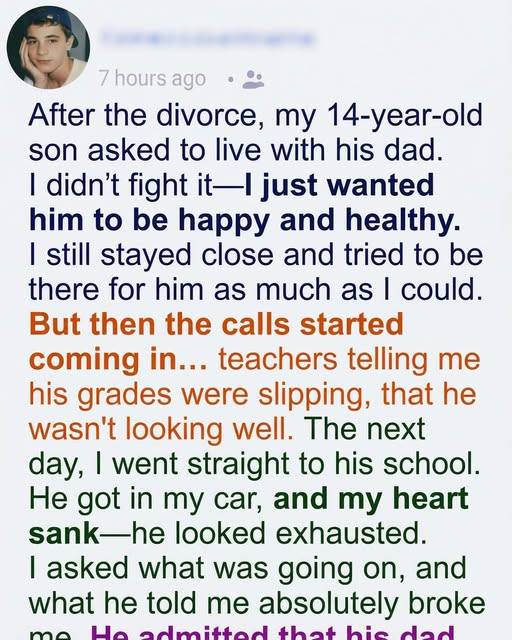
He stopped texting. The small, everyday messages that once marked the rhythm of our lives vanished overnight. No “good morning,” no “how was your day,” no random observations about homework or friends. He stopped smiling, too—not just the fleeting smiles that pass over a child’s face, but the kind that reaches the eyes, the kind that warms a room and reassures you that all is well. He stopped sounding like my son. His voice, once full of curiosity and lightness, now carried a weight I couldn’t place, a tone too old, too burdened for his years. I told myself it was just distance, just adjustment, just fallout from the divorce. I clung to those explanations because they were easier than facing the truth. But when the school called and told me his grades were slipping, that he seemed “elsewhere” in class, my chest tightened with a cold, rising dread that I could not shake. I drove through the rain that evening, each drop on my windshield echoing the uncertainty in my heart, not knowing that every step he took toward my car was carrying months of hidden pain, isolation, and sacrifice.
He slid into the passenger seat and, for a moment, said nothing. The silence between us was heavy, filled with unspoken words and the weight of what had been endured in private. His shoulders seemed smaller, his frame diminished by burdens no child should bear, and his voice sounded older than his years. Then, slowly, painfully, the truth began to spill out, in fragments, haltingly at first, then with growing urgency: the empty fridge he had pretended was a “diet,” the bills stacked on the counter he had tried to ignore, the nights spent alone in a dark house, pretending everything was fine so that neither parent would worry. He had been protecting his father’s pride and my peace of mind, quietly sacrificing his own well-being in ways no child should have to. Listening, I realized how much resilience and courage he had mustered just to survive each day, and my heart ached with a mixture of sorrow and admiration.
Bringing him home wasn’t a dramatic rescue, no triumphant music or heroics. It was a quiet, deliberate rearranging of our lives around what he truly needed—stability, presence, and the freedom to be a child again without fear of shouldering adult burdens. We rebuilt slowly, carefully: shared dinners became sacred rituals of conversation and laughter, consistent routines marked the days and gave him a sense of predictability, therapy sessions offered a safe space where his feelings, long buried, finally had room to breathe. I watched as color returned to his face, as the light of curiosity returned to his eyes, as laughter, hesitant at first, grew more frequent and genuine. I learned that love is not only about stepping back to give space, as I once thought. It is also about stepping in—gently but firmly—when silence starts to echo like a scream, when hidden pain threatens to go unnoticed. True love, I discovered, is about noticing the subtle signs, embracing the messy reality, and committing to stand beside the ones you care for, even when it feels impossible to fix everything at once.
Each day, as we rebuilt trust and presence, I realized that the smallest gestures—making breakfast together, walking him to school, sharing a joke—were as powerful as any grand intervention. Love doesn’t always announce itself with fanfare; sometimes it whispers in steady routines, in patience, and in the unwavering decision to be there, over and over again. And watching him reclaim his childhood, step by cautious step, reminded me that resilience is nurtured not through words alone, but through the constancy of care, the willingness to listen, and the courage to face the quiet desperation that had been hidden behind a young boy’s weary eyes.