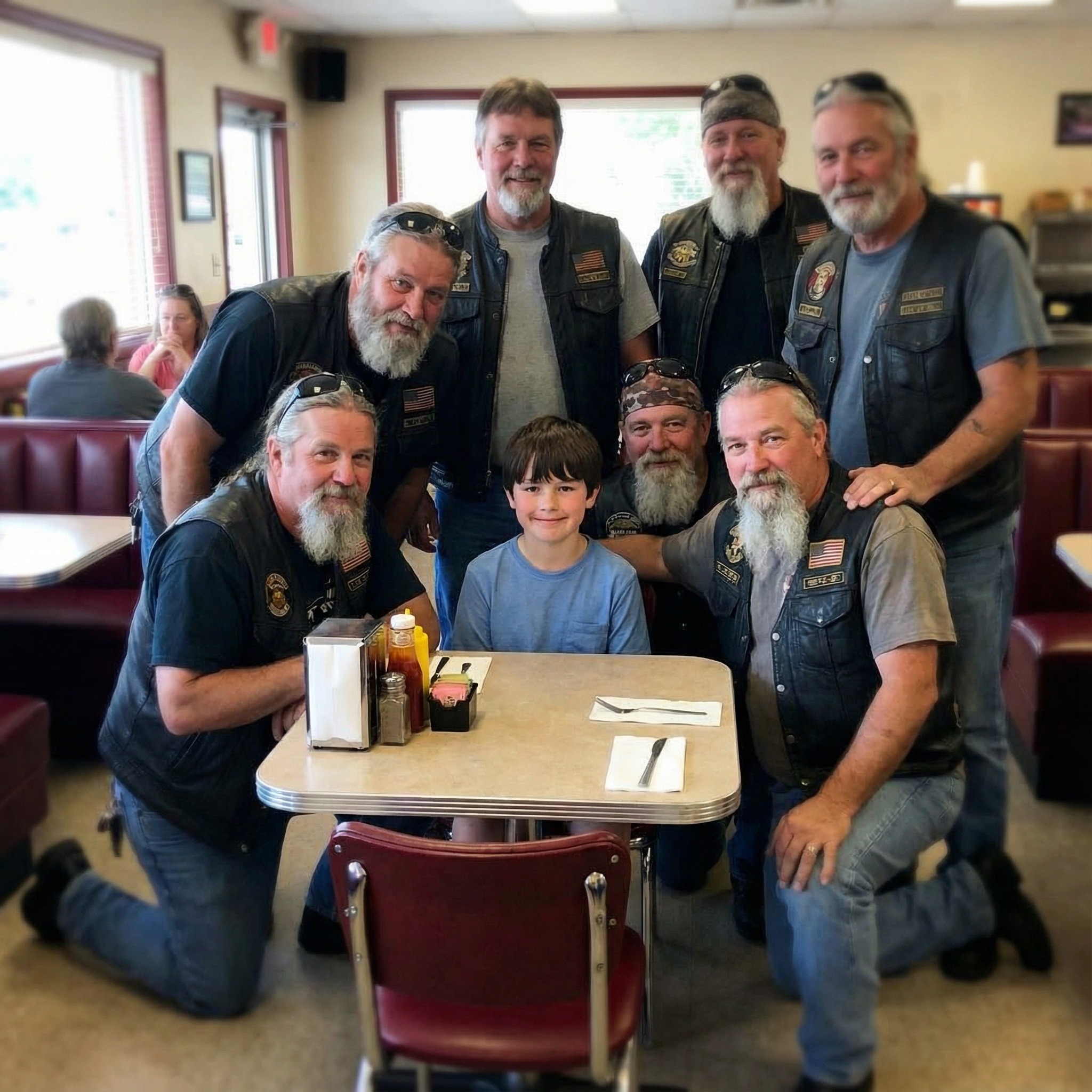
Marcus had struggled with his stutter since he was four, and by the age of nine, he had already experienced more cruelty than any child should. Some days, words flowed easily; other days, they got stuck, jumbled behind his teeth, leaving him red-faced and frustrated beyond his years. Kids laughed. Adults impatiently cut him off. Every mocking remark chipped away a bit more of his confidence.
That Saturday, three hours into a drive to my mother’s house, Marcus begged for a break to eat and use the restroom. Rosie’s Diner, with its neon sign buzzing above fifteen parked motorcycles, appeared on the roadside. A mix of leather, boots, and beards surrounded the place. I almost drove past, but Marcus squirmed in his seat, insistent.
“I r-really have to g-go, Mom,” he stammered.
Inside, eight bikers had combined three booths, their laughter filling the room. I guided Marcus to a distant booth and ordered his favorite—pancakes—his comfort food no matter the hour.
While waiting, a family of three boys slid into the booth behind us. Their mother kept her eyes glued to her phone as the boys bounced around like they’d never been taught boundaries.
When Marcus went to the restroom, he politely said, “E-excuse m-me,” as he passed their table.
One boy snorted, imitating him, “E-excuse m-me,” dragging the stutter out mockingly. The other two erupted in laughter.
Marcus froze, cheeks burning, and ran to the restroom.
“That’s unacceptable,” I said, trying to control my anger. “Apologize. Now.”
Their mother sighed, annoyed. “They’re just kids. Relax.”
“They’re bullying my child,” I said.
“It’s a joke. Maybe your son needs thicker skin.”
I clenched my jaw and turned forward, forcing myself to breathe.
When Marcus returned, the boys were ready again.
“W-w-want to play?” one taunted.
“W-what’s your n-name?” another mocked.
“R-r-r-retard!” the third spat out, and laughter followed.
Marcus stopped mid-diner, shoulders shaking, tears streaming, unable to speak.
And then, all eight bikers stood simultaneously.
The diner went silent. Even the waitress froze.
The largest biker, a towering man with a thick beard, approached the boys’ booth, boots thudding against the floor. Their mother straightened, her previous irritation replaced with fear.
“Is there a problem?” she asked weakly.
He ignored her, eyes locked on the boys.
“You think stuttering is funny?” he asked, his voice low, carrying weight.
The boys shook their heads frantically.
“I asked you a question.”
“No, sir,” the oldest whispered.
“That man back there,” he pointed to another biker, gray-haired and kind-eyed, “—he’s my little brother. He’s stuttered for sixty-two years. You want to mock him too?”
The boys began to cry.
The gray-haired biker knelt beside Marcus.
“H-hey, buddy. I’m J-Jimmy,” he said gently, stammering himself. “What’s your n-name?”
“M-Marcus,” my son whispered.
“That’s a g-great name,” Jimmy smiled. “I’ve st-stuttered all my life. And I’ve learned something—those who laugh at us? They’re scared. Talking with a stutter takes more courage than talking normally. Every word we manage to push out is a w-win.”
Marcus’s expression softened. He was truly listening.
Jimmy pulled a small laminated card from his vest, a motorcycle emblem gleaming on it.
“This is an honorary G-Guardian card. We give it to people who show courage. You’re one of them now.”
“You m-mean… I’m a Guardian?” Marcus whispered, eyes wide.
“You bet. Guardians look out for each other.”
Across the diner, the big biker addressed the boys’ mother.
“Your sons mocked this child in public. And you told his mother to relax?”
Her face went pale.
The club chaplain added, “The way we treat the vulnerable defines who we are. Your boys failed. And so did you.”
The room was silent, absorbing every word.
Then the oldest boy walked to Marcus.
“I’m really sorry,” he mumbled. “My grandpa can’t talk right after his stroke. I shouldn’t have done that.”
Marcus swallowed, then said clearly, “It’s o-okay. Just d-don’t do it again. To anyone.”
The bikers quietly cheered. They shifted booths, spent the next hour talking to Marcus as an equal, not a stuttering child.
Marcus spoke more in that hour than he had in months. Yes, he stuttered, but they never rushed him.
As we left, each biker shook his hand.
“Stay strong, little Guardian.”
“You ever need anything, call us.”
“Your voice matters, brother.”
Jimmy hugged him tightly. “You’re one of us now, M-Marcus.”
Marcus hugged back. “Th-thank you.”
On the drive, Marcus stared at the Guardian card with pride.
“Mom?” he asked.
“Yeah, baby?”
“T-they were the n-nicest people ever.”
“Yeah,” I said. “Yeah, they really were.”
Six months later, Marcus carries the card everywhere. He’s visited the Guardians clubhouse, helped with charity rides, and made friends who honor him for who he is.
His stutter remains. But the shame? Gone. Replaced with something stronger—self-worth.
Those bikers didn’t just stand up that day. They lifted him up—and changed the course of his life.
Marcus is proud of himself now, of his voice, and the courage it takes to speak every day.
And every time he shows that Guardian card and tells the story—stutter and all—I remember this truth:
The world isn’t shaped by those who mock.
It’s shaped by those who stand.