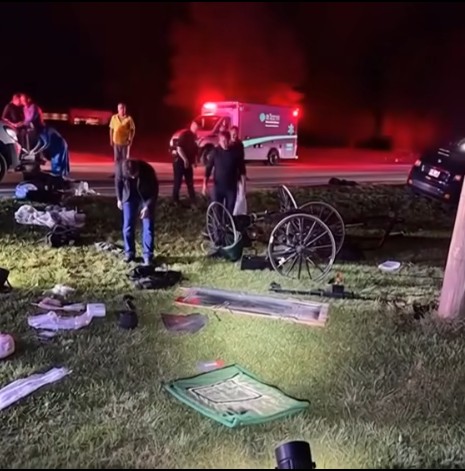
A quiet October night in rural Indiana turned deadly in seconds when a Jeep collided with a horse-drawn Amish buggy on State Road 218 near Berne. What should have been a peaceful ride home for one family became a chaotic emergency scene stretching across the dark highway. First responders arrived just after 11:20 p.m. on October 7, and what they found was grim: a shattered buggy scattered across the pavement, debris strewn in every direction, and a Jeep crumpled into a ditch.
The buggy carried nine passengers—a heavy load even under ideal conditions, and a dangerous one on a rural road at night. Seven occupants were injured seriously enough to require medical attention, including six juveniles. The driver, 32-year-old Ruben L. M. Schwartz of Berne, sustained the most critical injuries and was airlifted to Lutheran Hospital. Joseph L. M. Schwartz, 20, along with five children, were transported by ambulance to Parkview Hospital. Two other passengers—32-year-old Saraetta L. Schwartz and a 2-year-old child—declined treatment at the scene, shaken but physically unharmed.
According to Adams County Sheriff Dan Mawhorr, the Jeep was driven by 33-year-old Bradley J. Ocilka of Burlington, Kentucky. Traveling eastbound, he struck the buggy from behind. Buggies move slowly, especially at night, and their lanterns and reflective markers often make them difficult to see until it’s too late. Ocilka underwent a legal blood draw at the hospital but refused additional medical care. No charges had been filed as of the initial reports, though investigators emphasized that the investigation was ongoing.
Within minutes, emergency personnel filled the scene. Adams County EMS, the Berne and Geneva police departments, the Berne Fire Department, Wells and Jay County EMS, the Indiana State Police, and the Lutheran Hospital Flight Team all responded. The rural road became a temporary command center as crews worked quickly to stabilize patients, clear debris, and manage the frightened horse. First responders described the scene as chaotic—twisted wood, scattered personal items, a crumpled Jeep, a terrified horse, and panicked children and adults trying to process what had just occurred.
Photos released later illustrated the devastation: the buggy splintered and broken, its wheels askew, debris and personal belongings littering the road. Emergency vehicles lined the highway, their flashing red and blue lights cutting through the dark farmland. These roads are familiar to Adams County’s large Swiss-Amish population—daily routes for school, work, worship, and family visits. A crash like this resonates throughout the entire community, affecting not only the immediate household but an extended network of relatives and neighbors who share responsibilities, traditions, and mutual support.
Traveling by buggy at night is always risky. Modern drivers often misjudge a buggy’s speed or fail to leave enough space, and rural roads allow little margin for error. Safety experts repeatedly warn: slow down, maintain distance, and anticipate sudden stops. Reflective markers, lanterns, and battery lights help, but they cannot fully compensate for inattentive drivers.
This accident is a harsh reminder of the vulnerability of horse-drawn vehicles in a world built for speed. A single misjudgment, distraction, or delayed reaction can turn a routine journey into a life-altering tragedy. While the Amish accept these risks as part of their way of life, every crash deeply impacts families and the community—especially when children are involved.
Neighbors quickly mobilized to support the family. In Amish communities, assistance arrives almost immediately: meals prepared, chores taken over, children cared for, and emotional support offered quietly but steadfastly. The Schwartzes, like many families affected by tragedy, will not face recovery alone.
Investigators continue to piece together the events leading up to the crash. Crash reconstruction, witness interviews, vehicle inspections, and blood tests take time, and while no charges had been filed initially, that is common in early investigations. Authorities stress that updates will be released as more information becomes available.
For local drivers, the message is clear: slow down. Buggies will always travel these roads, moving at a pace that may frustrate modern motorists—but impatience is no excuse for recklessness. A moment of caution can prevent a lifetime of consequences. For those wishing to help the family, local churches and community groups often coordinate support or recovery funds. Meals, donations, or prayers are welcome, but privacy and respect for the family’s grieving process are paramount.
The Schwartzes face a long road ahead. Physical injuries will heal in time, but emotional wounds may linger. Children who were thrown from a buggy at night will carry memories of terror, and adults responsible for them bear their own burdens of guilt, even if they did nothing wrong.
Yet rural Indiana knows how to rally in times of tragedy. The Amish will shoulder much of the emotional weight, and the surrounding English-speaking community has already begun offering support. Crashes like this remind everyone that, on these roads, anyone can become a victim in an instant.
The investigation continues, and charges may follow. Regardless of the outcome, the message remains: when sharing the road with horse-drawn vehicles, slow down, pay attention, and give more space than you think necessary.
Lives depend on it—as this family painfully learned.