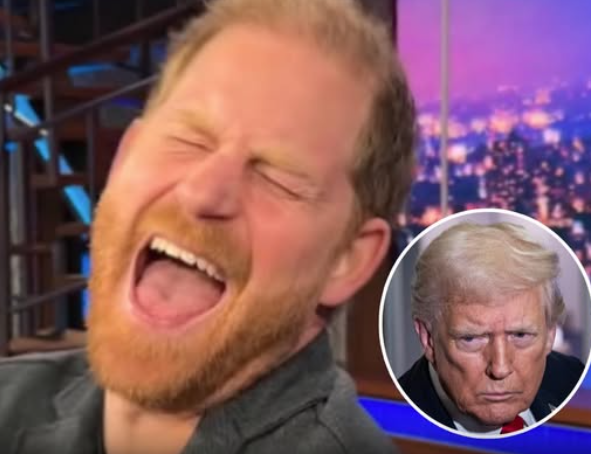
Harry didn’t hold back. One razor-sharp joke on live television sent shockwaves across both sides of the Atlantic, igniting a political and royal firestorm that few could have predicted. It wasn’t just a punchline; it was a calculated, pointed remark that immediately drew gasps, laughter, and instant headlines. In a single sentence, Harry reminded the world that while he may have stepped away from the formal duties of royalty, he still wields a remarkable power: the ability to turn a seemingly innocent talk-show moment into a global talking point. Trump, unsurprisingly, has already escalated the tension, threatening deportation. And now, the prince has placed himself squarely in the crosshairs of American politics, mocking a former president in front of millions of viewers — all while the audience’s reactions spoke volumes about the delicate balance he is navigating.
Prince Harry’s appearance on Stephen Colbert’s show had initially seemed like a lighthearted Hallmark-style segment, a moment for playful jabs and cultural banter. Colbert joked about America’s fascination with royalty, referencing the enduring allure of the monarchy and the public’s appetite for glamour, titles, and historical intrigue. Harry, with the calm poise and understated wit that has become his hallmark, delivered a line that was anything but innocent: “Really? I heard you elected a king.” The audience’s immediate reaction — a mix of boos, laughter, and nervous murmurs — underscored just how raw the political sensitivities surrounding Trump remain. What might have been a passing quip in any other context suddenly carried enormous weight. For a royal exile, navigating the treacherous waters of U.S. politics, the joke was both bold and perilous.
The quip did not exist in a vacuum. It landed atop months of simmering tension between Harry and Trump, and more broadly, between the British royal family and the complex realities of public perception in America. Trump has repeatedly said he “wouldn’t protect” Harry if he were to return to the White House and has suggested, in public statements and social media posts, that the prince could face deportation if he had misrepresented past drug use on his visa. This escalation of threats transformed Harry’s lighthearted humor into a high-stakes political gesture. In that context, what might have been seen as cheeky or playful takes on a new meaning: a member of a royal family openly challenging and mocking a powerful former head of state on his own turf.
The implications are profound. Harry, already estranged from his own family and living in self-imposed exile, is now signaling that he is willing to risk not just familial friction but an international incident by engaging directly with U.S. political tensions. His joke, while brief, carries the weight of both defiance and strategic positioning. Is it bravely honest, revealing a refusal to be silenced or intimidated? Or is it recklessly provocative, potentially opening a new front in the media war that surrounds both the former president and the prince? The answer is unclear, but the effect is unmistakable: Harry has staked a claim in the public imagination that he is unafraid to speak, even when the cost could be high.
Moreover, the moment highlights the intersection of celebrity, politics, and monarchy in the 21st century. Harry’s words were not delivered in private chambers or carefully edited interviews; they were broadcast to millions of viewers in real time. The reaction of the audience — the audible gasp, the laughter, the scattered boos — demonstrates the tension inherent in his position. He exists simultaneously as a former royal, a private citizen, and a global public figure whose every word is scrutinized through multiple lenses: cultural, political, and personal. In this environment, a single joke becomes more than humor; it becomes a statement about identity, courage, and the precarious dance between power and perception.
The broader context cannot be ignored. For months, media narratives have speculated about Harry’s willingness to challenge not only the traditional expectations of the British monarchy but also the conventions of global diplomacy. His life in exile, his public statements about family, and now his pointed comments about American politics reveal a figure willing to leverage his platform, charisma, and media presence to command attention. And while some critics may view his approach as confrontational or ill-advised, the impact is undeniable: Harry has forced the public, and the media, to confront the evolving role of royalty in a modern, politically charged world.
Ultimately, the joke made one thing abundantly clear: Prince Harry is not backing down. He is willing to face backlash, criticism, and potentially even legal or diplomatic consequences to assert his voice. In doing so, he transforms a simple talk-show moment into a far-reaching cultural and political event — a reminder that in an era dominated by social media, television, and globalized news cycles, humor can be both weapon and shield, commentary and confrontation. For millions watching, it was more than a joke. It was a bold declaration of independence, wit, and willingness to challenge authority on the world stage.