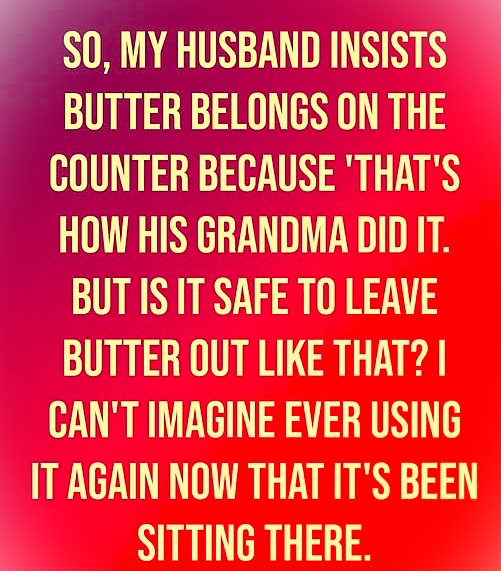
Not money. Not betrayal. Not some enormous relationship-ending tragedy. Butter. A simple porcelain dish sitting on the counter like a tiny domestic landmine. To me, it looked like a breeding ground for bacteria, a quiet invitation for sickness. To him, it looked like comfort — the way his grandmother always kept it, soft enough to spread on warm bread without tearing it. One text to my sister, one annoyed Facebook post from him, and suddenly our kitchen wasn’t a kitchen anymore. It was a courtroom. A battlefield. A mirror reflecting every unspoken fear we’d both carried into our life together.
But the butter was never really the issue.
What looked like a childish argument about food safety was actually a collision of memories and wounds we didn’t know we were protecting. He wasn’t fighting for a dish; he was fighting for a piece of his grandmother — the woman who raised him when no one else did, who taught him that softness, not anger, was strength. Every time he left that butter out, he felt her hands beside him in the kitchen, humming, laughing, making a home from almost nothing.
And I wasn’t panicking about germs. Not truly. I was fighting for the safety I never had growing up, trying to build a home where nothing could surprise or hurt us. I grew up in chaos — food that spoiled, bills that lapsed, rules that changed without warning. Cold butter meant control. Predictability. Proof that nothing in my adult life would fall apart the way everything did when I was a child.
Two entirely different childhoods clashed in a single porcelain dish.
For days we talked in circles, always debating butter, never touching the ache underneath. The tension seeped into everything — the way we cooked, the way we touched, the way we hesitated before speaking. The kitchen felt smaller, tighter, like the walls were waiting for us to snap.
But then something shifted.
We sat down one night with no intention to argue. The conversation wasn’t planned; it just spilled out of us. He told me about his grandmother’s kitchen — the smell of yeast bread, the sound of rain on the roof, the way she made him feel like nothing bad could reach him inside those walls. I told him about my childhood refrigerator — how food sometimes went bad, how I had gotten sick and no one noticed, how I still checked expiration dates like prayers.
Suddenly the porcelain dish didn’t look like a threat to either of us.
It looked like a story.
Once we named the truth, everything softened. The butter dish stopped being a battleground and became something gentler — almost an altar, a reminder that what we fight about is rarely what we’re fighting for. The framed photo of his grandmother on the shelf no longer felt like an argument waiting to happen; it felt like a shared inheritance, a bridge between who we were then and who we’re trying to become now.
We learned something important:
Compromise is never about winning. It’s about understanding.
It’s about asking, “What does this really mean to you?”
And listening hard enough to hear the answer beneath the explanation, beneath the defensiveness, beneath the sighs.
In the end, we made a simple agreement.
The butter stays in the fridge.
The memories stay warm on the counter in other ways — stories, recipes, rituals that don’t give me food-poisoning anxiety. We honor her without sacrificing the safety I need.
Because the truth is, we chose each other over being right.
And that choice, unlike the butter, will never go bad.