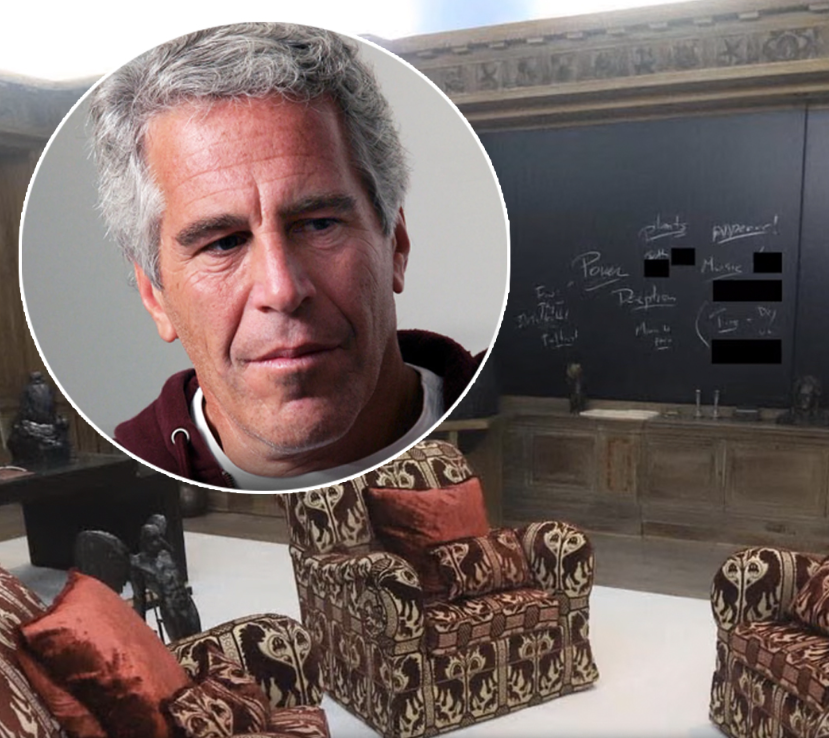
Democrats have released a new batch of Jeffrey Epstein island photos, and the material is far more disturbing, cryptic, and psychologically unnerving than anyone anticipated. What was expected to be routine documentation has instead ignited a wave of confusion and suspicion across the internet. A dentist’s chair sitting inexplicably in the middle of an improvised examination room. A collection of masks that look theatrical, ceremonial, or perhaps symbolic. A chalkboard scrawled with fragmented, incomplete words — some clearly visible, others aggressively blacked out by officials. And when people compared these newly published images to older versions, they noticed immediate inconsistencies: objects that once appeared are now missing, angles that once existed have been cropped, and details that were once clear have been obscured. To many observers, it feels less like transparency and more like a puzzle deliberately missing its most important pieces.
The photos aren’t disturbing solely because of what they show, but because of what they suggest. The chaotic dentist’s office — equipment scattered, tools left out, a chair facing a blank wall — doesn’t look medical; it looks staged, improvised, or repurposed for something entirely different. The masks, lying around as if discarded after a performance, hint at ritualistic behavior or psychological manipulation rather than innocent decoration. And that chalkboard has quickly become the center of online obsession. Viewers are zooming in on every blurred letter, every erased line, wondering why some phrases are allowed to remain while others have been redacted. If the objective was transparency, why present the public with something that appears selectively censored?
Instead of closing the case, the new images open dozens of new corridors of speculation. They feel less like an archive and more like a glimpse into the psychological ecosystem Epstein built — a private world designed around secrecy, control, and the quiet assurance that he was untouchable. The environment itself becomes a character: the strange décor, the mismatched furniture, the eerie stillness frozen in each photograph. Everything looks out of place, yet intentional. And that, to many, is what makes them so unsettling.
Adding fuel to the reaction are the photos showing Epstein smiling comfortably next to global elites, celebrities, academics, and even religious figures. These images re-emerge in the public consciousness every time new evidence is released, reminding people not just of Epstein himself, but of the network of influence that once shielded him. The photos don’t answer the questions that really matter — who knew what, who participated, who protected him — but they do underscore how deeply he had embedded himself into the highest reaches of power. The contrast between the bizarre, claustrophobic interior shots of the island and the polished, luxurious images of Epstein mingling with influential figures creates a narrative of duality: a front-facing world of privilege masking a hidden world of secrecy.
For survivors and advocates, this cycle is emotionally draining. Each new document dump promises revelation, justice, or at least a significant piece of truth. Yet what arrives feels partial — fragments that hint but never confirm, pieces of a confession without the accountability. Anger mixes with despair. Outrage mixes with resignation. People feel as though they’re being shown just enough to keep the story alive, but not enough to expose the full structure that allowed Epstein to operate for so many years.
What is increasingly clear is that transparency remains selective. The redactions, the mismatched archives, the missing frames — they all create the impression that the public is still being managed, not fully informed. It feels like a controlled leak, not an open disclosure. And until the unanswered questions are addressed directly — the complete list of names, the networks of protection, the institutions that looked the other way — these images will remain haunting, incomplete, and heavy with implications.
Rather than offering closure, this new wave of photos feels like an unfinished confession that stops just before the truth. And that, perhaps, is why they are more unsettling than anything released before.