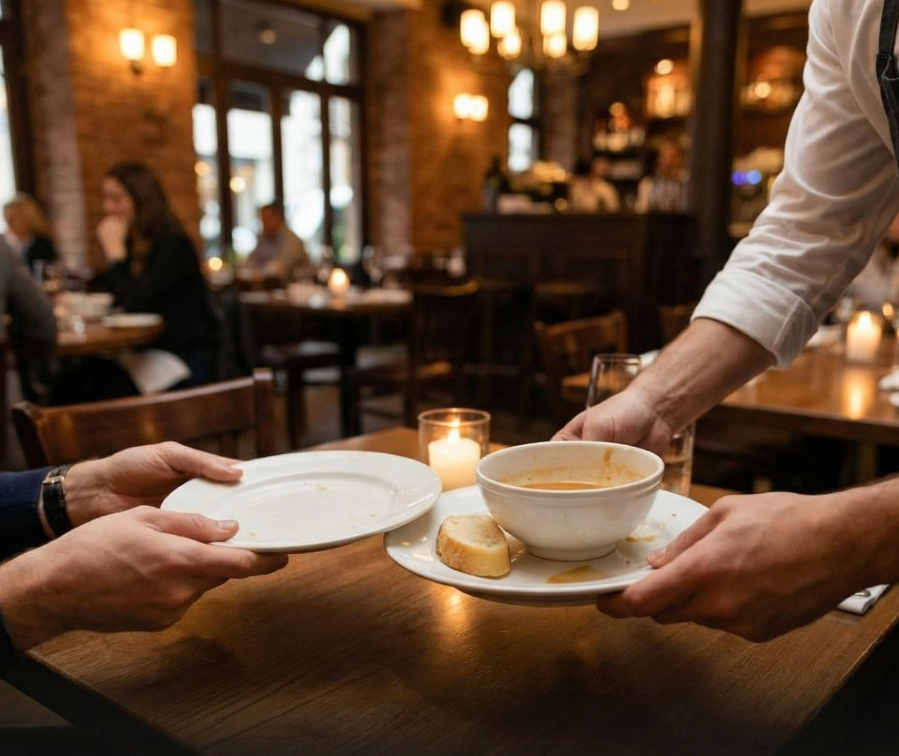
The plate leaves their hand—and in that moment, it speaks louder than words ever could. Amid the blur of clattering dishes, ringing bells, shouted orders, and overworked staff rushing from table to table, one subtle motion can reveal the essence of a person in a way no conversation ever will. The world of dining is frantic, chaotic, and loud, yet within it, the quiet choices—those almost imperceptible decisions to act or not act—carry enormous weight. A diner who instinctively notices the server struggling, who steps in without seeking recognition or applause, is signaling something far deeper than manners: an instinctive understanding of human effort, empathy, and shared responsibility. Psychologists, sociologists, and behavioral researchers agree that these tiny, almost invisible gestures often split the room into two categories of people, and the distinction runs deeper than etiquette. It’s about character, perception, and the way one sees the world.
Consider the mechanics of a busy restaurant. The clatter of silverware against plates, the hiss of the espresso machine, the sharp cadence of orders being shouted back and forth—it’s sensory overload. Servers move like dancers caught in a complicated choreography, their arms full, their eyes scanning, their minds calculating what to do first. In this chaos, the diner who merely notices the strain of a single hand carrying multiple dishes demonstrates a level of awareness that transcends ordinary attentiveness. This is a person who has either felt the weight of pressure themselves or possesses the rare ability to imagine it vividly. Their response isn’t performative; it’s intuitive. They step in not to speed up service, not to earn a smile, but to recognize the humanity of the person in front of them. A plate might seem insignificant, a gesture trivial, yet in that quiet intervention lies an entire philosophy of empathy in action.
Empathy in this form is layered. It combines social intelligence, self-assuredness, and humility. The individual reads the room with a fluidity born of experience, understanding not only what is happening, but what is needed without asking for validation. They act without hesitation or self-consciousness, and crucially, without judgment. No task is beneath them, no moment too small to merit attention. When someone instinctively clears a space for a struggling server, stacks plates left askew, or hands over a fork or napkin at just the right time, it softens the stress of the shift and offers relief without fanfare. This is quiet leadership, manifest not in a title but in action, visible only to those who know where to look.
Cultural norms and personal boundaries shape the way such gestures are expressed, but intention remains the core. The deliberate, selfless choice to care—however small—transforms spaces and interactions in subtle but lasting ways. Observers may notice a slight smile of gratitude, a fleeting nod of acknowledgment, or perhaps nothing at all, and yet the impact is undeniable. The rhythm of service improves, tension decreases, and the space itself feels lighter. The simple act of noticing and stepping in quietly communicates a profound truth: shared spaces function best when people act with awareness and compassion, when they understand that everyone’s work, however hidden, deserves recognition.
Moreover, the effect extends beyond the individual server or the immediate act. Other diners watch, consciously or unconsciously, and the room absorbs the example. A small gesture creates a ripple: a child sees it and learns, a colleague at another table notes it and imitates it, and the staff feels a rare sense of being seen and valued. The smallest interventions—a plate moved, a chair nudged, a glass refilled without being asked—carry disproportionate influence, reminding everyone present that the quality of an environment is shaped as much by care as it is by efficiency.
Ultimately, the diner who notices, acts, and intervenes in that moment communicates a quiet moral stance. They are saying, without words, that other people’s work matters. That effort deserves acknowledgment. That human connection is more important than personal convenience or anonymity. It’s a lesson in humility, attentiveness, and unspoken generosity: a demonstration that the rhythms of a busy world can be softened by conscious choice. In a society increasingly distracted by self-interest and digital noise, the ability to pause, observe, and act quietly is revolutionary. One plate, leaving one hand, can carry a message more profound than any speech: we see you. We care. And that small, unheralded decision transforms not only a single table or shift, but the subtle social contract by which civility and empathy survive.