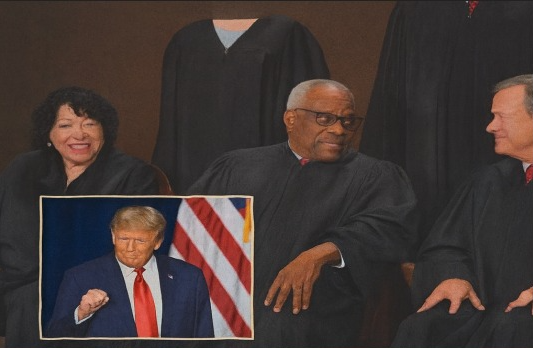
The ruling hit like a shockwave, one of those rare moments when the machinery of government shifts under the weight of a single decision. In a single 8–1 vote, the Supreme Court did far more than interpret law—it altered the trajectory of hundreds of thousands of lives, lives that had been quietly building, planning, and hoping under a fragile promise. For families who thought they had found some semblance of safety, the ruling tore open a new layer of uncertainty. Jobs they had relied on, homes they had invested in, and the futures of children born on American soil now hang in a delicate balance, at the mercy of shifting interpretations and political winds. Washington moved quietly in the background, recalculating the human stakes, while affected families grappled with a truth that had always lurked just beneath the surface: “temporary” can last a lifetime, and yet it can end abruptly with the stroke of a pen.
The Supreme Court’s ruling did not offer neat clarity. It did not draw lines that families could follow or guarantees they could cling to. Instead, it affirmed the executive branch’s sweeping authority over Temporary Protected Status, a power that places the stability of countless lives squarely in the hands of administrations whose priorities and interpretations may shift with every election cycle. TPS holders—individuals and families who have worked hard, paid taxes, and raised children in the only country many of them have ever truly called home—have relied on “temporary” status that stretched over decades. They built routines, bought homes, enrolled children in schools, and participated in communities, all under the assumption that their contributions mattered and that they could, in some way, trust the promise of continuity. The Court’s decision, by shifting ultimate control to the executive, transforms that tenuous trust into a daily calculus of risk, uncertainty, and anxiety.
Supporters of the ruling hail it as a necessary clarification: immigration and foreign policy decisions are the prerogative of the executive branch, not the judiciary. From this perspective, the Court has restored the proper constitutional order, ensuring that policy—and the consequences that come with it—are implemented by elected officials who can be held accountable at the ballot box. Yet critics argue that the human cost of this interpretation is enormous. For communities built over decades, the legal validation of executive discretion means that their lives can be uprooted almost overnight. Families may face fractured communities, job insecurity, and the terrifying prospect of returning to environments they fled years ago, all without warning or recourse. The ruling does not acknowledge the human bonds, the schools, the jobs, and the neighborhoods that have been painstakingly cultivated over generations.
In the wake of the decision, agencies charged with administering TPS protections are now tasked with weighing whether to renew, reshape, or end them entirely. Each new policy announcement carries a cascade of consequences. One letter from an immigration office can ripple through a community, disrupting education, employment, and healthcare access. Suddenly, children who had always assumed their lives were secure wonder if they might be forced to leave the only home they have ever known. Parents who had planned for years to provide stability now navigate a constantly shifting legal landscape, their hard work and dreams subject to the unpredictability of political change.
Beyond the administrative and legal complexities lies a profound moral question: what responsibility does a nation owe to people who built their lives under a promise never truly meant to be permanent, yet became the only home they knew? These families are not abstract statistics—they are neighbors, co-workers, teachers, doctors, and friends. They have participated in civic life, paid taxes, and contributed to the social and economic fabric of their communities. The Court’s ruling, by reaffirming the impermanence of their status, forces the country to confront the tension between legal authority and human consequence.
The ruling, therefore, is more than a legal interpretation—it is a human reckoning. It asks every American to consider the fragility of the lives that intersect with policy and law. Families who once relied on “temporary” protections must now prepare for rapid change, uncertain outcomes, and the possibility of returning to danger or displacement. Yet within this uncertainty lies resilience: communities are organizing, advocacy groups are mobilizing, and TPS holders continue to build their lives with courage and determination. The Supreme Court may have drawn a line of authority, but it cannot erase the human stories, the schools filled with children, the workplaces staffed by those who rely on TPS, or the communities that have been strengthened by their contributions.
Ultimately, the ruling serves as both a legal marker and a moral challenge. It clarifies the bounds of executive power, yet it simultaneously illuminates the profound human cost of “temporary” decisions. Jobs, homes, and futures hang in the balance, yes—but so too does a nation’s reckoning with its own principles, responsibilities, and compassion. As families wait, watch, and prepare for what comes next, the decision underscores a truth that cannot be ignored: law can define authority, but it cannot erase the lives built within it, nor the hope that sustains them.