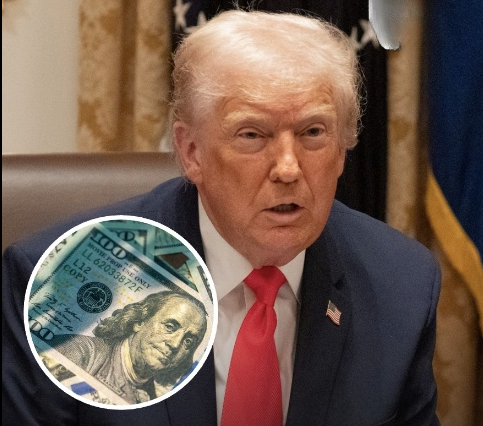
A $2,000 promise in a country drowning under the weight of mounting bills, credit card debts, student loans, and everyday expenses was always going to ignite a mixture of hope, skepticism, and outright debate. When Donald Trump first unveiled the idea of a $2,000 “tariff dividend,” he framed it as a lifeline for ordinary Americans, a sudden injection of relief in the midst of economic stress that has touched every corner of households across the nation. Families already juggling mortgage payments, daycare costs, and skyrocketing grocery bills immediately began calculating how the money could be spent—some dreaming of catching up on overdue rent, others imagining long-postponed repairs, and a few hoping to finally save for college tuition or retirement. For many, the promise felt almost tangible, a light at the end of an exhausting financial tunnel.
Trump has been deliberate in painting a hopeful picture, repeatedly emphasizing that the money will come from “trillions” collected through tariffs, suggesting that foreign trade disputes could directly benefit American families. He has positioned the payment as a dual-purpose tool: one, a reward for hard-working Americans who have been squeezed by inflation and policy missteps, and two, a cushion to soften the impact of the tariffs themselves, which have increased costs on everyday goods from electronics to groceries. In speeches and interviews, he has even hinted that the dividend could coincide with further tax relief, creating the impression of a multi-layered economic benefit—an injection of cash paired with smaller deductions from wages, letting Americans keep more of what they earn. The imagery is powerful: a country battered by debt and rising costs suddenly receiving a windfall designed to ease strain and restore a sense of control.
Yet beneath the bold rhetoric and carefully constructed public narrative lies a tangle of uncertainty and complexity that cannot be ignored. Critical details about implementation remain stubbornly unresolved, leaving economists, lawmakers, and citizens alike in a state of cautious anticipation. There is no formal legislation yet passed in Congress, no detailed framework for who qualifies, when checks will be sent, and how the funds will be administered. Treasury Secretary Scott Bessent has repeatedly cautioned that while the idea has been floated, its realization hinges entirely on Congress taking concrete action—drafting, debating, and ultimately passing a law. Until then, the $2,000 remains less a reality and more a symbolic promise, a beacon of hope suspended in procedural limbo.
The timing is equally uncertain. Trump has mentioned 2026 as the expected year for distribution, but experts warn that even minor legislative delays could push the payout further into the future. Political negotiations, partisan disagreements, and broader economic conditions all have the potential to derail what many are already counting on as a lifeline. This disconnect between expectation and execution has created a palpable tension: citizens are budgeting around money that does not yet exist, lawmakers are weighing the potential economic and political ramifications, and media outlets are dissecting every word of Trump’s announcements for hidden clues about feasibility.
Furthermore, the eligibility criteria—income limits of $75,000 for individuals and $150,000 for couples—though intended to target middle- and lower-income households, raise questions about fairness, enforcement, and the broader impact on tax policy. Economists are divided: some argue that it could stimulate spending, support small businesses, and provide a psychological boost to families living paycheck to paycheck; others warn that if funded through tariffs, it may disproportionately affect consumers by increasing prices on imported goods, effectively offsetting the benefit. Critics also highlight the broader political calculus: the timing of the announcement and the promise of a future windfall could be strategically designed to energize certain voter bases, adding yet another layer of complexity to the discussion.
For now, the $2,000 “tariff dividend” lives in the delicate intersection of hope and uncertainty. It represents a tantalizing possibility for millions of Americans struggling to balance daily financial pressures with long-term aspirations. It also serves as a reminder of how political promises, even when compelling, depend on intricate machinery—Congress, Treasury, and the practical realities of policy implementation—to transform them from words into checks that arrive in mailboxes. Until then, the promise exists as both a motivator and a mirage: a beacon of relief that is as emotionally powerful as it is legally tentative. Families across the country are waiting, imagining, and cautiously planning, their hopes tethered to a timeline that may or may not materialize, and to legislation that has yet to see the light of day.
In the end, the $2,000 remains what it has always been: a powerful, almost cinematic promise in a nation desperate for good news. Its potential impact is enormous, its risks and uncertainties equally large, and its ultimate fate will hinge on political negotiation, economic realities, and the ability of a divided government to turn vision into action. Until the checks are in hand, it is both a dream and a test—a reflection of America’s enduring desire to believe that even amidst mounting debt, rising costs, and political chaos, relief can come in a single, tangible moment.