After my stepmom’s funeral, I expected quiet—grief settling softly like dust, the slow unwinding of months spent in hospital rooms, and the peculiar stillness that comes when the role of caretaker ends. What I didn’t expect was the storm waiting for me the next morning, arriving disguised as a phone call from the very person who had abandoned her when she needed help the most.
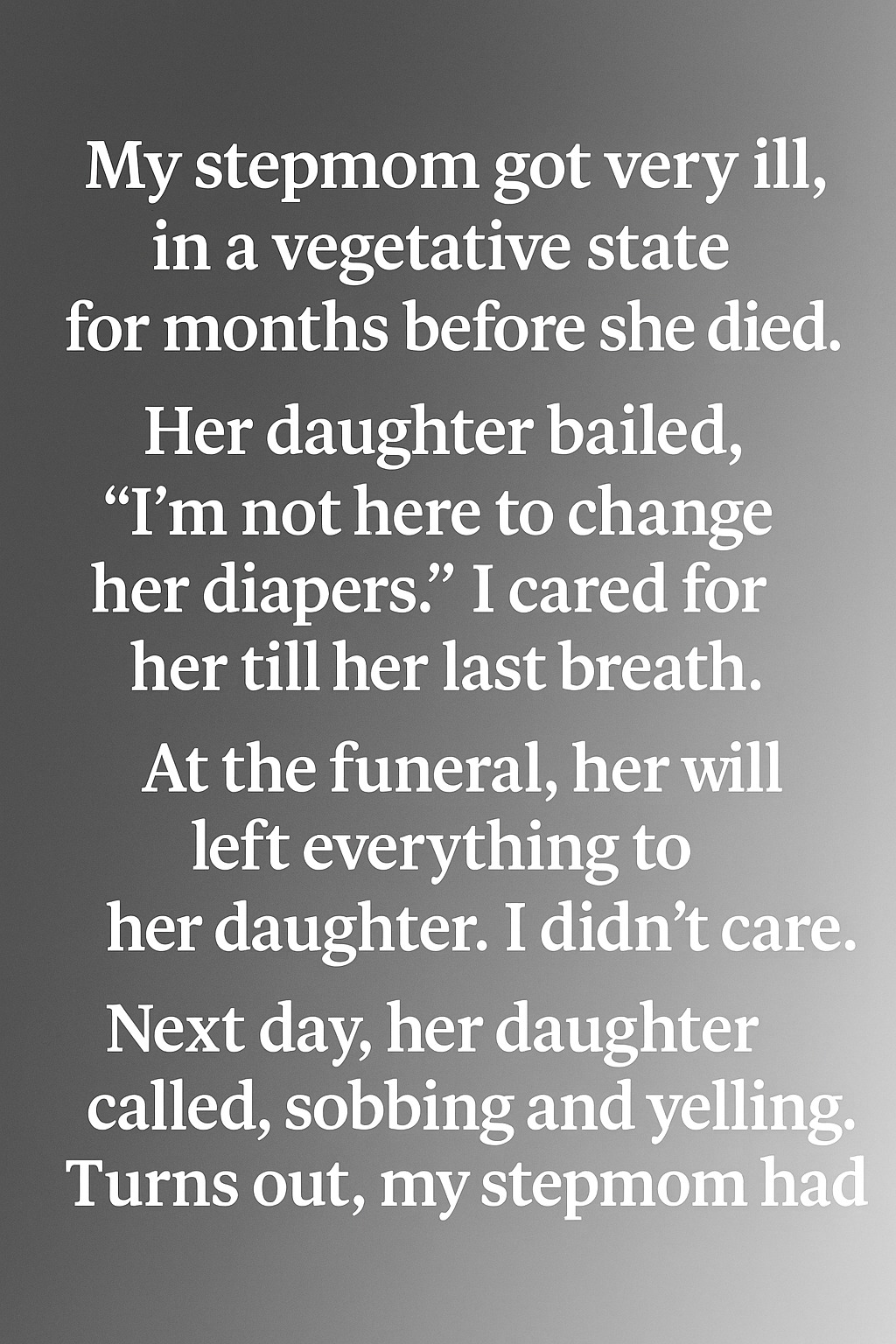
For months, my stepmom had lain in a vegetative state. Her daughter visited once, glanced around, and said, “I’m not here to change her diapers,” then left. Everything—medical decisions, nightly vigil, the exhausting routines—fell to me. I wasn’t her biological child, but I was the one who stayed. I learned to read every monitor, to hold her hand when machines beeped louder than her breaths, to soothe a body that could no longer respond.
When she finally passed, her hand was still warm in mine. My grief was gentle and exhausted, threaded with the relief that her suffering had ended. When the will was read that afternoon, everything went to her daughter—the house, the accounts, the belongings. I expected nothing. Strangely, that made it easier.
I thought that would be the end.
But the next morning, my phone rang before sunrise. Her daughter sounded neither triumphant nor relieved—she sounded furious, broken, terrified. Not because she had inherited everything, but because inheriting everything meant inheriting the consequences: the aging house full of medical equipment she had never learned to operate, unpaid bills, taxes, repairs, paperwork. And beneath all of it was guilt she couldn’t face.
That’s when I realized: she wasn’t asking for help. She was asking for absolution.
In the following days, I replayed the final months with my stepmom. The quiet moments of brushing her hair when she couldn’t see, the hum of my voice as I adjusted her pillows, the nurses and I talking to her as if she could respond. Every gesture felt right—honoring the person she used to be: warm, talkative, stubborn, alive before her body betrayed her.
I remembered the way she flinched whenever her daughter’s name came up—a silent hurt, a disappointment too deep for words. And yet, in her will, she still left everything to her. Perhaps it was hope. Perhaps forgiveness. Perhaps habit. Or maybe the final attempt of a mother trying, in her own flawed way, to hold a fractured family together.
Eventually, her daughter asked to meet. I braced for hostility. Instead, she walked in unraveling—smaller somehow, stripped of the anger that had always propped her up.
Her apology started carefully, then spilled into something raw. She admitted she hadn’t visited because she couldn’t bear seeing her mother helpless. She confessed she didn’t know how to confront vulnerability—hers or anyone else’s. She said she envied what my stepmom and I had shared. She said she wished she had been braver.
For the first time since the funeral, I saw her clearly—not as the daughter who abandoned her mother, but as someone afraid, overwhelmed, and unprepared for the reality she had inherited.
I didn’t tell her she was forgiven. I simply said I didn’t resent her. People break in different ways: some collapse inward, some run, some hide behind anger, and some stay even when it hurts. None of it makes grief simple.
We spent hours going through the house together: papers, photographs, medical receipts, childhood drawings. Among the clutter, small moments emerged—bursts of laughter, quiet recognition, stories shared without bitterness. Slowly, a bridge formed between us.
She chose to sell the house—not out of greed or spite, but because she realized she wasn’t running anymore. Part of the proceeds went to the care facility, an honest gesture, not a performative one.
When she handed over the keys, she hugged me—first stiffly, then tightly—whispering “Thank you” in a way that wasn’t about the house or the help, but about the forgiveness she didn’t know how to ask for.
In that fragile, quiet moment, I understood something I hadn’t before: the real inheritance wasn’t the property, the bills, or even the apology. It was the connection born from the ruins—two people standing on opposite sides of the same grief, finally meeting in the middle.