My 10-year-old son had been secretly sharing his lunch with a stray dog behind an old, abandoned hardware store. At first, I thought it was just a sweet act of kindness — a quiet, innocent gesture of a boy with a big heart. But then a shiny red SUV appeared one afternoon, and the dog’s heartbreaking past began to unravel before our eyes.
My name is Corinne, I’m 37, and I live in a small town tucked between rolling mountains and the faded memories of better days. Life here moves slowly, but it has its rhythm — from the scent of pine in the morning to the sound of cicadas in the evening. I work long hours at Millie’s, a local diner with chipped coffee mugs, a crackling jukebox that still plays Patsy Cline, and regulars like Hank, who orders black coffee and leaves a two-dollar tip without fail. It’s a simple life, not glamorous, but ours.
I’ve been raising my son, Theo, on my own since his father walked away when Theo was just three. Some days, I feel like the weight of the world is on my shoulders, but then I see Theo, and it reminds me why I keep going. He has this old-soul presence — polite to everyone, grateful for the smallest things, and endlessly compassionate. He’ll thank the bus driver each morning, wave at the garbage collectors like they’re celebrities, or stop mid-step to right a beetle flipped on its back.
“Everyone deserves help, Mom,” he told me once, crouching down and nudging the tiny creature upright with a twig.
That’s Theo. Quiet, unnoticed by most, but if you truly look, you’ll see the kindness radiating from him.
It all began one late spring afternoon, just after the last frost had melted from the town’s streets. I was cleaning up the kitchen at home when I noticed something strange: the peanut butter jar was almost empty, and the bread had been disappearing faster than usual. At first, I assumed Theo was just hungrier. Kids grow quickly at this age, after all.
But then I noticed his lunchbox — always empty. Not a single crumb left behind. Usually, Theo was a modest eater, leaving a few crusts or an apple slice. Suddenly, it was as if his food was vanishing into thin air.
Curiosity tugged at me. One Tuesday, I left work early. The afternoon rush at the diner had slowed, giving me a rare chance to walk home the long way. That’s when I saw him.
Theo had veered off the familiar sidewalk, heading behind the old hardware store with its faded red siding and sagging fence. I followed at a distance, careful not to be seen.
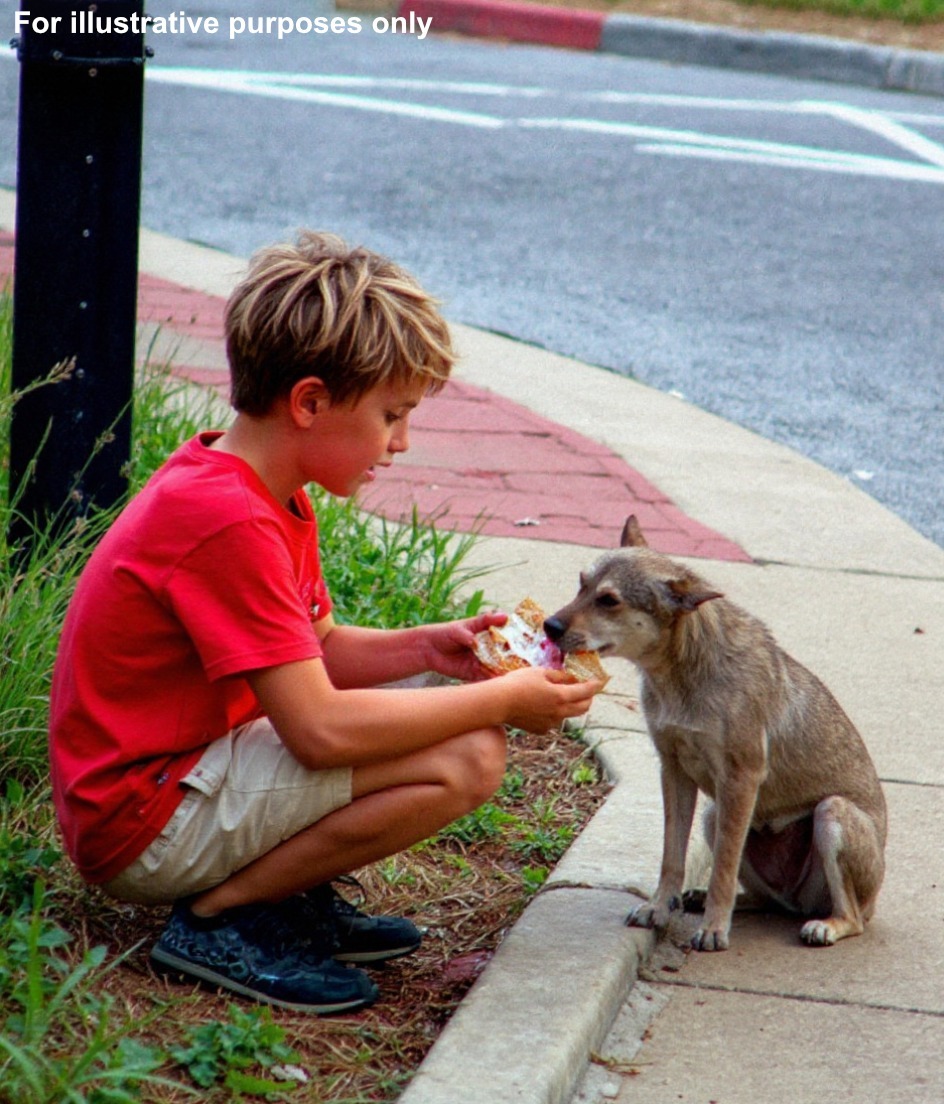
He knelt behind the store, unzipped his backpack, and pulled out a wax-paper-wrapped sandwich. He carefully tore it in half and set one piece on the ground beside a rusted dumpster. From the shadows emerged a small, scrappy dog. Its fur was matted, its body frail, ribs protruding — a creature that had clearly known hunger and neglect. But its tail wagged like lightning, as if Theo were the only joy it had known in weeks.
“Hey, buddy,” Theo said softly, crouching down. “I saved you some.”
The dog cautiously approached, sniffed the sandwich, and devoured it in seconds. Theo sat cross-legged, eating his own half, smiling as though they were lifelong friends sharing a secret meal. Afterward, he poured water into the wax paper and gently nudged it toward the dog.
“Don’t forget to drink up,” he said.
I stood frozen, my hand over my mouth, overwhelmed by a surge of pride and sorrow all at once.
That night, I quietly packed an extra sandwich, an apple, and a small jar of honey into Theo’s lunchbox. The next morning, he looked at me and whispered, “Thanks, Mom.”
From then on, it became their routine. Every day after school, Theo would meet the dog — whom he named Rusty — behind the hardware store. Rusty began waiting for him like clockwork. Sometimes I’d see them from across the street: Theo chatting quietly, Rusty tilting his head as if understanding every word. It was their secret world.
But in a small town, secrets rarely stay hidden. I first heard whispers at the grocery store:
“That Turner boy’s feeding strays again,” a woman muttered.
“Sweet, but kind of odd, don’t you think?” her friend replied.
I smiled and kept walking, letting them talk. But the teasing followed Theo to school, where kids called him “Dog Boy,” barked at him in the hallways, and laughed when he walked by.
When he told me, I felt my heart squeeze tight.
“Do you want me to talk to your teacher?” I asked.
He shook his head. “They laugh, but it doesn’t bother me. Rusty doesn’t care.”
One afternoon, everything changed. A teenage girl passed by the alley and snapped a picture of Theo and Rusty, bathed in the golden glow of late afternoon sun. She posted it online: “Whoever this kid is, he has more kindness than most adults I know.”
By morning, the photo had gone viral. Our small town buzzed with excitement. Even at the diner, customers showed me the picture, astonished. I was proud beyond words. Theo? He barely noticed the attention. “Rusty doesn’t have Facebook, Mom,” he said. “He just likes sandwiches.”
A few days later, a red SUV appeared near the alley. A tall man in a gray suit stepped out, eyes locked on Theo and Rusty. My instincts screamed danger, but curiosity kept me rooted.
“Rusty?” the man called softly. The dog froze, then sprinted toward him with recognition, barking and whining. The man fell to his knees, trembling.
“My son… Michael. He passed away in a car accident. Rusty was his dog. He ran away after the funeral. I thought I’d never see him again,” he choked out.
Theo turned to me. “Mom, he knows Rusty.”
Rusty pressed close to Theo, hesitating to leave. Theo looked down at him, voice steady:
“He doesn’t care who he belongs to. He just wants someone who stays.”
Gideon, the man, nodded slowly, unable to argue. Rusty remained with Theo.
In the following months, Gideon and Theo worked together to transform an old barn into an animal rescue, Michael’s Haven, honoring his late son. Theo learned to care for traumatized animals, while Gideon found healing. Every weekend, Theo rides out to the shelter, Rusty faithfully by his side.
Even years later, passing the shelter’s glowing porch light, I still see the trio: a boy, a man, and a dog — a small act of kindness blossomed into a lasting legacy. And I remember that first day, behind the hardware store, when Theo shared his sandwich with a lonely dog.
It was proof that compassion, no matter how quiet, has the power to change the world.